


Japan’s stock market would likely get support while the yen and long-term government bonds come under pressure following the surprise victory of pro-stimulus Sanae Takaichi in the nation’s ruling party leadership election.
That is the view from investors and strategists including Pepperstone Group Ltd and Nomura Securities Co, who said they expect the yield curve to steepen.
The ascent of Takaichi, a proponent of easy fiscal and monetary policy, would likely raise concern over rising bond supplies while reducing expectations of a Bank of Japan (BOJ) rate hike later this month.
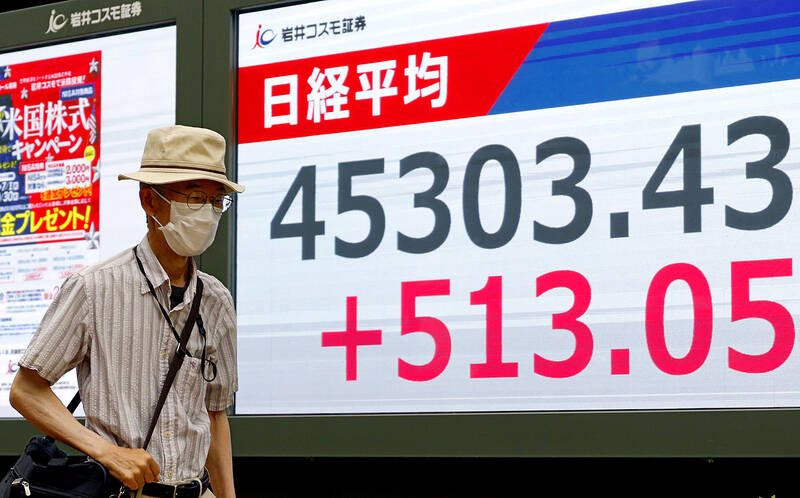
Photo: EPA
This was “very much a surprise result” and not the one that markets had been discounting, Pepperstone senior research strategist Michael Brown said.
Takaichi’s win is “likely to be yen negative, on the dovish BOJ repricing, coupled with a steeper JGB [Japanese government bond] curve given her looser fiscal views, though both of those combined should be a boost for the Nikkei.”
Takaichi is expected to become Japan’s first female prime minister later this month in a parliamentary vote after winning the Liberal Democratic Party (LDP) leadership contest on Saturday. Investors had expected the seat to go to political scion Shinjiro Koizumi, who was seen as taking a more fiscally cautious view while leaving the BOJ to press ahead with normalization.
Bank stocks would likely struggle on expectations that rate hikes will be pushed back, while domestic demand and small-cap shares might get a “significant tailwind” in the short term, said Richard Kaye, cohead of Japan equity strategy at Comgest Asset Management.
Market participants including foreign investors would welcome any signs of a move toward “Abenomics,” he said, a reference to the economic policies of the late former Japanese prime minister Shinzo Abe.
A protege of Abe, Takaichi has prompted views that her leadership would move the country back toward Abenomics. She has pushed for cash handouts and tax rebates to help households struggling with inflation, and has been the boldest among LDP candidates in saying that extra bond issuance might be needed.
Bond investors had been wary of fiscal spending even before Takaichi’s win, with opposition parties calling for tax cuts.
Coupled with speculation over BOJ rate hikes, 10-year yields have hovered at about their highest levels since 2008. That has helped push the yen stronger against the US dollar over the past week, while the Nikkei 225 refreshed its all-time high, helped by a global tech rally.
Takaichi’s unexpected win would revive a trade “characterized by a weaker yen, higher stock prices and a steeper yield curve,” Nomura Securities executive rates strategist Mari Iwashita said.
With market expectations for a rate this month likely to fall, “the BOJ is unlikely to deliberately proceed with a rate increase,” Iwashita said.
To be sure, any potential yen weakness from Takaichi’s win might be limited due to narrowing Japan-US interest rate differentials, Eastspring Investments Group Pte Ltd fixed income portfolio manager Rong Ren Goh said.
The outlook for the US Federal Reserve’s trajectory remains uncertain, he said.
In the mid to long-term, Kaye is optimistic about the outlook for Japan’s stock market.
“A shift in perception toward Japan will become a driver,” Kaye said. “New approaches are expected to emerge in deregulation for economic growth, monetary policy and Japan-US trade. This represents a significant opportunity for Japan and may mark a turning point.”

DAMAGE REPORT: Global central banks are assessing war-driven inflation risks as the law of unintended consequences careens around the world, spiking oil prices Central banks from Washington to London and from Jakarta to Taipei are about to make their first assessments of economic damage after more than two weeks of conflict between the US and Iran. Decisions this week encompassing every member of the G7 and eight of the world’s 10 most-traded currency jurisdictions are likely to confirm to investors that the specter of a new inflation shock is already worrying enough to prompt heightened caution. The US Federal Reserve is widely expected to do exactly what everyone anticipated weeks ahead of its March 17-18 policy gathering: hold rates steady. The narrative surrounding that
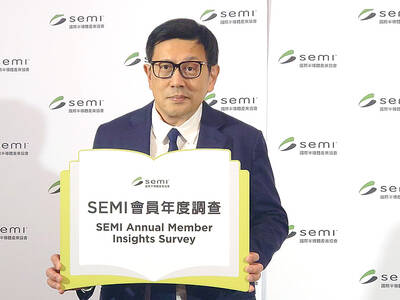
PRICE HIKES: The war in the Middle East would not significantly disrupt supply in the short term, but semiconductor companies are facing price surges for materials Taiwan’s semiconductor companies are not facing imminent supply disruptions of essential chemicals or raw materials due to the war in the Middle East, but surges in material costs loom large, industry association SEMI Taiwan said yesterday. The association’s comments came amid growing concerns that supplies of helium and other key raw materials used in semiconductor production could become a choke point after Qatar shut down its liquefied natural gas (LNG) production and helium output earlier this month due to the conflict. Qatar is the second-largest LNG supplier in the world and accounts for about 33 percent of global helium output. Helium is
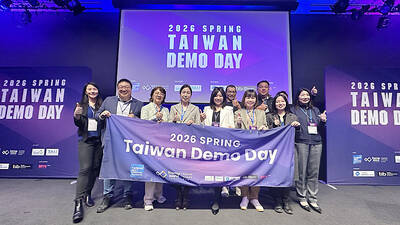
About 1,000 participants, including more than 200 venture capitalists, joined the Taiwan Demo Day in Silicon Valley on Saturday, the largest iteration to date of the event held ahead of Nvidia Corp’s annual GPU Technology Conference which runs from today to Thursday. Taiwan Demo Day, co-organized by the Taiwan Next Foundation and the Startup Island Taiwan Silicon Valley Hub, took place at the Computer History Museum in California, showcasing 12 teams focused on physical artificial intelligence (AI) and agentic AI technologies. Katie Hsieh (謝凱婷), founder of the Taiwan Next Foundation, said the event highlighted the strength of the Taiwan-US start-up ecosystem, with
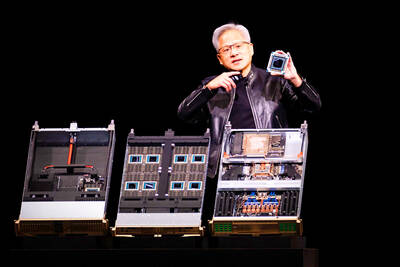
DOMESTIC COMPONENT: Huang identified several Taiwanese partners to be a key part of Nvidia’s Vera Rubin supply chain, including Asustek, Hon Hai and Wistron Nvidia Corp chief executive officer Jensen Huang (黃仁勳), addressing crowds at the company’s biggest annual event, unveiled a variety of new products while predicting that its flagship artificial intelligence (AI) processors would help generate US$1 trillion in sales through next year. During a two-and-a-half-hour keynote address, Huang announced plans to push deeper into central processing units (CPUs) — Intel Corp’s home turf — and introduced semiconductors made with technology acquired from start-up Groq Inc. The company even said it was developing chips for data centers in outer space. At the heart of Huang’s speech was the message that demand for computing power


 RSS
RSS