


Central banks from Washington to London and from Jakarta to Taipei are about to make their first assessments of economic damage after more than two weeks of conflict between the US and Iran.
Decisions this week encompassing every member of the G7 and eight of the world’s 10 most-traded currency jurisdictions are likely to confirm to investors that the specter of a new inflation shock is already worrying enough to prompt heightened caution.
The US Federal Reserve is widely expected to do exactly what everyone anticipated weeks ahead of its March 17-18 policy gathering: hold rates steady.
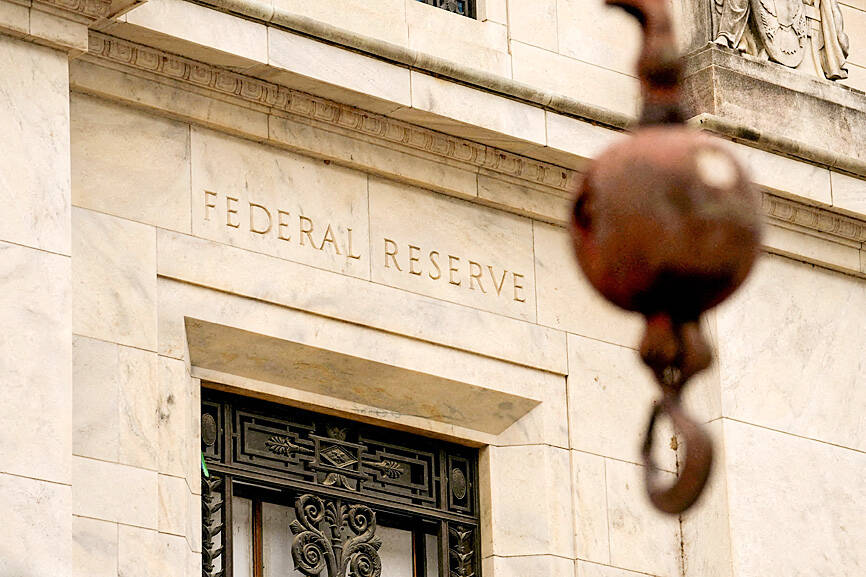
Photo: Reuters
The narrative surrounding that hold — that it might comfortably endure for months — has been smashed by renewed tremors in the labor market and a war in the Middle East that has sent oil prices surging. The combination puts the Fed’s dual mandates in conflict, clouding the outlook for rates, at least for the near-term.
Officials at the European Central Bank (ECB) are also anticipated to keep the deposit rate unchanged on Thursday. However, the Middle East crisis has all but dislodged the central bank’s policy from the “good place” that ECB President Christine Lagarde and colleagues claimed to inhabit.
The spike in energy prices, which has spurred bets on rate hikes, puts the onus on the Governing Council to explain how inflation risks have shifted, along with clues on how close they are to meeting those market expectations.
The Bank of Japan (BOJ) is expected to hold its benchmark rate steady on Thursday too, while assuring markets that it remains on the path toward policy normalization. BOJ Governor Kazuo Ueda is likely to emphasize the need to closely monitor developments given the country’s heavy reliance on oil imports from the Middle East. Traders would parse the BOJ’s statement and Ueda’s remarks for clues.
In London, a decision that appeared just last month to be tilted “50-50” toward a cut, Bank of England (BOE) Governor Andrew Bailey said, is highly likely to favor unchanged rates on Thursday as inflation risks are forcing BOE officials to pivot toward vigilance about consumer prices, despite signs of sputtering growth even before the energy shock.
For the Swiss National Bank, the central bank’s resolve to cap gains that pushed the franc to decade highs against the euro would draw close scrutiny at its first quarterly decision of the year on Thursday, after policymakers broke their usual silence to reveal increased willingness for intervention.
While any change in language on foreign exchange would be notable, economists are unanimous in saying the rate would stay at zero, meaning that they judge present circumstances do not warrant the more drastic and economically harmful option of a return to negative borrowing costs.
Reserve Bank of Australia (RBA) policymakers on Tuesday are due to set the cash rate, currently 3.85 percent, with markets pricing a solid chance of a second consecutive increase.
The RBA last month became the first major developed-market central bank this year to lift borrowing costs, citing stubborn price pressures and excess demand in a supply-constrained economy. Since then, data have reinforced the picture of resilience, while the Iran war has heightened concerns about domestic price pressures.
The central bank in Jakarta is expected to keep its rate steady at 4.75 percent on Tuesday, a decision that would force Bank Indonesia officials to balance rupiah stability against renewed worries about consumer prices.
While fuel subsidies would probably cushion faster inflation, such measures risk bloating the deficit amid heightened fiscal concerns. That could spur more capital outflows and undermine officials’ efforts to maintain a stable currency.
As for Taiwan, the country’s economy has been buoyed by strong global demand for its technology products that support artificial intelligence development. However, its central bank is unlikely to raise rates on Thursday after recent inflation stayed well below 2 percent. Instead, the central bank is expected to revise up its GDP and inflation forecasts, DBS Bank Ltd said.
While it remains premature to expect rate hikes this year, the growth-inflation dynamics indicate that the next policy move could be a rate hike rather than a rate cut, DBS added.
Additional reporting by staff writer
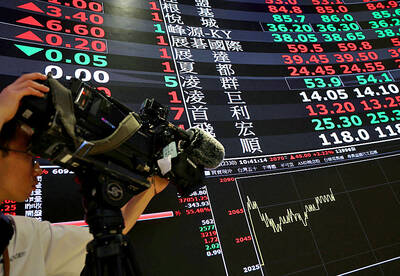
After several years flying high as Asia’s best Nvidia Corp proxy, Taiwan Semiconductor Manufacturing Co (TSMC, 台積電) is increasingly vying with other artificial intelligence (AI) stocks for investor attention. Stock traders are chasing a wider array of beneficiaries as mainstream usage of AI creates demand for hardware beyond the most-advanced chips TSMC makes for Nvidia. Subthemes from the deepening memory crunch to advances in robotics are also luring bids. At the same time, investment caps on single stocks are pushing funds to diversify, while retail investors long familiar with TSMC through its US depositary receipts are being offered a broader set of
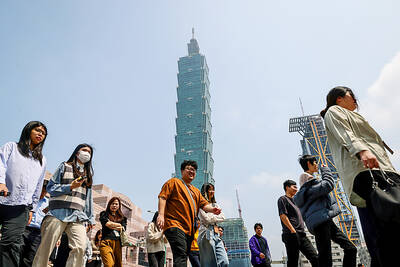
TECH RELIANCE: Growth is increasingly reflecting an unequal K-shaped distribution, where technology sectors outperform and other industries struggle, an expert said Standard Chartered Bank has significantly raised its forecast for Taiwan’s economic growth to 9.5 percent this year, up from 7.6 percent previously, citing surging artificial intelligence (AI) demand driving exports, semiconductor production and investment. The upgrade reflects a sustained AI supercycle that continues to fuel demand for advanced chips and technology infrastructure, which form the backbone of Taiwan’s exports, the bank said in a report this week. “We raise our 2026 growth forecast to reflect a much stronger-than-expected first-quarter GDP figure,” Standard Chartered senior economist for greater China and Asia Tommy Wu (胡東安) said in the report. Driven largely by a 35.3 percent
UNDER MICROSCOPE: Taiwan detained three people who allegedly conspired to buy servers in Taiwan and export them using fraudulent documentation, prosecutors said Nvidia Corp chief executive officer Jensen Huang (黃仁勳) on Saturday urged Super Micro Computer Inc to tighten up on compliance after Taiwan detained three people this week for allegedly making fraudulent declarations about artificial intelligence (AI) servers made by its US partner. The development marked the nation’s first crackdown on semiconductor smuggling, which grew after the US slapped restrictions on exports of high-end chips such as Nvidia AI accelerators to China. Nvidia is “rigorous” in explaining regulations to all of its partners, Huang told reporters after arriving in Taipei. “Ultimately Super Micro has to run their own company,” he said in response to
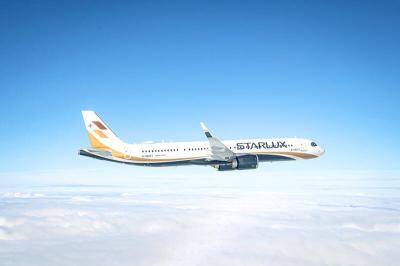
Two of Taiwan’s international carriers, Starlux Airlines Co (星宇航空) and EVA Airways Corp (長榮航空), have retained the five-star airline rating awarded by international airline review organization Skytrax. Starlux was awarded the distinction for a second consecutive year, while EVA Air received it for the 11th straight year, Skytrax said in statements released yesterday and on Thursday last week, respectively. The five-star rating is considered one of the airline industry's highest honors and is awarded following professional audits of airline product and frontline service standards, Skytrax said. The ratings are based on in-depth assessments using unified global quality standards rather than customer review scores


 RSS
RSS