


About 1,000 participants, including more than 200 venture capitalists, joined the Taiwan Demo Day in Silicon Valley on Saturday, the largest iteration to date of the event held ahead of Nvidia Corp’s annual GPU Technology Conference which runs from today to Thursday.
Taiwan Demo Day, co-organized by the Taiwan Next Foundation and the Startup Island Taiwan Silicon Valley Hub, took place at the Computer History Museum in California, showcasing 12 teams focused on physical artificial intelligence (AI) and agentic AI technologies.
Katie Hsieh (謝凱婷), founder of the Taiwan Next Foundation, said the event highlighted the strength of the Taiwan-US start-up ecosystem, with six Taiwan-based teams selected by StarFab Accelerator joining others from the US to showcase their innovations.
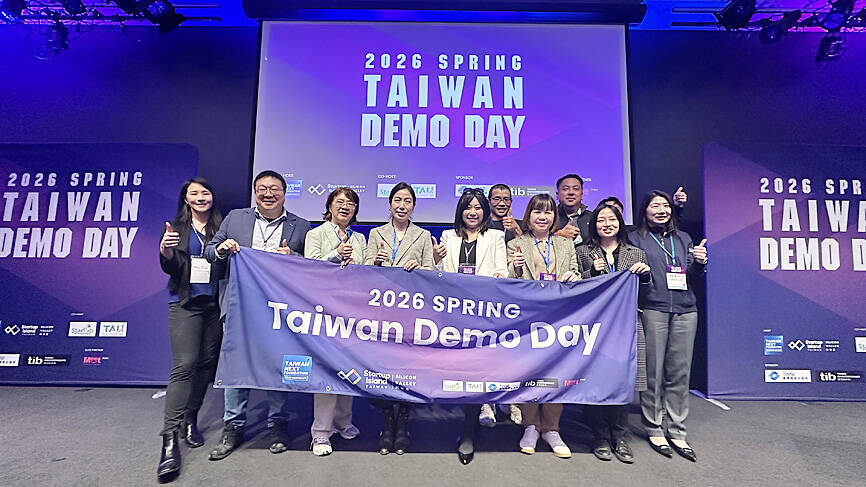
Photo: CNA
StarFab, founded in 2016 and regarded as Taiwan’s largest industry accelerator, is dedicated to fostering collaboration between start-ups and enterprises to accelerate
innovation and growth, according to its official Web site.
Hsieh said that about half of attendees came from the international start-up community, expressing hope that the event would foster new connections for Taiwan-led companies.
Startup Island Taiwan Silicon Valley Hub deputy director Uly Su (蘇祐立) said there was strong interest from local and US corporate investment divisions in Taiwan’s hardware technology, with this year’s attendance about double last year’s.
Joe Tolzmann, founder of Canadian software start-up RocketPlan Technologies Inc, said that his company was seeking opportunities to integrate Taiwan’s leading hardware technologies into its operations.
StarFab chairwoman Amanda Liu (劉晏蓉) led the group of six Taiwanese start-ups, which were selected in partnership with Nvidia and focus on manufacturing, healthcare and robotics.
Liu said she believes collaboration between large corporations and start-ups drives the best innovation, adding that these areas play to Taiwan’s industrial strengths and could enhance the global AI start-up sector.
Among the participants, Red Pill Lab Ltd cofounder RH Shih (石千泓) said his team uses Nvidia’s Isaac Lab framework to advance AI motion capture technologies that could be applied to home factories, emergency rescue operations and remotely controlled lunar robotics missions.
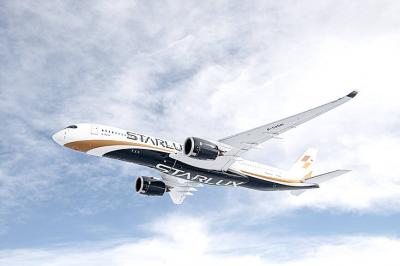
Starlux Airlines Co (星宇航空) today unveiled a long-haul network expansion plan at a shareholders’ meeting in Taipei, including direct flights to Barcelona, Spain, and Zurich, Switzerland, as well as a service connecting Taipei, Sydney and New Zealand. Starlux is to become the first Taiwanese carrier to offer non-stop services to the two European cities, while the inaugural oceanic route is expected to expand transit opportunities within the Australia-New Zealand market, Starlux said. Flight services to Chicago, Dallas, Washington and New York are under evaluation, the airline added. Prior to the shareholders’ meeting, the airline earlier this year announced that it would be

Netherlands-based semiconductor equipment supplier ASML Holding NV yesterday said that it is planning to hire an additional 1,000 people in Taiwan this year in response to growing demand from clients. ASML had previously planned to recruit 600 people this year, but that the plan has been adjusted upward, ASML vice president and ASML Taiwan general manager Grace Wang (汪佳慧) told reporters. ASML has a workforce of more than 4,500 in Taiwan, accounting for about 10 percent of its global total, Wang said. This year’s recruitment campaign would focus on adding people in the customer support, manufacturing and supply chain domains to assist ASML

UNDER MICROSCOPE: Taiwan detained three people who allegedly conspired to buy servers in Taiwan and export them using fraudulent documentation, prosecutors said Nvidia Corp chief executive officer Jensen Huang (黃仁勳) on Saturday urged Super Micro Computer Inc to tighten up on compliance after Taiwan detained three people this week for allegedly making fraudulent declarations about artificial intelligence (AI) servers made by its US partner. The development marked the nation’s first crackdown on semiconductor smuggling, which grew after the US slapped restrictions on exports of high-end chips such as Nvidia AI accelerators to China. Nvidia is “rigorous” in explaining regulations to all of its partners, Huang told reporters after arriving in Taipei. “Ultimately Super Micro has to run their own company,” he said in response to
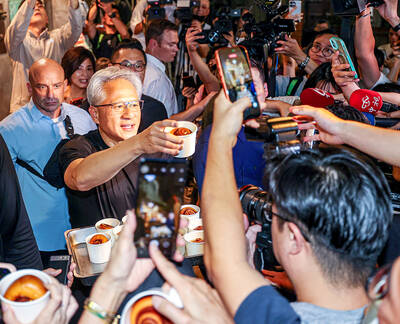
Nvidia Corp yesterday announced that CEO Jensen Huang (黃仁勳) would attend an employee meeting in Taipei tomorrow to celebrate the launch of the company’s Taiwan headquarters project. Huang would attend a gathering at the site of Nvidia’s planned headquarters in Beitou Shilin Technology Park (北投士林科技園區), the company said in a statement. After arriving in Taiwan on Saturday last week, Huang told reporters that he plans to meet with Quanta Computer Inc (廣達) chairman Barry Lam (林百里) and Taiwan Semiconductor Manufacturing Co (TSMC, 台積電) chairman C.C. Wei (魏哲家), and would attend the groundbreaking ceremony for Nvidia’s Taiwan headquarters tomorrow. Nvidia has not yet applied


 RSS
RSS