


Taiwan’s business climate monitor stayed “green” for the fourth consecutive month last month, signaling steady economic momentum, despite widening disparities across industries, the National Development Council (NDC) said yesterday.
The composite index gained one point from July to 30, as stronger production and exports offset weakness in traditional sectors, which came under pressure from US tariffs and intensifying global competition, the council said.
The NDC uses a five-color system to illustrate economic conditions: “green” indicates stable growth, “red” reflects a boom and “blue” signals recession, while dual colors denote transition.
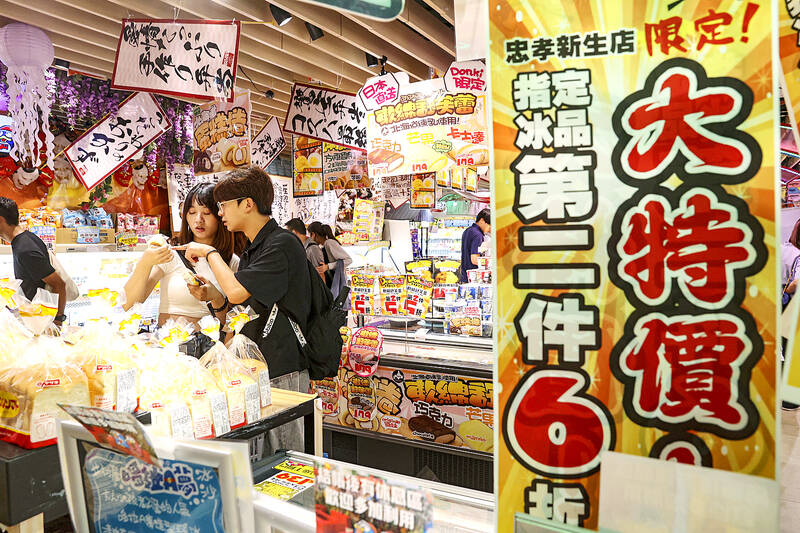
Photo: CNA
Of the nine components, stock prices and M1B money supply each added one point, buoyed by a market rebound, while the manufacturing sales index slipped by one point, as tariff impacts started to emerge, NDC Department of Economic Development Director Chen Mei-chu (陳美菊) said.
“The trend is expected to be sustainable, keeping the business climate measure in the ‘green’ range for the rest of the year,” Chen said.
The leading index, which projects economic conditions over the next six months, fell for a seventh straight month to 99.59, down 0.24 percent from July, the council said.
Weaker momentum in new construction, manufacturing business sentiment, export orders and net hiring weighed on the gauge, although money supply, stock prices and imports of semiconductor equipment improved, the NDC said.
The coincident index, which reflects the current state of the economy, edged up 0.26 percent to 106.52, advancing for the 27th straight month, supported by exports, electricity consumption and overtime hours, the council said.
However, retail, wholesale and restaurant revenues, industrial production, machinery imports and manufacturing sales all declined, it said.
Financial conditions brightened after US President Donald Trump pledged to exempt semiconductor firms with US investments from tariffs and the US Federal Reserve signaled willingness to cut interest rates to support the labor market, Chen said.
Trade and sales-related indicators showed resilience, but private consumption remained subdued in light of lackluster retail and restaurant turnover, she added.
A divergence is increasingly emerging between high-tech and traditional industries, she said.
Artificial intelligence (AI)-fueled demand is propelling semiconductor and the information and communications technology industries, but traditional sectors are grappling with tariff headwinds, slower production and mounting furlough cases, Chen said.
Although the latest manufacturing index edged up, firms remain uneasy about US tariffs, she said.
Chen said that Taiwan’s economy should stay resilient through the end of the year, supported by robust AI demand and strong capacity utilization at major technology firms, but geopolitical tensions and trade risks warrant close monitoring.
Poland is betting on a flood of investments and technology transfers from Taiwanese companies to reengineer its US$1 trillion economy. Polish Prime Minister Donald Tusk said yesterday that Poland will no longer be “just an assembly hub” as it pursues further investments from the likes of Foxconn Technology Group (富士康). The firm, whose full name is Hon Hai Precision Industry Co (鴻海精密), last month agreed to build electric vehicles (EVs) in the European Union nation and now could be a partner in a semiconductor venture, he said. The government’s aim is to boost manufacturing and the country’s high-tech chops in an era
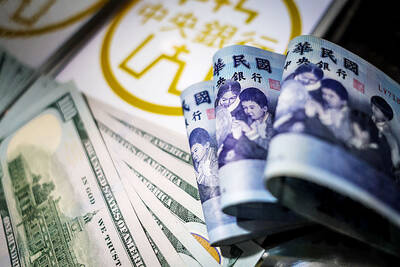
Taiwan remained the sixth-largest net creditor nation in the world last year, despite a fall of more than 10 percent in its net international investment position (NIIP) over the year, the central bank said yesterday. The NIIP is the difference between a country’s external financial assets and its external financial liabilities. Taiwan’s external financial assets hit US$3.27 trillion at the end of last year, up US$275.75 billion or 9.2 percent from a year earlier, the central bank said in its annual NIIP report. The growth largely reflected an increase in holdings of overseas marketable securities by residents in Taiwan, as well as a
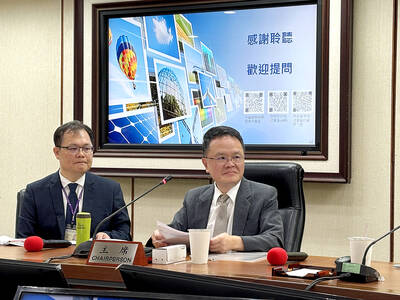
BAD FAITH LITIGATION? The two companies, owned by a California-based private equity firm, could be seeking licensing fees or a settlement payout with the suit Taiwan Intellectual Property Office (TIPO) Director-General Liao Cheng-wei (廖承威) said yesterday he suspected that two firms suing contract chipmaker Taiwan Semiconductor Manufacturing Co (TSMC, 台積電) for patent infringement are “patent trolls.” A patent troll refers to a company that buys patents not for manufacturing products, but to sue other companies for compensation, accusing them of using its patents. Patent trolls, formally called Non-Practicing Entities or Patent Assertion Entities, were responsible for more than 50 percent of lawsuits in the US last year, costing targeted businesses tens of billions of US dollars a year, according to the US-based LegalCharity Web site. Asked whether

RESTRICTION BREACH: ASML said that it denies ‘unfounded rumors regarding non-compliance with export controls concerning China,’ and enforces controls strictly US Secretary of Commerce Howard Lutnick in a series of recent meetings outlined concerns to Dutch chip-equipment giant ASML Holding NV’s senior leaders that one of its top-of-the-line machines might have made its way into China, in violation of US-led export restrictions. In the meetings, Lutnick expressed concern to ASML executives over the company’s extreme ultraviolet lithography (EUV) machines, people familiar with the talks said. EUV systems are used by firms such as Taiwan Semiconductor Manufacturing Co (台積電) to manufacture processors for the likes of Nvidia Corp and Apple Inc. ASML has never been allowed to ship them to China because of curbs


 RSS
RSS