


Popping supplements, drinking herbal teas and signing up for lifestyle classes, young Chinese are turning to the wellness industry as work stress and COVID-19 pandemic memories spur a growing interest in health.
These new habits are part of a global wellness boom, but the traditional concept of “yangsheng” (養生, cultivating one’s life force) has given the trend a unique cultural twist in China.
In Shanghai, Annie Huang sat in a trendy cafe-like establishment that sold traditional herbal teas, sipping a bitter concoction purported to protect the body against the summer heat.
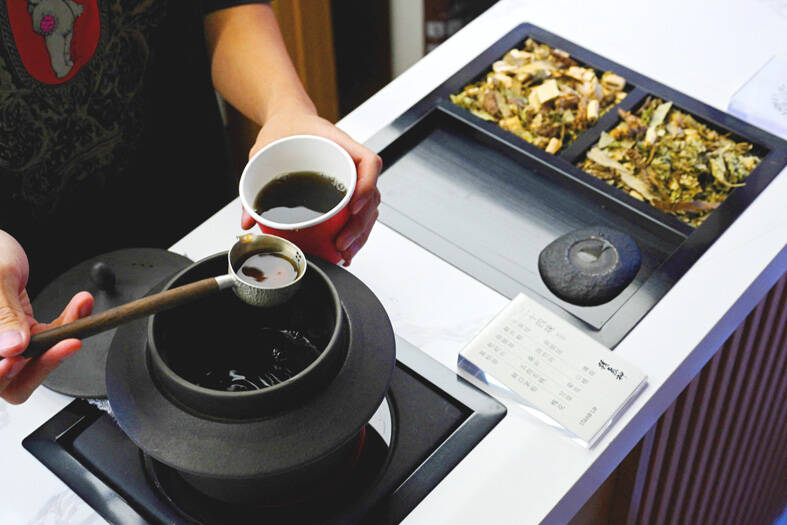
Photo: AFP
“Young people today frequently pull all-nighters ... so they want to drink something that they feel is good for their body,” said Huang, who is in her 30s.
Rooted in Taoism and traditional Chinese medicine beliefs, the vast umbrella of yangsheng includes habits such as avoiding foods thought to make the body cold, and targeted massages that purportedly treat a range of ailments.
Capitalizing on the trend, state-run traditional Chinese medicine giants such as Beijing Tongrentang (北京同仁堂) have opened fashionably decorated stores offering “all-nighter water” and goji berry lattes alongside traditional ingredients believed to promote health, such as bird’s nest and ginseng.
Thousands of yangsheng influencers have filled Chinese social media with posts that offer tips on “expelling body dampness,” how to incorporate ginger juice into daily meals and finger exercises that allegedly improve blood circulation.
The passion for yangsheng has even spilled over into tourism, with young people flocking to desert areas to lay on sand in the belief that the practice rids the body of unhealthy dampness.
The world’s second largest economy is battling sluggish consumption against the backdrop of a property crisis and stubborn youth unemployment.
However, health and wellness spending, especially among millennials and Gen Z, remains a bright spot.
Wellness purchases are “definitely increasing more than other categories,” despite many younger spenders tightening their belts overall, said Jason Yu (虞堅), greater China managing director at consumer research firm Kantar Worldpanel (凱度消費者指數).
“Nutrition supplement is one of the categories they really value and that they are willing to actually invest in,” Yu said.
The health craze has taken many forms ranging from medically proven to pseudoscience.
Chinese start-ups are selling everything from vitamin gummies to probiotic powders, vying for attention with traditionally more trusted imported brands.
The trend is inextricably tied to widespread anxiety about the negative health effects of high-pressure modern work culture.
Reports of overworked young people dying at their desks have prompted consumers to spring for “sudden death prevention packs” — combinations of supplements aimed at countering the effects of daily takeout meals and long workdays.
“You think you’re just working, but you’re actually cutting your lifespan,” said one post by a yangsheng-focused office worker influencer on the platform Xiaohongshu.
Young women juggling demanding careers with the pervasive pressure to have children are turning to classes that teach them to optimize their reproductive health.
At a night school in Shanghai, traditional Chinese medicine practitioner Zhang Qinhai pointed to a diagram of a uterus and ovaries as she told her oversubscribed class of mostly young women about the declining chances of a healthy birth at higher maternal ages.
“People are under too much pressure, so they’re in a state of poorer health,” a 33-year-old student said.
Meanwhile, health fears sparked by the COVID-19 pandemic have lingered.
People feel that their immunity has been lowered by the virus and “they may catch colds and fevers more easily,” said Tommy Qin, the owner of a herbal tea cafe.
Yu said he believed perception plays a big part in young consumers’ rush to protect their health.
“Higher awareness of different health issues, especially aided by social media, are really helping [to drive consumption’, because everybody feels they’re not healthy enough,” he said.

Ryanair, Transavia, Volotea and other low-cost airlines are feeling the financial pain from high jet fuel prices as a result of the Middle East war and are cutting flights. The closure of the Strait of Hormuz has taken a huge chunk of oil supplies off the market, sending the price of jet fuel soaring and triggering fears of shortages that could force airlines to cancel flights. Airlines are not waiting for a lack of supplies to react. “Travel alert: Airlines are cutting thousands of flights right now,” Travel Therapy host Karen Schaler said in an Instagram reel this past weekend.
MANAGING RISKS: Taiwan has secured LNG sufficient to cover 95 percent of electricity demand for next month, UBS said, describing the government’s approach as proactive UBS Group AG has raised its forecast for Taiwan’s economic growth this year to 8 percent, up from 6.9 percent previously, and said expansion could reach as high as 8.6 percent if external energy shocks are avoided. The upgrade reflects a stronger-than-expected first-quarter performance and sustained momentum in artificial intelligence (AI)-driven exports, which UBS said are providing a firm foundation for growth despite geopolitical and energy risks. Taiwan’s GDP expanded 13.69 percent year-on-year in the first quarter, the fastest growth since the second quarter of 1987, the Directorate-General of Budget, Accounting and Statistics (DGBAS) reported on Thursday. On a seasonally
The Fair Trade Commission’s (FTC) ongoing review of Grab Holdings Ltd’s US$600 million acquisition of Foodpanda Taiwan’s operations, announced on March 23, has taken on fresh urgency as industry experts warn that the transaction could embed significant Chinese cybersecurity vulnerabilities into Taiwan’s digital infrastructure through Grab’s deep ties to autonomous-driving firm WeRide (文遠知行). Less than 16 months after the FTC blocked Uber Eats’ direct attempt to acquire Foodpanda Taiwan — citing potential combined market shares of 80 to 90 percent — the emergence of Grab as the buyer has prompted questions about whether the same competitive harm is simply being rerouted

The list of Asian stocks that benefit from business partnership with Nvidia Corp is getting longer, as the region further integrates into the artificial intelligence (AI) chip giant’s business ecosystem. Just in the past week, South Korea’s LG Electronics Inc, Taiwan’s Nanya Technology Corp (南亞科技), as well as China’s Huizhou Desay SV Automotive Co (德賽西威) and Pateo Connect Technology Shanghai Corp (博泰車聯) have become the latest to rally on news of tie-ups, supply-chain participation or product collaboration with the US chip designer. Asian suppliers account for about 90 percent of Nvidia’s production costs, up from about 65 percent last year, data compiled


 RSS
RSS