


Tesla Inc on Tuesday reported a big drop in quarterly profits amid an increasingly cutthroat electric vehicle (EV) market, but shares rallied as CEO Elon Musk pledged to accelerate plans for more affordable EVs.
Tesla reported profits of US$1.1 billion, down 55 percent year-on-year on revenue of US$23.3 billion, down 9 percent, as the company described EV sales as “under pressure.”
However, shares rocketed up more than 11 percent in after-hours trading after Tesla pledged to “accelerate” new more affordable vehicles — something Wall Street analysts have been clamoring for.
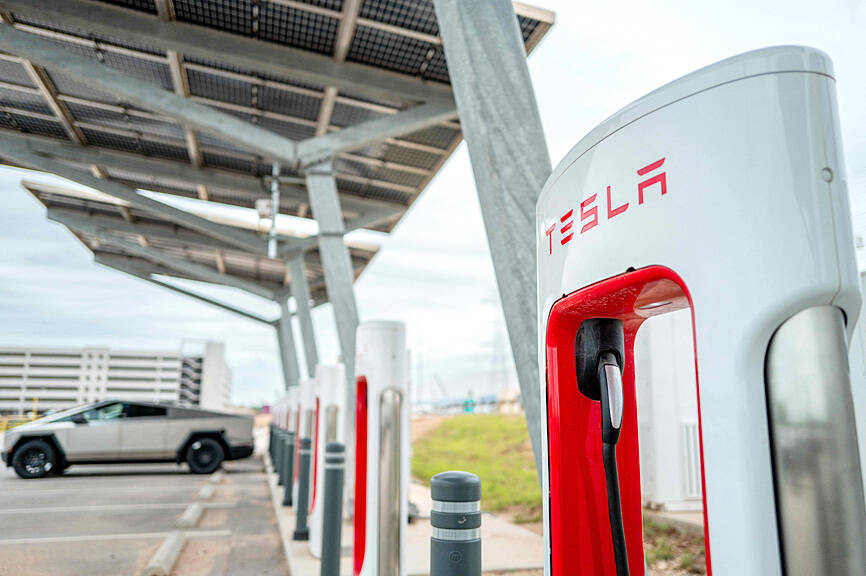
Photo: AFP
The results, which lagged analyst estimates, came after the company last week announced the layoffs of about 14,000 workers.
Cutting headcount by more than 10 percent would save Tesla more than US$1 billion annually in costs, chief financial officer Vaibhav Taneja said on a conference call with analysts.
In spite of the belt-tightening, Tesla’s report did provide some news likely to cheer investors, saying it planned to “accelerate the launch of new models ahead of our previously communicated start of production in the second half of 2025.”
The new vehicles would include “more affordable models,” Tesla said.
At the outset of Tuesday’s conference call, Musk said production of the vehicles would start early next year or late this year, up from the prior time frame of the latter half of next year.
The vehicles “will use new aspects of the next generation platform as well as aspects of our current platform,” Musk said. “So it’s not contingent on any new factory or massive new production line.”
Musk said more details would be released in August.
The Tesla CEO spoke at length about the promise of the company’s autonomous ventures, saying valuing the EV maker like a car company is the “wrong framework.”
“If somebody doesn’t believe Tesla is going to solve autonomy I think they should not be an investor,” he said.
The statement about new vehicles comes on the heels of speculation that Tesla is shelving plans for the “Model 2,” the unofficial name of what is expected to be a mass-marketed, lower-priced vehicle.
While Tesla’s statements about new vehicles boosted shares, “the company still hasn’t offered time lines for these new vehicles, which could take years to come to market at a time when EV competition in various markets is intensifying,” Emarketer senior technology analyst Gadjo Sevilla said.
Tesla also on Tuesday said it would continue to pursue a “revolutionary” manufacturing strategy on a “purpose-built robotaxi product.”
Leading analysts have expressed skepticism about the embrace of the robotaxi venture.
Musk’s announcement that the robotaxi would be unveiled in August “in no way means the technology is ready,” Deutsche Bank AG analysts said.
“We worry there is considerable execution risk to the development of robotaxi technology and that a fleet deployment could be years away,” Deutsche Bank analysts said.

Taiwan Semiconductor Manufacturing Co (TSMC, 台積電) last week recorded an increase in the number of shareholders to the highest in almost eight months, despite its share price falling 3.38 percent from the previous week, Taiwan Stock Exchange data released on Saturday showed. As of Friday, TSMC had 1.88 million shareholders, the most since the week of April 25 and an increase of 31,870 from the previous week, the data showed. The number of shareholders jumped despite a drop of NT$50 (US$1.59), or 3.38 percent, in TSMC’s share price from a week earlier to NT$1,430, as investors took profits from their earlier gains
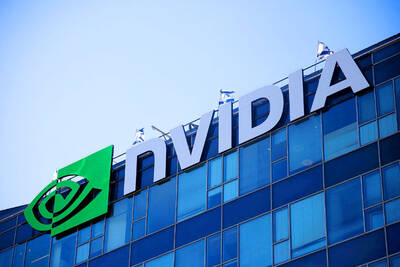
AI TALENT: No financial details were released about the deal, in which top Groq executives, including its CEO, would join Nvidia to help advance the technology Nvidia Corp has agreed to a licensing deal with artificial intelligence (AI) start-up Groq, furthering its investments in companies connected to the AI boom and gaining the right to add a new type of technology to its products. The world’s largest publicly traded company has paid for the right to use Groq’s technology and is to integrate its chip design into future products. Some of the start-up’s executives are leaving to join Nvidia to help with that effort, the companies said. Groq would continue as an independent company with a new chief executive, it said on Wednesday in a post on its Web

CHINA RIVAL: The chips are positioned to compete with Nvidia’s Hopper and Blackwell products and would enable clusters connecting more than 100,000 chips Moore Threads Technology Co (摩爾線程) introduced a new generation of chips aimed at reducing artificial intelligence (AI) developers’ dependence on Nvidia Corp’s hardware, just weeks after pulling off one of the most successful Chinese initial public offerings (IPOs) in years. “These products will significantly enhance world-class computing speed and capabilities that all developers aspire to,” Moore Threads CEO Zhang Jianzhong (張建中), a former Nvidia executive, said on Saturday at a company event in Beijing. “We hope they can meet the needs of more developers in China so that you no longer need to wait for advanced foreign products.” Chinese chipmakers are in
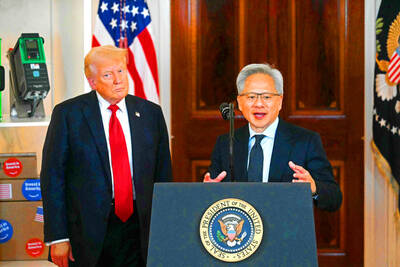
POLICY REVERSAL: The decision to allow sales of Nvidia’s H200 chips to China came after years of tightening controls and has drawn objections among some Republicans US House Republicans are calling for arms-sale-style congressional oversight of artificial intelligence (AI) chip exports as US President Donald Trump’s administration moves to approve licenses for Nvidia Corp to ship its H200 processor to China. US Representative Brian Mast, the Republican chairman of the US House Committee on Foreign Affairs, which oversees export controls, on Friday introduced a bill dubbed the AI Overwatch Act that would require the US Congress to be notified of AI chips sales to adversaries. Any processors equal to or higher in capabilities than Nvidia’s H20 would be subject to oversight, the draft bill says. Lawmakers would have


 RSS
RSS