


Taiwan’s manufacturing purchasing managers’ index (PMI) last month edged up 1.2 points, but remained in contraction mode at 48, declining for an 11th straight month, the Chung-Hua Institution for Economic Research (CIER, 中華經濟研究院) said yesterday.
The economic barometer seeks to gauge the health of the manufacturing industry, with values of 50 and larger suggesting expansion and points below the threshold signifying contraction.
“Companies were generally cautious and adjusted capacity while waiting for a concrete recovery,” CIER president Yeh Chun-hsien (葉俊顯) said.
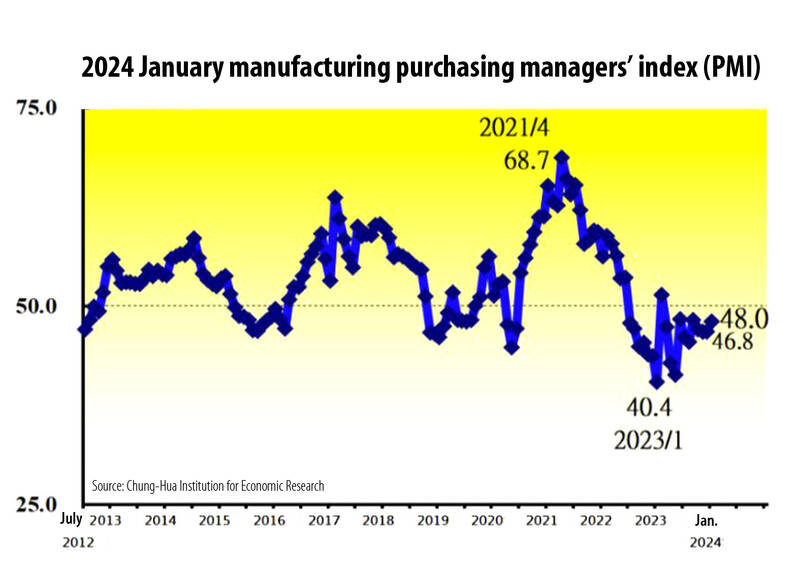
The Taipei-based think tank said the worst is over and a mild recovery is under way.
Firms shipped goods ahead of schedule to meet rerouting needs due to the Red Sea turmoil and are mixed about the outlook of delivery time and raw material prices, Yeh said.
Production schedule adjustments explained why the crucial subindex of new business orders dropped 0.3 points to 46.2, but the measure on industrial production rose 4 points to the healthy territory of 51.3, he said.
Furthermore, the reading on employment squeezed out a 0.5 point increase to 48.3, as firms raised staffing levels slightly to fill orders and accommodated longer shipping time.
Meanwhile, the sub-index on delivery time rose 1.6 points to 48.4, reflecting shipping disruptions linked to Red Sea rerouting, the CIER survey showed.
Uncertainties linger and many firms expressed hope that clients could shed more light on order visibility after the Lunar New Year holiday, Yeh said.
The subindex on inventory printed 45.7, virtually unchanged from 45.8 one month earlier, while customers’ inventory edged up 1.9 points to 43.6 as depletion continued.
Raw material prices gained 2.4 points to 56.2, meaning things grew more expensive, but firms hesitated to pass cost hikes to customers.
The measure on the six-month outlook grew 0.8 points to 46.2, the smallest decline in four months, as local manufacturers stayed largely conservative, accounting for the insignificant uptick in sentiment, it said.
Chip packagers and semiconductor equipment suppliers are relatively optimistic about their business prospects, Yeh said.
By comparison, services providers fared stronger, with the non-manufacturing index coming in at 53.5, expanding for 15 months in a row, albeit down 2.5 points from one month earlier, CIER said in a separate report.
Yeh said that demand for hospitality services cooled slightly, as more people traveled abroad.
Business at financial institutions improved, buoyed by the TAIEX’s rally, he said.
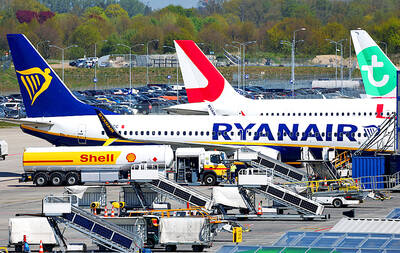
Ryanair, Transavia, Volotea and other low-cost airlines are feeling the financial pain from high jet fuel prices as a result of the Middle East war and are cutting flights. The closure of the Strait of Hormuz has taken a huge chunk of oil supplies off the market, sending the price of jet fuel soaring and triggering fears of shortages that could force airlines to cancel flights. Airlines are not waiting for a lack of supplies to react. “Travel alert: Airlines are cutting thousands of flights right now,” Travel Therapy host Karen Schaler said in an Instagram reel this past weekend.
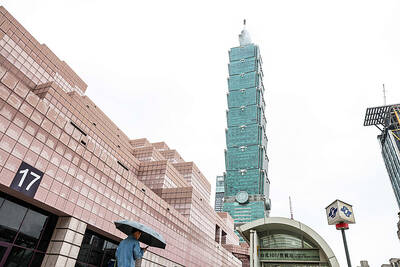
MANAGING RISKS: Taiwan has secured LNG sufficient to cover 95 percent of electricity demand for next month, UBS said, describing the government’s approach as proactive UBS Group AG has raised its forecast for Taiwan’s economic growth this year to 8 percent, up from 6.9 percent previously, and said expansion could reach as high as 8.6 percent if external energy shocks are avoided. The upgrade reflects a stronger-than-expected first-quarter performance and sustained momentum in artificial intelligence (AI)-driven exports, which UBS said are providing a firm foundation for growth despite geopolitical and energy risks. Taiwan’s GDP expanded 13.69 percent year-on-year in the first quarter, the fastest growth since the second quarter of 1987, the Directorate-General of Budget, Accounting and Statistics (DGBAS) reported on Thursday. On a seasonally

The Fair Trade Commission’s (FTC) ongoing review of Grab Holdings Ltd’s US$600 million acquisition of Foodpanda Taiwan’s operations, announced on March 23, has taken on fresh urgency as industry experts warn that the transaction could embed significant Chinese cybersecurity vulnerabilities into Taiwan’s digital infrastructure through Grab’s deep ties to autonomous-driving firm WeRide (文遠知行). Less than 16 months after the FTC blocked Uber Eats’ direct attempt to acquire Foodpanda Taiwan — citing potential combined market shares of 80 to 90 percent — the emergence of Grab as the buyer has prompted questions about whether the same competitive harm is simply being rerouted

The list of Asian stocks that benefit from business partnership with Nvidia Corp is getting longer, as the region further integrates into the artificial intelligence (AI) chip giant’s business ecosystem. Just in the past week, South Korea’s LG Electronics Inc, Taiwan’s Nanya Technology Corp (南亞科技), as well as China’s Huizhou Desay SV Automotive Co (德賽西威) and Pateo Connect Technology Shanghai Corp (博泰車聯) have become the latest to rally on news of tie-ups, supply-chain participation or product collaboration with the US chip designer. Asian suppliers account for about 90 percent of Nvidia’s production costs, up from about 65 percent last year, data compiled


 RSS
RSS