


Driverless trucks with no humans on board would soon cruise Texas highways if three start-ups have their way, despite objections from critics who say financial pressures, not safety, is behind the timetable.
After years of testing, Aurora Innovation Inc, Kodiak Robotics Inc and Gatik AI Inc expect to remove safety drivers from trucks that are being guided by software and an array of sensors including cameras, radar and LiDAR, which sends pulses of light that bounces off objects.
The companies have already hauled cargo for big names such as Walmart Inc, Kroger Co, FedEx Corp and Tyson Foods Inc.
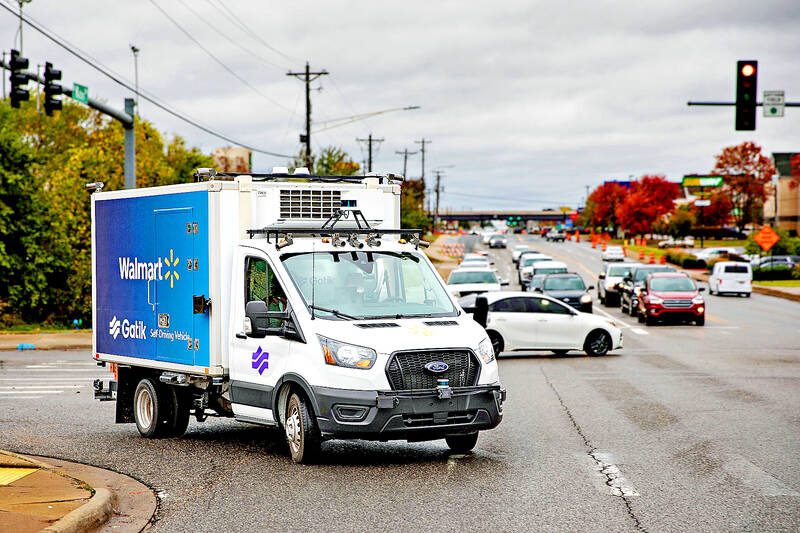
Gatik AI / handout via Reuters
“At the end of the year, we anticipate getting to the point where we begin operating those trucks without drivers on board,” Chris Urmson, cofounder and chief executive officer of Pittsburgh-based Aurora, said in an interview.
All of the companies say they are ready to deploy the technology, although they know there is little-to-no margin for error.
The risk is worth it, they say, because the technology promises to improve highway safety and lower transportation costs.
Detractors say the companies have incentive to reduce the losses that investors have been financing during the development and testing phase.
“We are concerned about the lack of regulation, the lack of transparency, the lack of comprehensive data collection,” Advocates for Highway and Auto Safety president Cathy Chase said.
The list of opponents also includes the International Brotherhood of Teamsters, the 1.3 million member union that represents drivers and warehouse workers.
Trucks pose severe dangers, because they would be traveling at highway speeds and weigh as much as 36,287kg, or more than 15 times as much as General Motors Co’s troubled Cruise driverless robotaxi, opponents say.
The US government for now has left regulation of driverless large trucks mostly up to states, creating a patchwork of rules.
California suspended Cruise operations in October last year after several incidents in San Francisco. The state’s lack of rules for allowing trucks to be tested on public roads encouraged the three driverless truck firms and others to turn to Texas for testing and deployment.
The difficulties that Cruise’s robotaxis faced on the streets of San Francisco — unpredictable pedestrians, sudden road closures and emergency vehicles — are less of a problem for driverless trucks, the companies said.
Trucks largely move cargo on fixed routes and mostly on highways that require much less interaction with passenger vehicles and pedestrians.
Besides saving on wages, the trucks can travel longer than the 11-hour limit on human drivers. The sensors scan in all directions several times a second to identify objects, speeding up reaction time.
Emissions would be reduced an estimated 10 percent or more because the vehicles would stay just below the speed limit and travel at a steady cadence, the companies say.
Human drivers do not guarantee safe operations. In 2021, 5,700 large trucks, which weigh 4,536kg or more, were involved in fatal crashes, statistics compiled by the US Federal Motor Carrier Safety Administration (FMCSA) showed.
A majority of those incidents came from trucks with a gross weight of 14,969kg or more. These so-called Class 8 trucks are similar in size to those in Kodiak and Aurora fleets.
While driverless trucks have not had any at-fault incidents with other vehicles in testing with safety drivers, the FMCSA report suggests that they might not be immune to accidents.
Nearly two-thirds of fatal accidents occur when a person, object, animal or other vehicle veers into a truck’s lane. Data collected by a self-driving truck’s computer system would be key to determining what caused an accident.
“They can’t just say we’re better than humans,” JPMorgan Chase & Co transportation industry analyst Brian Ossenbeck said of the companies planning to go driverless this year. “They have to reach that superhuman level, at least initially, until there’s broader acceptance, and who knows how long that would take.”
At Aurora’s terminal just south of Dallas, a worker cleans sensors on top and at the side of a dark blue Peterbilt Motors Co truck, while a safety driver sits in the cab ready for the vehicle to pull out. If all goes as planned, the safety driver, whose hands hover above the wheel without touching it while the truck is in transit, would soon no longer be needed for the 322km trek to Houston.
“Our intent is this is going to feel like just another day, except this day the truck’s going to head out on the road without anybody in it,” Urmson said.
Wall Street would be watching closely to see if Aurora meets its goal of going driverless by the end of this year, said TD Cowen analyst Jeff Osborne, who has a “market perform” rating on the stock.
Otherwise, investors would raise cash-burn concerns, Osborne said.
“If something is slightly delayed, you just end up getting punished,” he said.
The start-up raised US$850 million this summer, giving it enough cash to operate through the second half of next year.
Aurora then aims to raise a similar amount to carry it through 2027, when it is expected to turn a profit, Urmson said.
Gatik AI, a Mountain View, California-based start-up, has already driven trucks without a driver in Arkansas and Canada.
The company uses smaller, box trucks and plans to deliver from distribution centers to stores.
This year, the company expects to deploy driverless trucks in the Dallas area “at scale,” Gatik cofounder and CEO Gautam Narang said in an interview.
Kodiak plans to “start small in 2024 and gradually ramp it up as we build confidence in the system that we didn’t miss anything,” said Don Burnette, CEO of the closely held Mountain View, California-based company that he founded in 2018.
“We’ve seen the damage that can be done,” as in the case of robotaxis in San Francisco, he said.
The first operations without a human aboard would be short runs near the company’s truck terminal just south of Dallas and extend from there, Burnette said.
The companies have truckport partners to help with refueling their diesel-powered fleets and roadside assistance in case of a flat tire.
For now, it is mostly southern states — from Arizona to Florida — that allow self-driving trucks. Kodiak has been hauling cargo with a safety driver from Dallas to Atlanta and from Houston to Oklahoma City. Most companies plan to start in the south because there is less inclement winter weather.
Texas first adopted legislation allowing driverless trucks in 2017. State authorities have worked with the start-ups to address issues such as inspections and how law enforcement would interact with a driverless truck.
“Autonomous vehicles are expected to help improve safety, spur economic growth and improve the transportation experience for all Texans,” the Texas Department of Transportation said in a statement.
Still, the self-driving start-ups realize that state and federal regulators “have the ability to force a recall and stop the operation of vehicles if they believe they’re creating unreasonable risk to the motoring public,” Urmson said.
The potential transformation of the trucking industry would depend on whether the initial driverless runs are completed without a hitch.
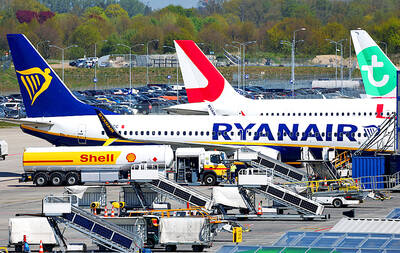
Ryanair, Transavia, Volotea and other low-cost airlines are feeling the financial pain from high jet fuel prices as a result of the Middle East war and are cutting flights. The closure of the Strait of Hormuz has taken a huge chunk of oil supplies off the market, sending the price of jet fuel soaring and triggering fears of shortages that could force airlines to cancel flights. Airlines are not waiting for a lack of supplies to react. “Travel alert: Airlines are cutting thousands of flights right now,” Travel Therapy host Karen Schaler said in an Instagram reel this past weekend.
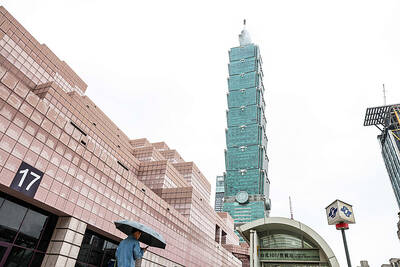
MANAGING RISKS: Taiwan has secured LNG sufficient to cover 95 percent of electricity demand for next month, UBS said, describing the government’s approach as proactive UBS Group AG has raised its forecast for Taiwan’s economic growth this year to 8 percent, up from 6.9 percent previously, and said expansion could reach as high as 8.6 percent if external energy shocks are avoided. The upgrade reflects a stronger-than-expected first-quarter performance and sustained momentum in artificial intelligence (AI)-driven exports, which UBS said are providing a firm foundation for growth despite geopolitical and energy risks. Taiwan’s GDP expanded 13.69 percent year-on-year in the first quarter, the fastest growth since the second quarter of 1987, the Directorate-General of Budget, Accounting and Statistics (DGBAS) reported on Thursday. On a seasonally

The Fair Trade Commission’s (FTC) ongoing review of Grab Holdings Ltd’s US$600 million acquisition of Foodpanda Taiwan’s operations, announced on March 23, has taken on fresh urgency as industry experts warn that the transaction could embed significant Chinese cybersecurity vulnerabilities into Taiwan’s digital infrastructure through Grab’s deep ties to autonomous-driving firm WeRide (文遠知行). Less than 16 months after the FTC blocked Uber Eats’ direct attempt to acquire Foodpanda Taiwan — citing potential combined market shares of 80 to 90 percent — the emergence of Grab as the buyer has prompted questions about whether the same competitive harm is simply being rerouted
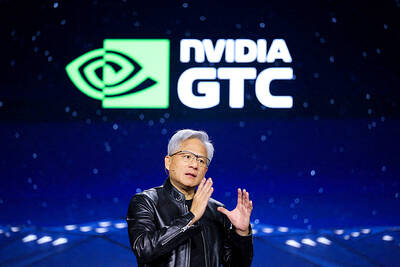
The list of Asian stocks that benefit from business partnership with Nvidia Corp is getting longer, as the region further integrates into the artificial intelligence (AI) chip giant’s business ecosystem. Just in the past week, South Korea’s LG Electronics Inc, Taiwan’s Nanya Technology Corp (南亞科技), as well as China’s Huizhou Desay SV Automotive Co (德賽西威) and Pateo Connect Technology Shanghai Corp (博泰車聯) have become the latest to rally on news of tie-ups, supply-chain participation or product collaboration with the US chip designer. Asian suppliers account for about 90 percent of Nvidia’s production costs, up from about 65 percent last year, data compiled


 RSS
RSS