


CTBC Bank (中國信託銀行) was ranked the world’s 128th most valuable bank in the Brand Finance Banking 500 report this year, the ninth time the bank was listed as the highest-rated Taiwanese financial institution in the brand valuation consultancy’s listing.
According to the report — created jointly by the consultancy and The Banker magazine, both of which are based in the UK — CTBC Bank has a brand value of US$2.112 million, which advanced its placement in the listing by 13 places from last year.
The report also listed CTBC Bank’s brand strength index as the 41st highest globally, up 58 ranks from the bank’s placement the previous year.
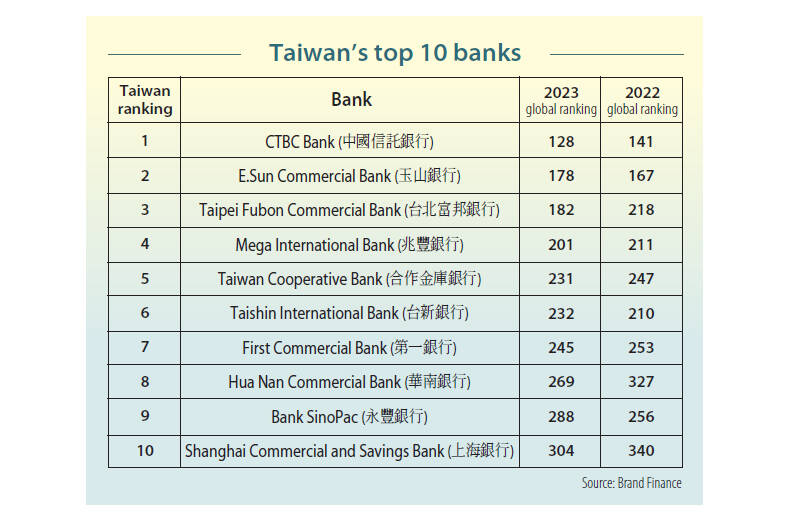
Regarded as the industry’s most authoritative report of its kind, the Brand Finance Banking 500 report gauges the brand value of the world’s financial institutions through quantitative and qualitative metrics, including brand strength, brand royalty rate and revenue forecasts.
CTBC Bank’s 28 percent year-on-year increase in brand value is due largely to a stable financial performance that contributed to steady growth, while the bank’s brand strength index score of 83 reflected its “AAA-” credit rating, the report said.
CTBC Bank is Taiwan’s only financial institution to be included in the report’s top 50 ranking for brand strength.
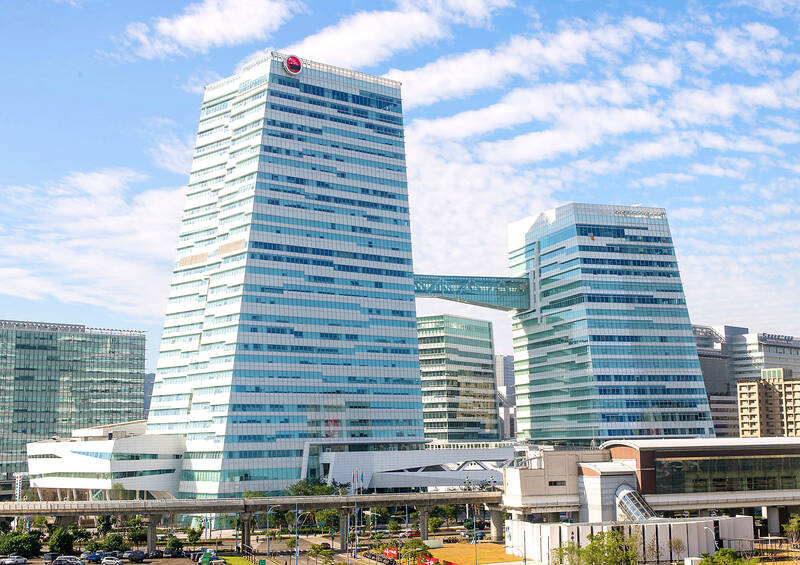
Photo courtesy of CTBC Bank Co
The bank’s brand royalty rating — a gauge of its value and influence on profits — rose to 3.7 percent, representing a 0.4 percentage point increase over last year, which suggests sound performance in operational effectiveness, financial services and client satisfaction.
CTBC Bank is the Taiwanese financial institution with the furthest international reach and has a strong presence throughout Southeast Asia.
It operates branches in Singapore, India and Vietnam, subsidiaries in Indonesia and the Philippines, offices in Malaysia and Myanmar, and since 2020 has been the largest shareholder of the Thailand-based LH Financial Group.
Demonstrating its status as a regionally significant financial institution, CTBC Bank participates in the government’s New Southbound Policy, conducting a wide range of overseas operations to facilitate Taiwanese investments there.
Last year, CTBC Bank won 290 domestic and international awards including all seven of the Taiwan Banking and Best Practice Awards, 41 Asia Pacific and global awards, its seventh Best Taiwan Global Brands award and its eighth World Branding Forum Brand of the Year award, the sole Taiwanese financial institution to hold that distinction.
Additionally, CTBC Bank is the only Domestic Systemically Important Bank to exceed all three capital requirement metrics for 2025 and its “A1” rating from Moody’s shows the bank to be the most robust financial institution in the nation.

Netherlands-based semiconductor equipment supplier ASML Holding NV yesterday said that it is planning to hire an additional 1,000 people in Taiwan this year in response to growing demand from clients. ASML had previously planned to recruit 600 people this year, but that the plan has been adjusted upward, ASML vice president and ASML Taiwan general manager Grace Wang (汪佳慧) told reporters. ASML has a workforce of more than 4,500 in Taiwan, accounting for about 10 percent of its global total, Wang said. This year’s recruitment campaign would focus on adding people in the customer support, manufacturing and supply chain domains to assist ASML
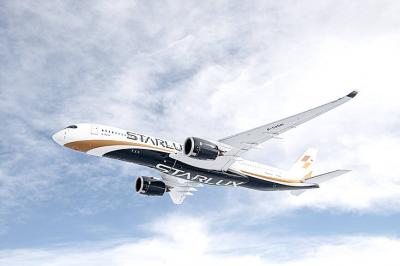
Starlux Airlines Co (星宇航空) today unveiled a long-haul network expansion plan at a shareholders’ meeting in Taipei, including direct flights to Barcelona, Spain, and Zurich, Switzerland, as well as a service connecting Taipei, Sydney and New Zealand. Starlux is to become the first Taiwanese carrier to offer non-stop services to the two European cities, while the inaugural oceanic route is expected to expand transit opportunities within the Australia-New Zealand market, Starlux said. Flight services to Chicago, Dallas, Washington and New York are under evaluation, the airline added. Prior to the shareholders’ meeting, the airline earlier this year announced that it would be
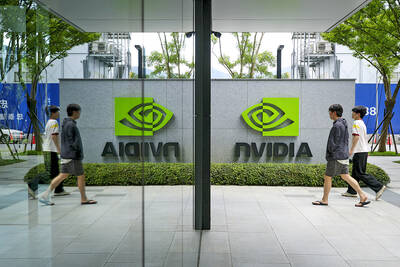
UNDER MICROSCOPE: Taiwan detained three people who allegedly conspired to buy servers in Taiwan and export them using fraudulent documentation, prosecutors said Nvidia Corp chief executive officer Jensen Huang (黃仁勳) on Saturday urged Super Micro Computer Inc to tighten up on compliance after Taiwan detained three people this week for allegedly making fraudulent declarations about artificial intelligence (AI) servers made by its US partner. The development marked the nation’s first crackdown on semiconductor smuggling, which grew after the US slapped restrictions on exports of high-end chips such as Nvidia AI accelerators to China. Nvidia is “rigorous” in explaining regulations to all of its partners, Huang told reporters after arriving in Taipei. “Ultimately Super Micro has to run their own company,” he said in response to

Nvidia Corp yesterday announced that CEO Jensen Huang (黃仁勳) would attend an employee meeting in Taipei tomorrow to celebrate the launch of the company’s Taiwan headquarters project. Huang would attend a gathering at the site of Nvidia’s planned headquarters in Beitou Shilin Technology Park (北投士林科技園區), the company said in a statement. After arriving in Taiwan on Saturday last week, Huang told reporters that he plans to meet with Quanta Computer Inc (廣達) chairman Barry Lam (林百里) and Taiwan Semiconductor Manufacturing Co (TSMC, 台積電) chairman C.C. Wei (魏哲家), and would attend the groundbreaking ceremony for Nvidia’s Taiwan headquarters tomorrow. Nvidia has not yet applied


 RSS
RSS