


Chinese auto giant BYD Co (比亞迪) is poised to surpass Tesla Inc as the world’s biggest electric vehicle (EV) company in annual sales.
The two groups are expected to soon publish their final figures for this year, and based on sales data so far this year, there is almost no chance the US company led by CEO Elon Musk would retain its leadership position.
As of the end of last month, BYD, which also produces hybrid vehicles, had sold 2.07 million EVs.

Photo: AFP
Tesla, for its part, had sold 1.22 million by the end of September. Tesla’s September figures included a one-time boost in sales to nearly half-a-million vehicles in a three-month period, before the expiration of a US tax credit for buyers of EVs — which ended under legislation backed by US President Donald Trump, a climate change skeptic.
Tesla’s sales in the December quarter are expected to fall to 449,000, a FactSet analysis consensus said. That would give the company about 1.65 million sales for the entire year, a drop of 7.7 percent and well below BYD’s level by the end of last month.
Deutsche Bank AG, which projects just 405,000 Tesla EV sales during the fourth quarter, sees the company’s sales down by about one-third in North America and Europe, and by one-tenth in China.
Industry watchers said it would take time for EV demand to reach a level of equilibrium in the US following the elimination of the US$7,500 US tax credit at the end of September.
Even prior to that, Tesla had seen sales struggle in key markets over Musk’s political support of Trump and other far-right politicians. Tesla has also faced rising EV competition from BYD and other Chinese companies, and from European giants.
“We believe Tesla will see some weakness on deliveries” in the fourth quarter, Wedbush Securities Inc analyst Dan Ives said.
Sales of 420,000 would be “good enough to show stable demand,” with Wall Street “laser focused on the autonomous chapter kicking off in 2026,” Ives added, referring to plans for self-driving vehicles.
Even as it has grown quickly, BYD has faced challenges in its home market. With profitability in China weighed down by price-wary consumers, the company has sought to strengthen its foothold in foreign markets.
BYD is “one of the pioneers to establish overseas production capacity and supply chains for EVs,” Fitch Ratings Asia-Pacific corporate research director Jing Yang (楊靜) said.
“Going forward, its geographical diversification is likely to help it to navigate an increasingly complicated global tariff environment,” Yang said.
Overseas rivals have balked at Chinese state subsidies and other state supports that have allowed the company to sell vehicles cheaply. Former US president Joe Biden imposed 100 percent tariffs on Chinese EV imports, which could potentially go up under Trump. Europe has also imposed tariffs on Chinese imports, but BYD is building manufacturing capacity in Hungary.
While the chance of Tesla reclaiming its global leadership in EVs looks uncertain, it is also potentially positioned for growth.
TD Cowen Inc analyst Itay Michaeli said autonomous technology could play an increasingly important role for Tesla, with breakthroughs in its full self-driving (FSD) offerings potentially boosting sales.
“As Tesla really begins to roll out eyes-off features and expand FSD capability, if they do that successfully, that should generate more demand for their vehicles,” Michaeli said.
Musk said the Cybercab, an autonomous robotaxi model, would begin production in April next year.
The company also unveiled cheaper versions of the Model 3 and Y that could boost sales.


Taiwanese firms have increased investment in the Philippines in recent years as Manila’s ties with Washington deepen and global supply chains continue to shift away from China, an expert at the Chung-Hua Institution for Economic Research (CIER, 中華經濟研究院) said yesterday. The Philippines had not been among Taiwanese investors’ top choices in Southeast Asia, CIER Taiwan ASEAN Studies Center director Kristy Hsu (徐遵慈) said at a seminar in Taipei. However, Taiwan’s investment in the country has grown significantly since the COVID-19 pandemic, reaching US $257 million last year, a high in recent years, she said. Although Taiwan’s total investment in the Philippines still lags
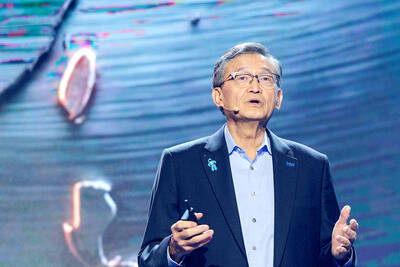
Intel Corp regards Taiwan Semiconductor Manufacturing Co (TSMC, 台積電) as a longstanding partner, as the US chipmaker would continue outsourcing production of advanced chips to TSMC, Intel chief executive officer Lip-Bu Tan (陳立武) said yesterday. “I don’t look at people as competitors. I look at the collaboration... Nvidia is also, you know, a good friend,” Tan told a news conference following his keynote speech at the Computex trade show in Taipei. “It’s a very trusted partnership for us... We are a big, top customer for them, and we’re going to continue doing that,” he said, referring to TSMC, the world’s largest foundry
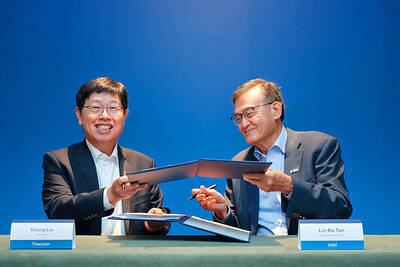
Hon Hai Precision Industry Co (鴻海精密) yesterday said it would work with US chipmaker Intel Corp to jointly develop and deploy next-generation artificial intelligence (AI) infrastructure and intelligent computing platforms in a move to capture booming demand for AI computing systems. Hon Hai, also known as Foxconn Technology Group (富士康), said in a statement that the partnership would combine its global manufacturing scale, system integration expertise and AI data center deployment capabilities with Intel’s strengths in processor architecture, silicon technologies and software ecosystem. The companies said they plan to work on equipment used in AI data centers, including server racks powered by
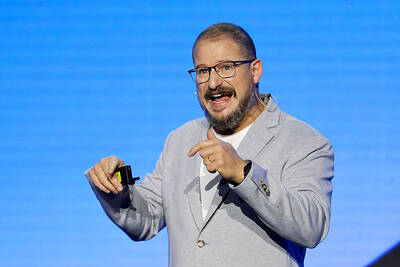
Artificial intelligence (AI) agents would supplant smartphones as the center of people’s digital lives, fundamentally reshaping personal devices and driving a major computing upgrade cycle, Qualcomm Inc CEO Cristiano Amon said yesterday. In his keynote speech for this year’s Computex trade show in Taipei, Amon said that the rise of "agentic AI" — AI systems capable of reasoning, planning and carrying out tasks autonomously — would transform how people interact with technology across phones, PCs, vehicles and wearable devices. Describing the technology as the next major evolution in computing, Amon said that "2026 is the year of agents.” For decades, smartphones have sat


 RSS
RSS