


Meta Platforms Inc is expected to face another large fine after an EU data watchdog on Tuesday imposed binding decisions concerning the treatment of personal data by the owner of Facebook, Instagram and WhatsApp.
The European Data Protection Supervisor said in a statement that the rulings concerned Meta’s use of data for targeted advertising, but did not give details or recommend fines.
Authorities in Ireland, where Meta has its European headquarters, have a month to impose the ruling.
Photo: REUTERS
Previous interventions by the watchdog have led to large fines on tech platforms, including a 405 million euros (US$425 million) fine on Instagram in September over a breach in the handling of children’s data.
The latest case follows complaints by privacy campaigning group NOYB that Meta’s three apps allegedly fail to meet the EU’s strict rules on data protection.
NOYB said the apps flouted the EU’s landmark General Data Protection Regulation, which came into force in May 2018, by failing to give users the option of holding back their personal data and blocking targeted advertising.
Facebook says these are vital to its functioning.
“This is not the final decision and it is too early to speculate,” a Meta spokesman said, adding that EU law left open a possibility for targeted ads.
In October last year, the Irish Data Protection Authority recommended a fine of just 28 million to 36 million euros for lack of transparency.
However, this was rejected as far too low by the French National Commission for Technology and Freedoms and other national watchdogs, which asked the EU watchdog to investigate the case.
“The EU regulators’ decision, if it is upheld, would have a dramatic impact on Meta’s revenue in Europe,” Insider Intelligence analyst Debra Aho Williamson said.
The decision would be a “kneecapping” of Meta’s ability to sell targeted advertising and given the stakes, Meta would “fight vigorously to defend its business,” she said.
Citing internal documents, the Politico news site reported that Meta earmarked 3 billion euros for possible European fines this year and next year.
As well as the Instagram fine in September, Meta was last month fined 265 million euros over a data leak that saw 500 million users’ details published on a hacking Web site.
That adds to a 60 million euros fine in France in January over its use of “cookies,” the digital trackers used to target advertising.


The domestic unit of the Chinese-owned, Dutch-headquartered chipmaker Nexperia BV will soon be able to produce semiconductors locally within China, according to two company sources. Nexperia is at the center of a global tug-of-war over critical semiconductor technology, with a Dutch court in February ordering a probe into alleged mismanagement at the company. The geopolitical tussle has disrupted supply chains, with some carmakers reportedly forced to cut production due to chip shortages. Local production would allow Nexperia’s domestic arm, Nexperia Semiconductors (China) Ltd (安世半導體中國), to bypass restrictions in place since October on the supply of silicon wafers — etched with tiny components to
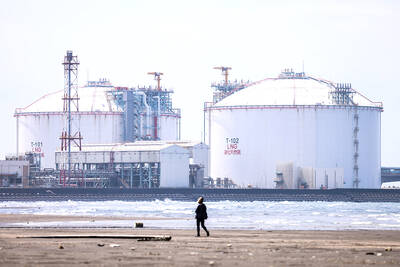
Taiwan is open to joining a global liquefied natural gas (LNG) program if one is created, but on the condition that countries provide delivery even in a scenario where there is a conflict with China, an energy department official said yesterday. While Taiwan’s priority is to have enough LNG at home, the nation is open to exploring potential strategic reserves in other countries such as Japan or South Korea, Energy Administration Deputy Director-General Chen Chung-hsien (陳崇憲) said. While the LNG market does not have a global reserve for emergencies like that of oil, the concept has been raised a few times —
AI-FUELED DEMAND: The company has been benefiting from the skyrocketing prices for DRAM chips amid the AI frenzy, especially its core product — DDR4 DRAM chips DRAM chipmaker Nanya Technology Corp (南亞科技) yesterday reported that its revenue for the first quarter surged 582.91 percent to NT$49.09 billion (US$1.54 billion) from NT$7.19 billion a year earlier, as the supply crunch caused chip price spikes. Last quarter’s figure is the highest on record. On a quarterly basis, revenue jumped 63.14 percent from NT$30.09 billion, the company said. In January, Nanya Technology expected global DRAM supply scarcity to continue through the first half of 2028, thanks to strong demand for artificial intelligence (AI) applications. Market researcher TrendForce Corp (集邦科技) forecast prices of standard DRAM chips would rise between 58 percent and 63

HIGHER PRICES: Given rising energy costs, CPC raised natural gas prices for generators by 41.58%, which Taipower said would raise its power generation costs by NT$10 billion State-run CPC Corp, Taiwan (CPC, 台灣中油) has activated its fourth naphtha cracker to boost ethylene supply, aiming to ease concerns over plastic material shortages amid tensions in the Middle East, the Ministry of Economic Affairs said yesterday. The move is expected to add 19,000 tonnes of supply this month and 30,000 tonnes next month, Deputy Minister of Economic Affairs Ho Chin-tsang (何晉滄) said at a meeting of the legislature’s Economics Committee in Taipei. CPC on Tuesday held talks with major polyethylene producers, including Formosa Plastics Corp (台塑), Asia Polymer Corp (亞聚) and USI Corp (台聚), and pledged to supply ethylene feedstock


 RSS
RSS