


Taiwan is open to joining a global liquefied natural gas (LNG) program if one is created, but on the condition that countries provide delivery even in a scenario where there is a conflict with China, an energy department official said yesterday.
While Taiwan’s priority is to have enough LNG at home, the nation is open to exploring potential strategic reserves in other countries such as Japan or South Korea, Energy Administration Deputy Director-General Chen Chung-hsien (陳崇憲) said.
While the LNG market does not have a global reserve for emergencies like that of oil, the concept has been raised a few times — most notably by Japan in 2023. The US and Israeli attacks on Iran has upended the global gas market, triggering a wider conflict that has forced Qatar to close the world’s largest LNG export plant. About one-third of Taiwan’s LNG came from Qatar last year.
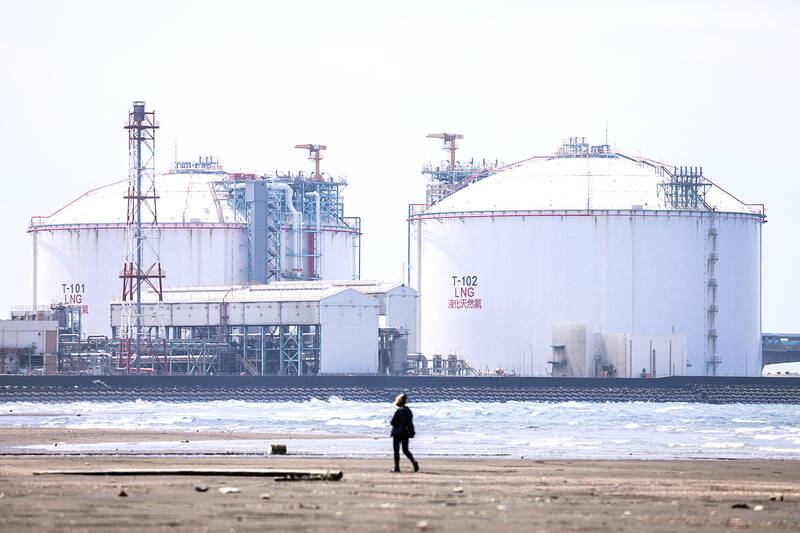
Photo: Cheng I-hwa, AFP
If Taiwan were to set up strategic reserves, “we must make sure those materials can be imported into Taiwan,” even if there are hostilities with China, Chen said.
Taiwan has about 11 days of LNG reserve onshore and plans to extend that to 14 days starting next year, he said. The long term goal would be to expand domestic stockpiles, provided exploration sites could be identified and the right environmental protections are put in place, he added.
Taiwan is making it a priority to shift away from the Middle East for its LNG imports, targeting 25 percent shipments from the US by 2029 from 10 percent today, Chen said, adding that there are also pans to increase purchases from Australia.
Taiwan imported one-third of its LNG from Australia last year.
Global LNG supply has been badly hampered by the war in Iran, with the closure of the Strait of Hormuz cutting the world off from about one-fifth of the total.
Asian LNG imports fell the most in more than three years last month as natural gas deliveries to the region declined 8.6 percent from a year earlier to about 20.6 million tonnes, ship-tracking data compiled by Bloomberg showed. That is the biggest drop since December 2022.
The region has been scrambling to seek alternative sources of energy, with countries including Bangladesh, India and Japan flocking back to coal, while in Vietnam, Vingroup JSC asked the government to allow it to replace an LNG project with renewable energy.

Cairo’s new monorail slices across the city skyline, running above the familiar chaos of blaring horns and aging buses’ exhaust fumes that mark rush hour below. The US$4.5 billion monorail, opened this month, is among Egypt’s most prominent new transport projects, part of a debt-funded infrastructure drive criticized for sapping state finances while bringing limited benefits to most of the country’s 109 million people. “It feels like you’re in a different country,” said Ramy Sayed, a restaurant manager, aboard a driverless Innovia 300 train. “No noise, no traffic, we’re not used to this.” The eastern line runs 56km from the bustling middle-class

Taiwanese firms have increased investment in the Philippines in recent years as Manila’s ties with Washington deepen and global supply chains continue to shift away from China, an expert at the Chung-Hua Institution for Economic Research (CIER, 中華經濟研究院) said yesterday. The Philippines had not been among Taiwanese investors’ top choices in Southeast Asia, CIER Taiwan ASEAN Studies Center director Kristy Hsu (徐遵慈) said at a seminar in Taipei. However, Taiwan’s investment in the country has grown significantly since the COVID-19 pandemic, reaching US $257 million last year, a high in recent years, she said. Although Taiwan’s total investment in the Philippines still lags

Intel Corp regards Taiwan Semiconductor Manufacturing Co (TSMC, 台積電) as a longstanding partner, as the US chipmaker would continue outsourcing production of advanced chips to TSMC, Intel chief executive officer Lip-Bu Tan (陳立武) said yesterday. “I don’t look at people as competitors. I look at the collaboration... Nvidia is also, you know, a good friend,” Tan told a news conference following his keynote speech at the Computex trade show in Taipei. “It’s a very trusted partnership for us... We are a big, top customer for them, and we’re going to continue doing that,” he said, referring to TSMC, the world’s largest foundry

Artificial intelligence (AI) agents would supplant smartphones as the center of people’s digital lives, fundamentally reshaping personal devices and driving a major computing upgrade cycle, Qualcomm Inc CEO Cristiano Amon said yesterday. In his keynote speech for this year’s Computex trade show in Taipei, Amon said that the rise of "agentic AI" — AI systems capable of reasoning, planning and carrying out tasks autonomously — would transform how people interact with technology across phones, PCs, vehicles and wearable devices. Describing the technology as the next major evolution in computing, Amon said that "2026 is the year of agents.” For decades, smartphones have sat


 RSS
RSS