


Cathay Financial Holding Co (國泰金控) on Thursday said it would issue 1.5 billion common shares to raise new capital, with an aim to boost the financial strength of its life and property insurance subsidiaries, which were struck by key interest rate hikes and a huge number of COVID-19 compensation claims.
Cathay Financial is to receive proceeds of NT$39 billion to NT$60 billion (US$1.2 billion to US$1.9 billion), as the new shares were priced at NT$26 to NT$40 each, corporate data showed.
That would be the largest capital financing project ever launched by the company. Cathay Financial raised NT$42 billion by issuing 700 million preferred shares at NT$60 each in June 2018, corporate data showed.
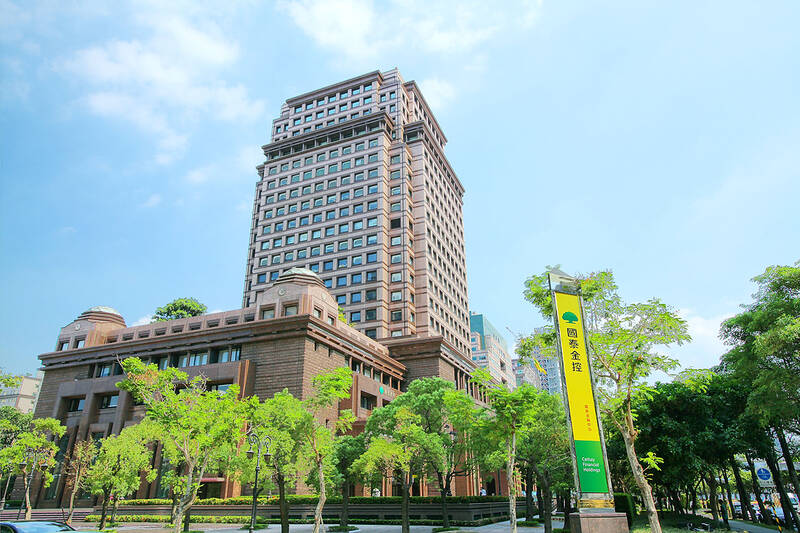
Photo: Cathay Financial Holding Co
Cathay Financial’s equity-to-asset ratio dipped to 2.63 percent at the end of last month, as hiked interest rate hikes at central banks worldwide led to price declines of foreign bonds, which cut the valuation of the life insurer’s fixed-income investment, the data showed.
Equity-to-asset ratio is a solvency measure, and all life insurers are required by the Financial Supervisory Commission (FSC) to maintain an equity-to-asset ratio higher than 3 percent.
Cathay Financial would use the proceeds to inject NT$35 billion into Cathay Life Insurance (國泰人壽) and NT$10 billion into Cathay Century Insurance Co (國泰世紀產險), by subscribing all their new shares, the company said in a filing to the Taiwan Stock Exchange (TWSE).
Cathay Life planned to offer 500 million new shares at NT$70 each, to supplement its capital and boost its equity-to-asset ratio, it said in another statement to the TWSE.
Cathay Life’s board members on Thursday approved the proposal to reclassify its financial assets, a change that would boost its equity-to-asset ratio to 5.78 percent, with the reclassification dating back to Oct. 1, the statement said, adding that shareholders’ equity would increase by NT$242.6 billion the end of last month.
Cathay Life is the second local life insurer seeking to free itself from deteriorating financial reports by reclassifying assets, following the steps of Nan Shan Life Insurance Co (南山人壽) last week.
Cathay Financial’s share price retreated 3.43 percent to NT$36.55 in Taipei trading yesterday, with investors concerned that the capital injection could signal a dilution in profit, TWSE data showed.
The injection is expected to strengthen the capital adequacy of its insurance units and help protect against volatility in the financial markets, Moody’s Investors Service analyst Kelvin Kwok (郭嘉銘) said in a note yesterday.
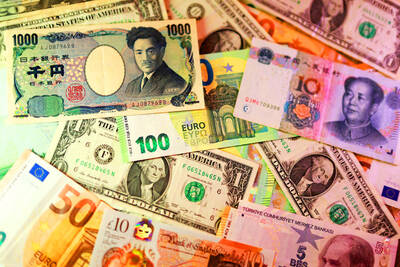
Taiwan’s foreign exchange reserves fell below the US$600 billion mark at the end of last month, with the central bank reporting a total of US$596.89 billion — a decline of US$8.6 billion from February — ending a three-month streak of increases. The central bank attributed the drop to a combination of factors such as outflows by foreign institutional investors, currency fluctuations and its own market interventions. “The large-scale outflows disrupted the balance of supply and demand in the foreign exchange market, prompting the central bank to intervene repeatedly by selling US dollars to stabilize the local currency,” Department of Foreign

ENERGY ISSUES: The TSIA urged the government to increase natural gas and helium reserves to reduce the impact of the Middle East war on semiconductor supply stability Chip testing and packaging service provider ASE Technology Holding Co (日月光投控) yesterday said it planned to invest more than NT$100 billion (US$3.15 billion) in building a new advanced chip testing facility in Kaohsiung to keep up with customer demand driven by the artificial intelligence (AI) boom. That would be included in the company’s capital expenditure budget next year, ASE said. There is also room to raise this year’s capital spending budget from a record-high US$7 billion estimated three months ago, it added. ASE would have six factories under construction this year, another record-breaking number, ASE chief operating officer Tien Wu
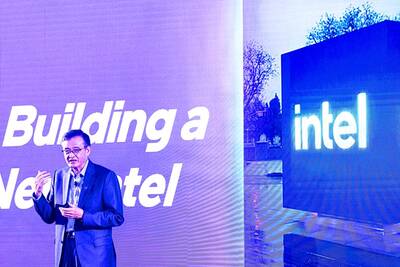
Intel Corp is joining Elon Musk’s long-shot effort to develop semiconductors for Tesla Inc, Space Exploration Technologies Corp and xAI, marking a surprising twist in the chipmaker’s comeback bid. Intel would help the Terafab project “refactor” the technology in a chip factory, the company said on Tuesday in a post on X, Musk’s social media platform. That is a stage in the development process that typically helps make chips more powerful or reliable. The chipmaker’s shares jumped 4.2 percent to US$52.91 in New York trading on Tuesday. The Terafab project is a grand plan by Musk to eventually manufacture his own chips for

For weeks now, the global tech industry has been waiting for a major artificial intelligence (AI) launch from DeepSeek (深度求索), seen as a benchmark for China’s progress in the fast-moving field. More than a year has passed since the start-up put Chinese AI on the map in early last year with a low-cost chatbot that performed at a similar level to US rivals. However, despite reports and rumors about its imminent release, DeepSeek’s next-generation “V4” model is nowhere in sight. Speculation is also swirling over the geopolitical implications of which computer chips were chosen to train and power the new


 RSS
RSS