


European shares on Friday gained, marking an upbeat end to the week, helped by an initial boost after the British government’s turnaround on tax cuts, but this faded due to continued uncertainty about its fiscal stance.
The region-wide STOXX 600 index closed up 0.56 percent at 391.31, building on Thursday’s rally, but was still off session highs hit immediately after British Prime Minister Liz Truss announced the scrapping of parts of the government’s fiscal program. It posted a weekly loss of 0.09 percent.
Truss fired British chancellor of the exchequer Kwasi Kwarteng, and said that Britain would retain plans to increase corporation tax.

Kwarteng, whose announcement of unfunded tax cuts had sparked a rout in bond markets last month, has been replaced by former secretary of state for foreign and commonwealth affairs and secretary of state for health and social care Jeremy Hunt.
“It’s been a little bit of a relief trade, but we still have concerns that we don’t know exactly what is happening. We’re going to have to keep an eye out on what the new chancellor says next week,” Capital.com market analyst Daniela Hathorn said.
“Markets need a bit more clarity on what this fiscal plan currently stands at, and they’re going to want to know exactly where we can see the funding come from,” she said.
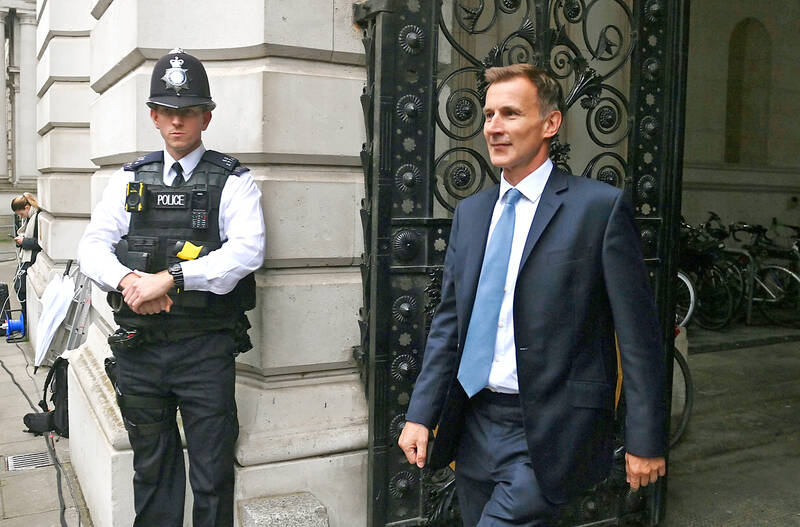
Photo: EPA-EFE
London’s blue-chip FTSE 100 also came off session highs and ended up 0.12 percent at 6,858.79. It was down 1.89 percent for the week.
The STOXX 600 has fallen 19.8 percent so far this year, with markets on edge about aggressive interest rate hikes from central banks tipping the economy into a recession. An energy crisis exacerbated by Russia’s invasion of Ukraine has also added to worries about an economic slowdown in Europe.
Meanwhile, big US banks reported a hit to profits on Friday as they braced for a weaker economy.
Still, Friday’s gains helped the STOXX index erase some losses from the first three days of the week.
Adding to recent market optimism, Russian President Vladimir Putin on Friday said there was no need for massive new strikes on Ukraine and that Russia was not looking to destroy the country.
Most STOXX 600 sectors were trading higher, led by real estate stocks and utilities.
Among individual stocks, Temenos AG slumped 19 percent after the Swiss banking software group slashed its guidance for the year.
UPM-Kymmene Oyj added 5.7 percent after the Finnish forestry group reported higher third-quarter results and said it expected the year’s earnings before interest and taxes to improve compared with last year.


The domestic unit of the Chinese-owned, Dutch-headquartered chipmaker Nexperia BV will soon be able to produce semiconductors locally within China, according to two company sources. Nexperia is at the center of a global tug-of-war over critical semiconductor technology, with a Dutch court in February ordering a probe into alleged mismanagement at the company. The geopolitical tussle has disrupted supply chains, with some carmakers reportedly forced to cut production due to chip shortages. Local production would allow Nexperia’s domestic arm, Nexperia Semiconductors (China) Ltd (安世半導體中國), to bypass restrictions in place since October on the supply of silicon wafers — etched with tiny components to
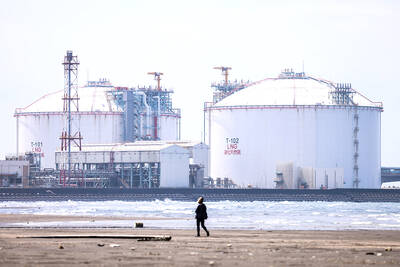
Taiwan is open to joining a global liquefied natural gas (LNG) program if one is created, but on the condition that countries provide delivery even in a scenario where there is a conflict with China, an energy department official said yesterday. While Taiwan’s priority is to have enough LNG at home, the nation is open to exploring potential strategic reserves in other countries such as Japan or South Korea, Energy Administration Deputy Director-General Chen Chung-hsien (陳崇憲) said. While the LNG market does not have a global reserve for emergencies like that of oil, the concept has been raised a few times —

Taiwan Semiconductor Manufacturing Co (TSMC, 台積電) yesterday received government approval to deploy its advanced 3-nanometer (3nm) process at its second fab currently under construction in Japan, the Ministry of Economic Affairs said in a news release. The ministry green-lit the plan for the facility in Kumamoto, which is scheduled to start installing equipment and come online in 2028 with a monthly production capacity of 15,000 12-inch wafers, the ministry said. The Department of Investment Review in June 2024 authorized a US$5.26 billion investment for the facility, slated to manufacture 6- to 12nm chips, significantly less advanced than 3nm process. At a meeting with
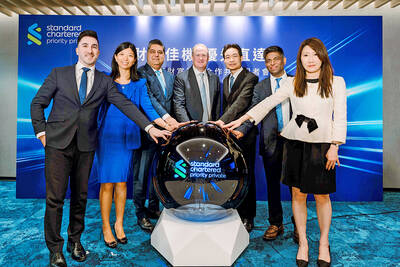
Standard Chartered Taiwan on March 26 announced that it has partnered with international fintech firm FinIQ to build an “Automated Structured Products Pricing Platform.” The bank is also introducing products from global issuers including Goldman Sachs Group Inc, Barclays PLC and BNP Paribas SA. The new platform enables an end-to-end process whereby it finds the most competitive pricing across multiple issuers in a matter of minutes, followed by automated documentation and transaction execution, which significantly shortens time-to-market and delivers a superior wealth management experience. Standard Chartered Bank Taiwan CEO Anthony Yu (游天立) said: “Standard Chartered is increasingly leveraging its wealth management


 RSS
RSS