


The manufacturing purchasing managers’ index (PMI) last month lost another 2.3 points and dropped to 44.9, its lowest level in more than two years, as operating conditions for local manufacturers weakened further and might not recover in the next quarter, the Chung-Hua Institution for Economic Research (CIER, 中華經濟研究院) said yesterday.
The latest PMI data came after new business orders and industrial production declined, in line with tepid demand for technology products, CIER president Chang Chuang-chang (張傳章) said.
The PMI gauges the health of the manufacturing industry, with values of above 50 suggesting expansion and points below the threshold indicating contraction.
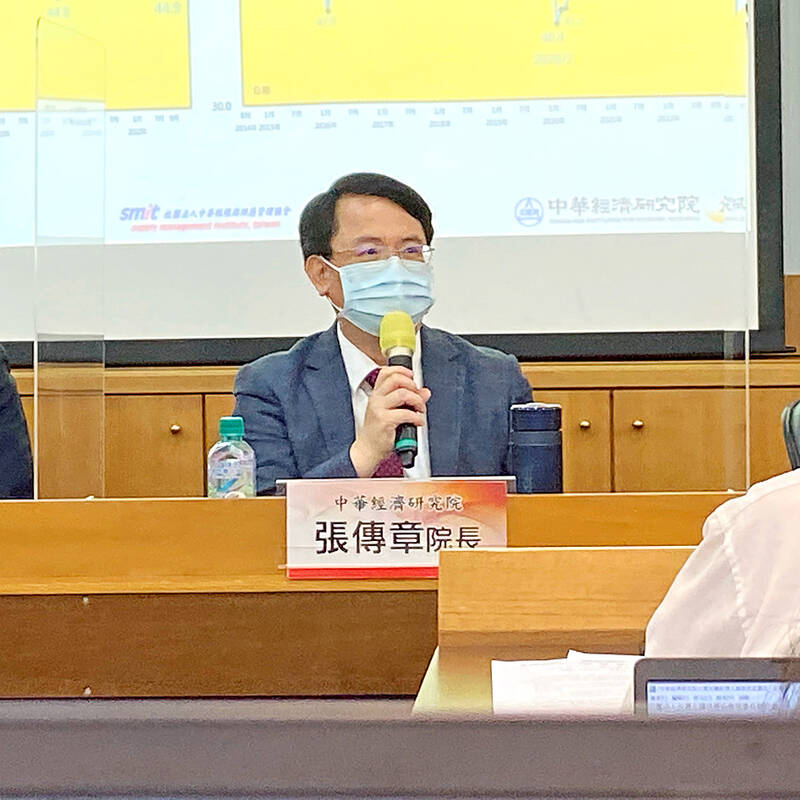
Photo: Huang Tzu-hsun, Taipei Times
“Business momentum would remain soft in the near future, and much uncertainty looms over the medium term, depending on how global economic scenes pan out,” Chang said.
Local manufacturers are generally conservative about their business prospects, with the reading on the six-month outlook standing at 28.3, unchanged from one month earlier, the Taipei-based think tank said.
Local firms were most concerned about economic uncertainty, and that risks related to the Ukraine war, global inflation and monetary tightening would not settle any time soon, CIER researcher Chen Shin-hui (陳馨蕙) said.
The reading on clients’ inventory stayed high at 52.4, although down 6.8 points from August, meaning that customers have more inventory than necessary to operate, it said.
At the same time, tight COVID-19 controls in China continue to cloud order visibility and weigh on business for local firms, Chen said.
Some firms expressed hope that Beijing could reverse course on the lockdowns following the 20th National Congress of China’s top leaders on Oct. 16, Chen said.
China and the US account for more than 50 percent of Taiwanese exports.
CIER vice president Wang Jiann-chyuan (王健全) said that local firms should be prepared for disappointing sales of the latest iPhone series in light of unfavorable economic conditions globally.
Taiwan might follow in the steps of South Korea, a major trade rival, which has reported trade deficits for six months straight, Wang said.
The government can help avoid such a scenario by helping industrial sectors to take bolder steps to encourage private consumption.
“Spending is not a sin, but a virtue,” if the nation is to maintain its growth momentum, Wang said.
The non-manufacturing index (NMI) shed 1.6 points to 52.2, above the expansion mark for three consecutive months, as sectors reliant on domestic demand emerge from the COVID-19 pandemic, CIER said.
Most service sectors experienced improvement, even though wholesale operators and financial institutes failed to share the benefit, it said.
Still, the six-month business measure dropped 2.8 points to 41.1, as most service providers are preparing for a business downturn amid poor consumer confidence.
Restaurants, hotels and educational facilities are among businesses holding a positive outlook in anticipation of strict border controls being lifted this month, CIER said.
Taiwan’s foreign exchange reserves fell below the US$600 billion mark at the end of last month, with the central bank reporting a total of US$596.89 billion — a decline of US$8.6 billion from February — ending a three-month streak of increases. The central bank attributed the drop to a combination of factors such as outflows by foreign institutional investors, currency fluctuations and its own market interventions. “The large-scale outflows disrupted the balance of supply and demand in the foreign exchange market, prompting the central bank to intervene repeatedly by selling US dollars to stabilize the local currency,” Department of Foreign

ENERGY ISSUES: The TSIA urged the government to increase natural gas and helium reserves to reduce the impact of the Middle East war on semiconductor supply stability Chip testing and packaging service provider ASE Technology Holding Co (日月光投控) yesterday said it planned to invest more than NT$100 billion (US$3.15 billion) in building a new advanced chip testing facility in Kaohsiung to keep up with customer demand driven by the artificial intelligence (AI) boom. That would be included in the company’s capital expenditure budget next year, ASE said. There is also room to raise this year’s capital spending budget from a record-high US$7 billion estimated three months ago, it added. ASE would have six factories under construction this year, another record-breaking number, ASE chief operating officer Tien Wu

The EU and US are nearing an agreement to coordinate on producing and securing critical minerals, part of a push to break reliance on Chinese supplies. The potential deal would create incentives, such as minimum prices, that could advantage non-Chinese suppliers, according to a draft of an “action plan” seen by Bloomberg. The EU and US would also cooperate on standards, investments and joint projects, as well as coordinate on any supply disruptions by countries like China. The two sides are additionally seeking other “like-minded partners” to join a multicountry accord to help create these new critical mineral supply chains, which feed into

For weeks now, the global tech industry has been waiting for a major artificial intelligence (AI) launch from DeepSeek (深度求索), seen as a benchmark for China’s progress in the fast-moving field. More than a year has passed since the start-up put Chinese AI on the map in early last year with a low-cost chatbot that performed at a similar level to US rivals. However, despite reports and rumors about its imminent release, DeepSeek’s next-generation “V4” model is nowhere in sight. Speculation is also swirling over the geopolitical implications of which computer chips were chosen to train and power the new


 RSS
RSS