


Peanut farmers in China are left with empty shells as extreme weather wreaks havoc on harvests in the world’s most populous nation.
Nutless pods are a consequence of alternating drought and excessive rains during key planting and growth periods. That is bad news for China, the world’s biggest grower, after farmers shrank the planting area.
The empty shells are one factor that could result in peanut output tumbling as much as 30 percent this season, analysts estimate.
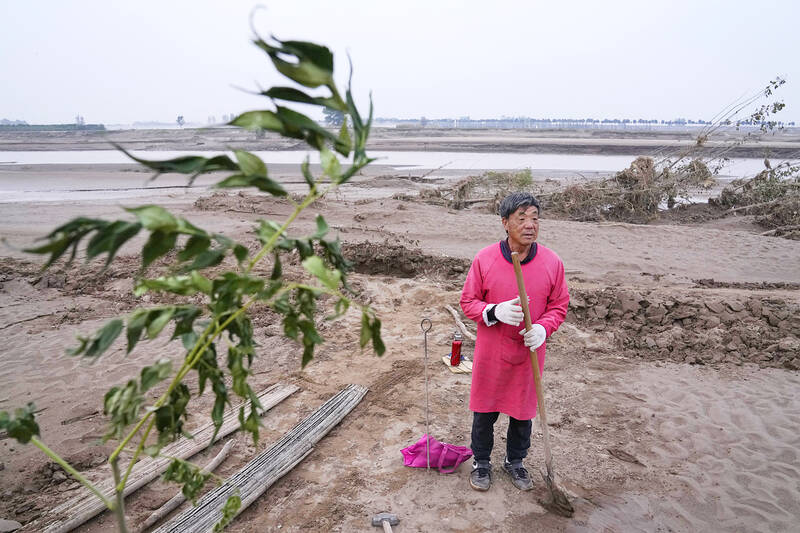
Photo: AP
“I’ve never encountered anything like this in previous years,” said a peanut trader surnamed Song in Shandong Province, where a delayed harvest has just begun.
The plight of farmers can be seen in a video of peanut fields ravaged by drought that made its rounds on social media.
Posted by “Brother Peanut” in Shandong three months ago, when parts of China were already struggling with inadequate rainfall, it shows a large spread of land that used to be planted with peanuts, now mostly barren and dotted with an abnormally small crop.
Peanuts have become the latest casualty as extreme weather roils Chinese agricultural markets during the crucial harvest period.
Sichuan Province suffered its worst drought in 60 years as searing temperatures baked central and southwestern China, while flooding inundated the northeast.
Other crops have seen similar damage across the globe this summer, exacerbating a food inflation that has been gripping the world. Scorching heat shriveled the corn crop in the US, leaving some stalks with no ears at all. Sunflowers are withering in Europe amid a once-in-a-generation drought.
The humble peanut, the fourth-largest oilseed crop in the world, is generally resistant to drought, but the legume needs calcium to grow. If the ground is too severely dry or flooded, it would cause a loss of calcium, making it difficult for the plant’s roots to absorb enough. The result: a shell with no nut.
“High temperature and drought, or too much moisture in the soil, can both lead to empty peanuts,” said Huatai Futures Co (華泰期貨) analyst Jiang Ying, who estimates a 20 to 30 percent fall in China’s overall peanut output this season.
Any considerable drop in peanut production in China, which produces one-third of the global output, could push up global oilseed prices further.
It would also thwart Beijing’s drive for self-reliance in oilseeds, part of an overarching food security push, after the COVID-19 pandemic and soured relations with major trading partners threatened steady supplies from overseas markets.
Beijing has said it would spare no effort to improve oilseed capacity, aiming to produce more than 19 million tonnes of peanuts by 2025, according to the Chinese government’s five-year plan.
Now, that goal looks very much up in the air.
Even before the bad weather, the stage was set for a poor crop. Low prices of peanuts had pushed many farmers to switch to other crops such as corn and vegetable, seeking better profits and easier work.
Those who decided to stick with peanuts found the land was too dry to seed when drought hit in April and May. Under the double whammy, the planting area of peanuts plunged more than 30 percent in some main production areas.
After the crop was finally planted, excessive rains hit some areas in Shandong and the northeast, flooding peanut fields right before harvest. In Henan Province, where drought has been the dominating problem, pest disease rose along with the extreme weather, also hurting output, said Wang Xiaoyang, an analyst with Sinolink Futures Co (國金期貨).
“Farmers will probably hold off selling if the price offer is not high while traders will scramble to snap up the new harvest,” Song said.

ENERGY ISSUES: The TSIA urged the government to increase natural gas and helium reserves to reduce the impact of the Middle East war on semiconductor supply stability Chip testing and packaging service provider ASE Technology Holding Co (日月光投控) yesterday said it planned to invest more than NT$100 billion (US$3.15 billion) in building a new advanced chip testing facility in Kaohsiung to keep up with customer demand driven by the artificial intelligence (AI) boom. That would be included in the company’s capital expenditure budget next year, ASE said. There is also room to raise this year’s capital spending budget from a record-high US$7 billion estimated three months ago, it added. ASE would have six factories under construction this year, another record-breaking number, ASE chief operating officer Tien Wu

The EU and US are nearing an agreement to coordinate on producing and securing critical minerals, part of a push to break reliance on Chinese supplies. The potential deal would create incentives, such as minimum prices, that could advantage non-Chinese suppliers, according to a draft of an “action plan” seen by Bloomberg. The EU and US would also cooperate on standards, investments and joint projects, as well as coordinate on any supply disruptions by countries like China. The two sides are additionally seeking other “like-minded partners” to join a multicountry accord to help create these new critical mineral supply chains, which feed into

For weeks now, the global tech industry has been waiting for a major artificial intelligence (AI) launch from DeepSeek (深度求索), seen as a benchmark for China’s progress in the fast-moving field. More than a year has passed since the start-up put Chinese AI on the map in early last year with a low-cost chatbot that performed at a similar level to US rivals. However, despite reports and rumors about its imminent release, DeepSeek’s next-generation “V4” model is nowhere in sight. Speculation is also swirling over the geopolitical implications of which computer chips were chosen to train and power the new
TECH WINNERS: Taiwan and South Korea reported robust trade, which suggests that they have critical advantages in the rapidly expanding AI supply chain, an official said Exports last month surged to a new high, as booming demand tied to artificial intelligence (AI) infrastructure fueled shipments of advanced technology components, underscoring the nation’s pivotal role in the global semiconductor supply chain. Outbound shipments climbed to US$80.18 billion, the highest ever for a single month, rising 61.8 percent from a year earlier and marking the 29th consecutive month of growth, the Ministry of Finance said yesterday. “The surge was driven primarily by global investment in AI infrastructure,” Department of Statistics Director-General Beatrice Tsai (蔡美娜) said. The mass production of next-generation AI computing systems has accelerated procurement across the semiconductor supply


 RSS
RSS