


The central bank could raise interest rates by 12.5 basis points later this week to curb inflation, following a 25 basis-point increase in March, a DBS Bank Ltd economist said ahead of the monetary policymaker’s quarterly board meeting on Thursday.
Singapore-based Ma Tieying (馬鐵英) said in a report on Wednesday that she was expecting a less aggressive hike of 12.5 basis points because “growth headwinds have increased.”
At its March 17 meeting, the central bank decided to raise its benchmark discount rate by a larger-than-expected 25 basis points to 1.375 percent, its first rate hike in 10 years, as the bank sensed that high inflation could become entrenched if it did not take action.
Photo: Ashley Pon/Bloomberg
However, the disrupting impact of recent lockdowns in key Chinese manufacturing hubs was bigger than expected, Ma said, adding that Taiwan’s export orders fell 5.5 percent year-on-year in April, the first decline since February 2020, while the S&P Global Taiwan manufacturing purchasing managers’ index also dropped to 50 last month, the lowest reading for the nation’s factory activity over the past two years.
Furthermore, a local outbreak of the Omicron variant of SARS-CoV-2 has also weighed on domestic consumption and the service sector this quarter, with retail and recreation activities declining by about 15 percent from the middle of April to the end of last month, Ma said, citing Google mobility data.
“Beyond the short term, there are mounting concerns about a general global slowdown in 2023, in the aftermath of the supply-side inflation shock, monetary policy tightening and geopolitical tensions,” Ma said.
“As global growth uncertainties increase, the central bank is likely to adopt a more careful approach on its pace of monetary policy normalization in the remainder of this year and 2023,” she said.
The central bank may plan to pursue a gradual normalization approach to lift its benchmark discount rate further toward the 2 percent level in a bid to address the issue of negative “real” interest rates, Ma said, adding that she expects a sequential rate hike by the bank at its next seven policy meetings.
Negative real interest rates happen when the nominal interest rate is lower than the inflation rate, meaning that consumers’ purchasing power is weakening.
On the back of rising food and fuel prices, the consumer price index grew 3.39 percent from a year earlier last month, the highest since August 2012, the Directorate-General of Budget, Accounting and Statistics said on Tuesday.
However, inflation is different in Taiwan compared with the US, while local COVID-19 outbreaks have had an impact on domestic demand, so the central bank does not need to follow in the footsteps of the US Federal Reserve, said Dachrahn Wu (吳大任), director of National Central University’s Research Center for Taiwan Economic Development.
The Fed has begun raising interest rates aggressively, with another significant hike expected this week, as US policymakers attempt to combat inflationary pressures without triggering a recession.
Additionally, steep rate hikes would add financial burdens to households, such as increases in housing loans, causing people to reduce unnecessary consumption. As a result, corporate profits would decrease, Wu told the Chinese-language Liberty Times (the Taipei Times’ sister newspaper) on Sunday.

ENERGY ISSUES: The TSIA urged the government to increase natural gas and helium reserves to reduce the impact of the Middle East war on semiconductor supply stability Chip testing and packaging service provider ASE Technology Holding Co (日月光投控) yesterday said it planned to invest more than NT$100 billion (US$3.15 billion) in building a new advanced chip testing facility in Kaohsiung to keep up with customer demand driven by the artificial intelligence (AI) boom. That would be included in the company’s capital expenditure budget next year, ASE said. There is also room to raise this year’s capital spending budget from a record-high US$7 billion estimated three months ago, it added. ASE would have six factories under construction this year, another record-breaking number, ASE chief operating officer Tien Wu

The EU and US are nearing an agreement to coordinate on producing and securing critical minerals, part of a push to break reliance on Chinese supplies. The potential deal would create incentives, such as minimum prices, that could advantage non-Chinese suppliers, according to a draft of an “action plan” seen by Bloomberg. The EU and US would also cooperate on standards, investments and joint projects, as well as coordinate on any supply disruptions by countries like China. The two sides are additionally seeking other “like-minded partners” to join a multicountry accord to help create these new critical mineral supply chains, which feed into

For weeks now, the global tech industry has been waiting for a major artificial intelligence (AI) launch from DeepSeek (深度求索), seen as a benchmark for China’s progress in the fast-moving field. More than a year has passed since the start-up put Chinese AI on the map in early last year with a low-cost chatbot that performed at a similar level to US rivals. However, despite reports and rumors about its imminent release, DeepSeek’s next-generation “V4” model is nowhere in sight. Speculation is also swirling over the geopolitical implications of which computer chips were chosen to train and power the new
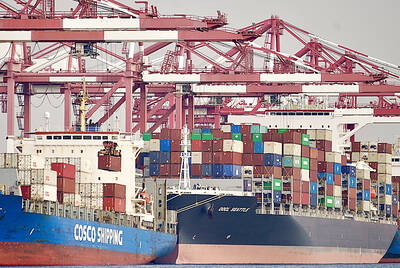
TECH WINNERS: Taiwan and South Korea reported robust trade, which suggests that they have critical advantages in the rapidly expanding AI supply chain, an official said Exports last month surged to a new high, as booming demand tied to artificial intelligence (AI) infrastructure fueled shipments of advanced technology components, underscoring the nation’s pivotal role in the global semiconductor supply chain. Outbound shipments climbed to US$80.18 billion, the highest ever for a single month, rising 61.8 percent from a year earlier and marking the 29th consecutive month of growth, the Ministry of Finance said yesterday. “The surge was driven primarily by global investment in AI infrastructure,” Department of Statistics Director-General Beatrice Tsai (蔡美娜) said. The mass production of next-generation AI computing systems has accelerated procurement across the semiconductor supply


 RSS
RSS