


Shares in Taiwan yesterday bounced back from a recent slump, although market sentiment continued to be affected by the military conflict between Russia and Ukraine, dealers said.
Bargain hunting took place across the board, especially in the bellwether electronics sector and old economy stocks, such as the shipping and steel industries, which pushed the local main board back above 17,000, dealers said.
The TAIEX closed up 190.11 points, or 1.13 percent, at 17,015.36, after moving between 16,944.08 and 17,072.74.
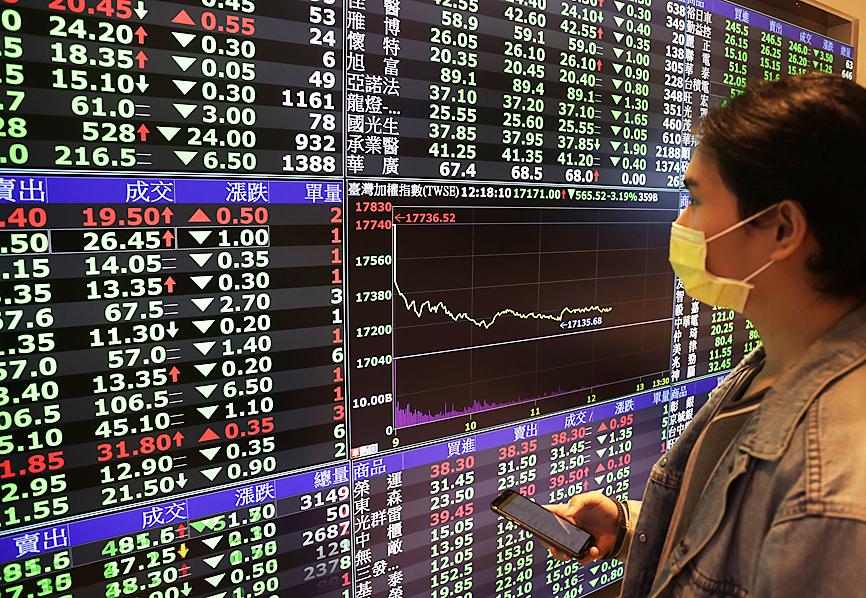
Photo: CNA
Turnover totaled NT$316.107 billion (US$11.117 billion), with foreign institutional investors selling a net NT$31.82 billion of shares after a net sell of NT$46.12 billion on Tuesday, Taiwan Stock Exchange data showed.
“Today’s gains were technical in nature, as there have been no signs that the war waged by Russia against Ukraine will end any time soon. Uncertainty over the ongoing geopolitical tensions continued to weigh on market sentiment,” Master Link Securities Corp (元富證券) analyst Tom Tang (湯忠謙) said.
US President Joe Biden announced overnight a ban on oil and gas imports from Russia, a move that sent international crude oil prices higher by 3.6 percent in the New York market and 3.9 percent in London.
“Political conflicts have led to economic consequences, as a spike in crude prices is pushing up the already high inflationary pressure worldwide, prompting many investors to expect the US Federal Reserve to speed up the pace in tightening its monetary policy,” Tang said.
“Fears over an economic impact made many investors reluctant to chase prices, so turnover remained moderate today, despite today’s gains in the TAIEX,” he said.
In the wake of a rebound staged by semiconductor stocks on the US market on Tuesday, the local semiconductor subindex closed up 1 percent, while the electronics index closed up 1.02 percent at 769.52, off a high of 800.99.
Contract chipmaker Taiwan Semiconductor Manufacturing Co (台積電) was one of the semiconductor heavyweights that saw its earlier gains eroded, closing up 0.89 percent at NT$568.
Among other large-cap semiconductor stocks, United Microelectronics Corp (聯電), a smaller contract chipmaker, gained 4.23 percent to close at NT$51.8, while smartphone IC designer MediaTek Inc (聯發科) underperformed the broader market, rising only 0.31 percent to close at NT$966.
Although Apple Inc unveiled the third-generation iPhone SE and the fifth-generation iPad Air overnight, “Apple concept stocks” in Taiwan appeared mixed. Smartphone camera lens supplier Largan Precision Co (大立光) fell 0.25 percent to close at NT$1,980, but rival Genius Electronic Optical Co (玉晶光) rose 1.32 percent to close at NT$421.5.
In addition, iPhone assembler Hon Hai Precision Industry Co (鴻海精密) closed unchanged at NT$101.5, while Wistron Corp (緯創), a smaller iPhone assembler, fell 0.52 percent to close at NT$28.8.
“While many foreign institutional investors have become very cautious amid global volatility, major local market players remain willing to pick up shipping and steel stocks,” Tang said.
Amid high hopes regarding their generous cash dividend payout policies, Evergreen Marine Corp (長榮海運) rose 6.12 percent to close at NT$156.00, while rivals Yang Ming Marine Transport Corp (陽明海運) rose 6.36 percent to close at NT$125.5 and Wan Hai Lines Ltd (萬海航運) rose 2.05 percent to close at NT$174.
Riding the waves of higher raw material prices, China Steel Corp (中鋼) rose 1.47 percent to close at NT$37.95, while Tung Ho Steel Enterprise Corp (東和鋼鐵) rose 2.17 percent to close at NT$70.7.
Skyrocketing crude prices boosted Formosa Plastics Corp (台塑) by 1.44 percent to close at NT$105.5, while Nan Ya Plastics Corp (南亞塑膠) rose 1.62 percent to close at NT$88.
“After a plunge in recent sessions, the TAIEX has entered a downtrend technically and today’s rebound is unlikely to change that trend,” Tang said. “As long as the global markets remain choppy, it is possible the local main board will remain under pressure, despite today’s rebound.”
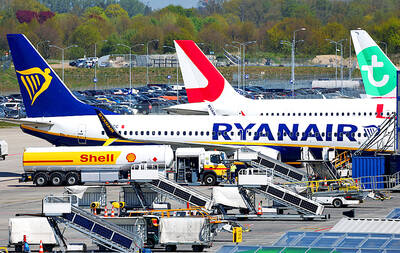
Ryanair, Transavia, Volotea and other low-cost airlines are feeling the financial pain from high jet fuel prices as a result of the Middle East war and are cutting flights. The closure of the Strait of Hormuz has taken a huge chunk of oil supplies off the market, sending the price of jet fuel soaring and triggering fears of shortages that could force airlines to cancel flights. Airlines are not waiting for a lack of supplies to react. “Travel alert: Airlines are cutting thousands of flights right now,” Travel Therapy host Karen Schaler said in an Instagram reel this past weekend.
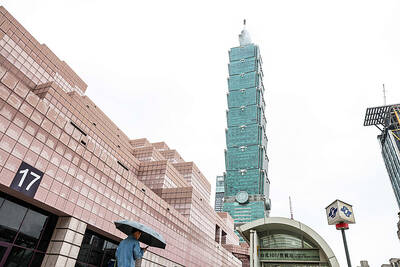
MANAGING RISKS: Taiwan has secured LNG sufficient to cover 95 percent of electricity demand for next month, UBS said, describing the government’s approach as proactive UBS Group AG has raised its forecast for Taiwan’s economic growth this year to 8 percent, up from 6.9 percent previously, and said expansion could reach as high as 8.6 percent if external energy shocks are avoided. The upgrade reflects a stronger-than-expected first-quarter performance and sustained momentum in artificial intelligence (AI)-driven exports, which UBS said are providing a firm foundation for growth despite geopolitical and energy risks. Taiwan’s GDP expanded 13.69 percent year-on-year in the first quarter, the fastest growth since the second quarter of 1987, the Directorate-General of Budget, Accounting and Statistics (DGBAS) reported on Thursday. On a seasonally

The Fair Trade Commission’s (FTC) ongoing review of Grab Holdings Ltd’s US$600 million acquisition of Foodpanda Taiwan’s operations, announced on March 23, has taken on fresh urgency as industry experts warn that the transaction could embed significant Chinese cybersecurity vulnerabilities into Taiwan’s digital infrastructure through Grab’s deep ties to autonomous-driving firm WeRide (文遠知行). Less than 16 months after the FTC blocked Uber Eats’ direct attempt to acquire Foodpanda Taiwan — citing potential combined market shares of 80 to 90 percent — the emergence of Grab as the buyer has prompted questions about whether the same competitive harm is simply being rerouted

The list of Asian stocks that benefit from business partnership with Nvidia Corp is getting longer, as the region further integrates into the artificial intelligence (AI) chip giant’s business ecosystem. Just in the past week, South Korea’s LG Electronics Inc, Taiwan’s Nanya Technology Corp (南亞科技), as well as China’s Huizhou Desay SV Automotive Co (德賽西威) and Pateo Connect Technology Shanghai Corp (博泰車聯) have become the latest to rally on news of tie-ups, supply-chain participation or product collaboration with the US chip designer. Asian suppliers account for about 90 percent of Nvidia’s production costs, up from about 65 percent last year, data compiled


 RSS
RSS