


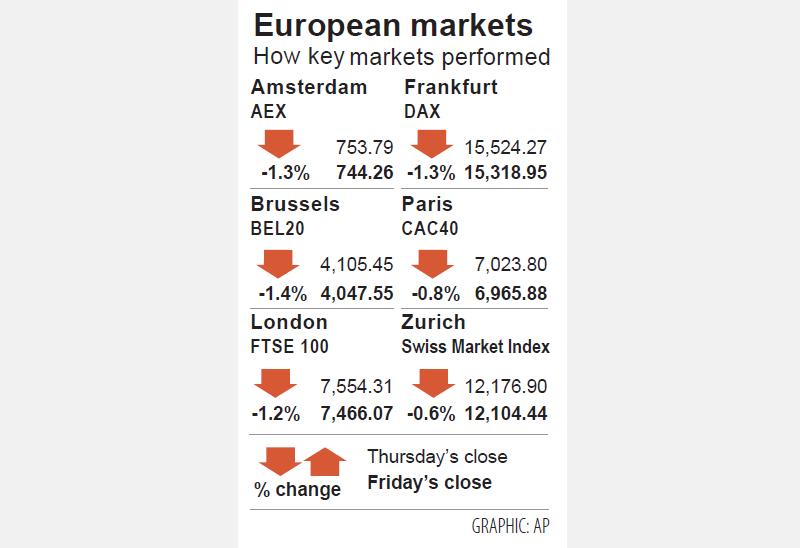
European shares fell on Friday, with the STOXX 600 index down for a fourth straight week as auto and technology stocks led declines amid the prospect of higher interest rates and concern over the situation in Russia and Ukraine.
The pan-European index shed 1.02 percent to 465.55, paring some losses after falling as much as 2 percent earlier in the day. The index lost 1.87 percent this week, marking its worst performance in more than two months.
Eurozone bond yields increased following the hawkish message that emerged from the US Federal Reserve policy meeting earlier this week.
“There’s a whole lot to make investors nervous at the moment, and today seems to be the day European markets are really waking up to what the Fed’s increasingly hawkish stance will mean for all that cash sloshing around,” AJ Bell financial analyst Danni Hewson said.
Russia on Friday sent its strongest signal so far that it is willing to engage with US security proposals and reiterated that it does not want war over Ukraine.
“As we’re approaching the weekend, a lot could happen in relation to the situation on the Ukrainian border and Russian troops,” Equiti Capital market analyst David Madden said.
“The fear is that stock markets are closed for a 48-hour period, and what happens as tensions get ratcheted up in that time frame is a huge deal,” Madden said.
The top sectoral decliner, technology, fell 1.7 percent, tracking its worst month since 2008.
Adding to the gloom, eurozone economic sentiment deteriorated this month, pulled down by a more downbeat sentiment in the industry and services sectors.
Meanwhile, France posted its strongest growth in more than five decades last year, hitting 7 percent, as the eurozone’s second-biggest economy bounced back from the COVID-19 crisis faster than expected, data showed.
However, the German economy, Europe’s largest, contracted more than expected in the fourth quarter of last year as COVID-19-related restrictions hampered activity.
British stocks weakened on Friday as investors locked in gains in bank shares.
The blue-chip FTSE 100 fell 1.17 percent to 7,466.07, with financials weighing the most after a run of strong gains. It declined 0.37 percent from a week earlier.
The banking sub-index rose more than 12 percent this month on support from higher yields, as investors expect lenders to benefit from rising interest rates this year.
“Looking at the way the FTSE 100 and the big banking names have performed year-to-date, this drop is potential profit taking ahead of the weekend and the Bank of England meeting due next week where expectations are for a 25 bps rate hike,” CMC Markets UK analyst Michael Hewson said.
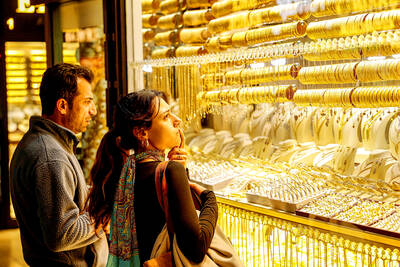
In Italy’s storied gold-making hubs, jewelers are reworking their designs to trim gold content as they race to blunt the effect of record prices and appeal to shoppers watching their budgets. Gold prices hit a record high on Thursday, surging near US$5,600 an ounce, more than double a year ago as geopolitical concerns and jitters over trade pushed investors toward the safe-haven asset. The rally is putting undue pressure on small artisans as they face mounting demands from customers, including international brands, to produce cheaper items, from signature pieces to wedding rings, according to interviews with four independent jewelers in Italy’s main

Macronix International Co (旺宏), the world’s biggest NOR flash memory supplier, yesterday said it would spend NT$22 billion (US$699.1 million) on capacity expansion this year to increase its production of mid-to-low-density memory chips as the world’s major memorychip suppliers are phasing out the market. The company said its planned capital expenditures are about 11 times higher than the NT$1.8 billion it spent on new facilities and equipment last year. A majority of this year’s outlay would be allocated to step up capacity of multi-level cell (MLC) NAND flash memory chips, which are used in embedded multimedia cards (eMMC), a managed

Japanese Prime Minister Sanae Takaichi has talked up the benefits of a weaker yen in a campaign speech, adopting a tone at odds with her finance ministry, which has refused to rule out any options to counter excessive foreign exchange volatility. Takaichi later softened her stance, saying she did not have a preference for the yen’s direction. “People say the weak yen is bad right now, but for export industries, it’s a major opportunity,” Takaichi said on Saturday at a rally for Liberal Democratic Party candidate Daishiro Yamagiwa in Kanagawa Prefecture ahead of a snap election on Sunday. “Whether it’s selling food or

In the wake of strong global demand for AI applications, Taiwan’s export-oriented economy accelerated with the composite index of economic indicators flashing the first “red” light in December for one year, indicating the economy is in booming mode, the National Development Council (NDC) said yesterday. Moreover, the index of leading indicators, which gauges the potential state of the economy over the next six months, also moved higher in December amid growing optimism over the outlook, the NDC said. In December, the index of economic indicators rose one point from a month earlier to 38, at the lower end of the “red” light.


 RSS
RSS