


Memorychip tester and packager Powertech Technology Inc (PTI, 力成科技) yesterday said that strict COVID-19 control measures are disrupting production at its plant in Xian, China, but the issues would have a limited effect on its revenue this month.
The company’s subsidiary Powertech Semiconductor (Xian) Co (西安力成半導體) provides DRAM chip testing and packaging services in Xian, as well as semiconductor backend manufacturing services, mostly to US firm Micron Technology Inc.
“Due to the COVID-19 pandemic status in Xian, the local government further tightened lockdown measures, which did not significantly impact the revenue of Powertech Semiconductor (Xian) at the beginning,” PTI said in a regulatory filing. “However, some employees could not go to work.”
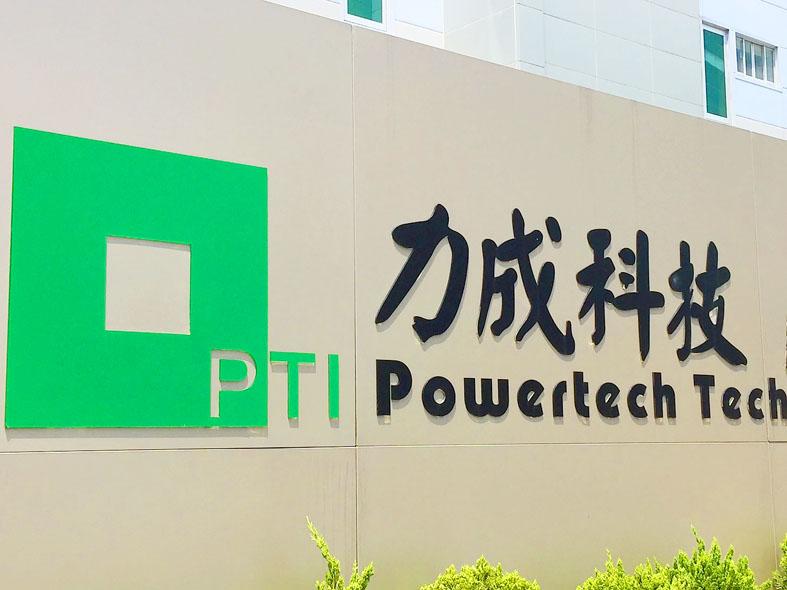
Photo: Grace Hung, Taipei Times
The plant is operating at 40 to 50 percent of capacity, it added.
The lockdown, which took effect on Thursday last week, would have limited effect on its consolidated revenue and profit in the near term, but longer-term effects depend on the subsequent action by the Xian City Government, PTI said.
The company is mitigating the situation by adjusting the semiconductor production schedule and has asked its main customer to adjust the delivery schedule according to the temporarily reduced output, it said.
PTI reported that consolidated revenue for the first 11 months of this year rose 9.27 percent annually to NT$76.47 billion (US$2.76 billion).
The Xian unit, launched in May 2015, reported NT$5.11 billion in revenue last year.
Micron said that the lockdown has reduced its team member and contractor workforce at the Xian site, affecting output levels at its DRAM assembly and test operations there.
“We are tapping our global supply chain, including our subcontractor partners, to help service our customers for these DRAM products. We project that these efforts will allow us to meet most of our customer demand. However, there may be some near-term delays as we activate our network,” Micron said in a statement on Wednesday. “New or more stringent restrictions impacting our operations in Xian may be increasingly difficult to mitigate.”
South Korea’s Samsung Electronics Co also faces disruptions at its Xian facilities, mainly to scheduling shifts, market researcher TrendForce Corp (集邦科技) said in a news release.
Samsung operates two NAND flash fabs in Xian, assembling consumer electronics such as universal flash storage and solid-state drives, TrendForce said.
As the company’s inventory levels are relatively high, it should be able to keep supplying these products to customers with no issues in the short term, the market researcher said.
However, TrendForce said that if the situation does not normalize within one or two weeks, short-term effects on Samsung’s production utilization rate might lead to a slight decline in output.
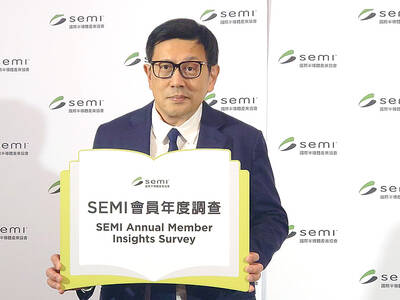
PRICE HIKES: The war in the Middle East would not significantly disrupt supply in the short term, but semiconductor companies are facing price surges for materials Taiwan’s semiconductor companies are not facing imminent supply disruptions of essential chemicals or raw materials due to the war in the Middle East, but surges in material costs loom large, industry association SEMI Taiwan said yesterday. The association’s comments came amid growing concerns that supplies of helium and other key raw materials used in semiconductor production could become a choke point after Qatar shut down its liquefied natural gas (LNG) production and helium output earlier this month due to the conflict. Qatar is the second-largest LNG supplier in the world and accounts for about 33 percent of global helium output. Helium is
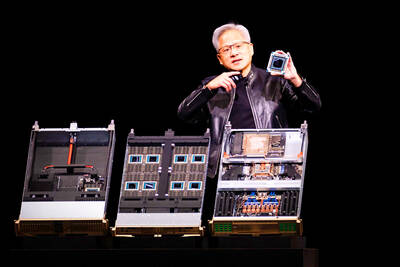
DOMESTIC COMPONENT: Huang identified several Taiwanese partners to be a key part of Nvidia’s Vera Rubin supply chain, including Asustek, Hon Hai and Wistron Nvidia Corp chief executive officer Jensen Huang (黃仁勳), addressing crowds at the company’s biggest annual event, unveiled a variety of new products while predicting that its flagship artificial intelligence (AI) processors would help generate US$1 trillion in sales through next year. During a two-and-a-half-hour keynote address, Huang announced plans to push deeper into central processing units (CPUs) — Intel Corp’s home turf — and introduced semiconductors made with technology acquired from start-up Groq Inc. The company even said it was developing chips for data centers in outer space. At the heart of Huang’s speech was the message that demand for computing power

OPTIMISTIC: Inflation still has a chance of remaining below the central bank’s 2 percent alert level, as Taiwan’s economy is resilient with healthy exports, the NDC minister said Taiwan’s inflation could exceed 2 percent this year if oil prices continue to surge amid escalating tensions in the Middle East, prompting the government to reassess its economic outlook, the Directorate-General of Budget, Accounting and Statistics (DGBAS) said yesterday. DGBAS Minister Chen Shu-tzu (陳淑姿) told lawmakers at a meeting of the legislature’s Finance Committee that the agency’s earlier growth forecast of 1.68 percent in the consumer price index (CPI) and 7.71 percent for GDP this year did not account for the ongoing Middle East conflict and would need revision, if tensions persist. The previous forecast assumed an average international crude price of

ELECTRIC DREAMS: Smart cities would use ‘virtual power plants,’ which integrate idle electricity use from households, businesses and factories, Asustek said Asustek Computer Inc (華碩) yesterday showcased key components of its artificial intelligence (AI)-driven smart city initiatives at a trade show in Taipei, eyeing new business opportunities as cities develop sovereign AI infrastructure. Advances in generative, multimodal and physical AI are driving cities toward a new phase of “sovereign AI,” Asustek cochief executive officer Samson Hu (胡書賓) told reporters on the sidelines of the Smart City Summit and Expo at Taipei Nangang Exhibition Center’s Hall 2. The company showcased its “AI City” framework, which comprises three layers — computing infrastructure centered on AI servers, AI models and a platform layer for data processing


 RSS
RSS