

Medigen Vaccine Biologics Corp (高端疫苗) yesterday said it would apply to the Australian Therapeutic Goods Administration (TGA) for provisional approval of its COVID-19 vaccine in the near term, after obtaining a provisional determination from the agency.
A provisional approval in Australia is similar to emergency use authorization in other countries, Medigen said in a statement.
Medigen would provide the regulator with all required data, including those from its phase 2 clinical trials conducted in Taiwan and from its clinical trials conducted in other countries, such as Paraguay, spokesperson Leo Lee (李思賢) told the Taipei Times.
Photo: Billy H.C. Kwok, Bloomberg
The TGA has provisionally approved the COVID-19 vaccines made by Moderna Inc, Pfizer Inc, Johnson & Johnson and AstraZeneca PLC. It has also given a provisional determination to Novavax Inc.
Medigen said it yesterday became the sixth firm to gain a provisional determination, after the agency granted a provisional determination to Grand Pacific CRO, the Australian sponsor acting on behalf of Medigen for its MVC-COV1901 vaccine.
The protein-based subunit vaccine would be considered for active immunization to prevent COVID-19 caused by SARS-CoV-2 in people aged 18 or older, the TGA said in a statement.
If the vaccine is approved, a complete course of MVC-COV1901 is likely to be two doses given as an injection four weeks apart, the TGA said.
Provisional determination is the first step in the provisional registration process and means that Grand Pacific CRO is eligible to apply for provisional registration, the agency said.
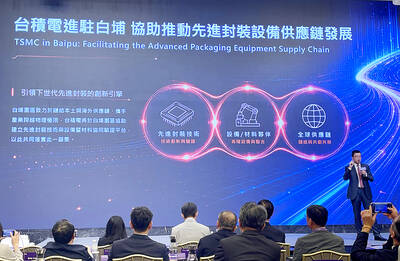
EXPANSION: The 3-hectare site would include small clean rooms and laboratories as well as a world-class training base for advanced packaging talent, the company said Taiwan Semiconductor Manufacturing Co (TSMC, 台積電) is to establish a presence in the Baipu Industrial Park (白埔產業園區) in Kaohsiung to accelerate the testing and validation of semiconductor materials and equipment, a company executive said on Tuesday. The company is working with the Ministry of Economic Affairs and the Kaohsiung City Government on the plan, which is expected to improve validation efficiency by 25 to 50 percent, TSMC vice president of advanced packaging technology and service Jun He (何軍) said at a 3D IC global summit held ahead of the Semicon Taiwan trade show, which opened in Taipei yesterday. TSMC would also conduct
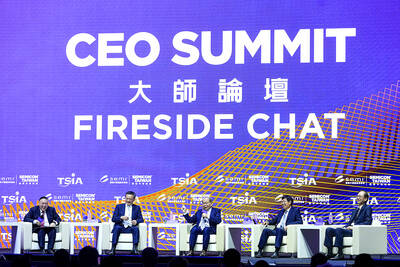
Taiwan Semiconductor Manufacturing Co (TSMC, 台積電) is accelerating capacity expansion fivefold this year, but it is still unable to keep up with the booming demand for artificial intelligence (AI), TSMC deputy cochief operating officer Cliff Hou (侯永清) said yesterday. This year alone, the company is building 25 chip manufacturing fabs and advanced packaging facilities worldwide, including 13 plants in Taiwan, which is unprecedented, Hou said at a CEO Summit fireside chat at Semicon Taiwan in Taipei. In the past, the company was able to build five or six factories a year, said Hou, who is also chairman of the Taiwan Semiconductor Industry
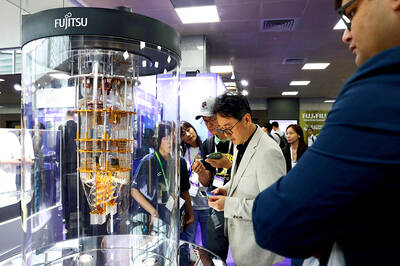
Visitors look at a 64-qubit superconducting quantum computer on display at the Fujitsu booth at the Semicon Taiwan trade show in Taipei yesterday.

Silicon photonics would play a dominant role next year and make chip-level co-packaged optics (CPO) packaging possible, Taiwan Semiconductor Manufacturing Co (TSMC, 台積電) said yesterday. “For years, critics questioned the reliability of CPO. The doubts are being thoroughly dismantled by real-world data and market validation,” TSMC vice president of advanced packaging technology development K.C. Hsu (徐國晉) said at a SEMI forum in Taipei. The company is on track to enter production of CPO later this year, Hsu said in another forum arranged by Imec in Taipei yesterday, about four months after TSMC announced its progress in CPO development in May.


 RSS
RSS