


US Secretary of the Treasury Janet Yellen on Monday spoke with French Minister of Finance Bruno Le Maire about the importance of working together toward a solution in the ongoing Organisation for Economic Co-operation and Development (OECD) discussions on international taxation, the US Department of the Treasury said in a statement.
During their conversation, Yellen emphasized US support for a strong economic recovery and explained US President Joe Biden’s administration’s broader plans to support jobs and investment in the US, the department said.
“The secretary also expressed support for measures to promote the global recovery through multilateral mechanisms and support for low-income countries,” it said.
Nearly 140 countries are racing to wrap up talks by the middle of this year to modernize outdated rules on how much governments can tax cross-border commerce and set a global minimum corporate tax rate.
The talks stalled last year following a proposal by the administration of then-US president Donald Trump to let companies out of new global tax rules, but Yellen has since dropped that demand.
Yellen had underscored her commitment to reaching a global agreement through the OECD, and would discuss the issue with her G20 counterparts when they meet virtually next week.
The US in January had already refrained from imposing threatened tariffs on US$1.3 billion in imports of French Champagne, cosmetics, handbags and other goods in retaliation for France’s digital tax, but said it could still impose them if the OECD talks did not result in a global solution.
US Trade Representative Katherine Tai (戴琪) last week said the same applied to US tariffs threatened against goods from Austria, India, Italy, Spain, Turkey and the UK in retaliation for their respective digital services taxes.
The Office of the US Trade Representative investigations into the taxes adopted by the six countries found that they discriminate against US technology companies and are inconsistent with international tax norms.
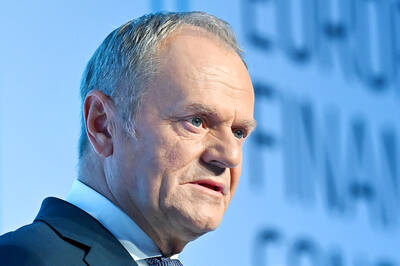
Poland is betting on a flood of investments and technology transfers from Taiwanese companies to reengineer its US$1 trillion economy. Polish Prime Minister Donald Tusk said yesterday that Poland will no longer be “just an assembly hub” as it pursues further investments from the likes of Foxconn Technology Group (富士康). The firm, whose full name is Hon Hai Precision Industry Co (鴻海精密), last month agreed to build electric vehicles (EVs) in the European Union nation and now could be a partner in a semiconductor venture, he said. The government’s aim is to boost manufacturing and the country’s high-tech chops in an era

Taiwan remained the sixth-largest net creditor nation in the world last year, despite a fall of more than 10 percent in its net international investment position (NIIP) over the year, the central bank said yesterday. The NIIP is the difference between a country’s external financial assets and its external financial liabilities. Taiwan’s external financial assets hit US$3.27 trillion at the end of last year, up US$275.75 billion or 9.2 percent from a year earlier, the central bank said in its annual NIIP report. The growth largely reflected an increase in holdings of overseas marketable securities by residents in Taiwan, as well as a
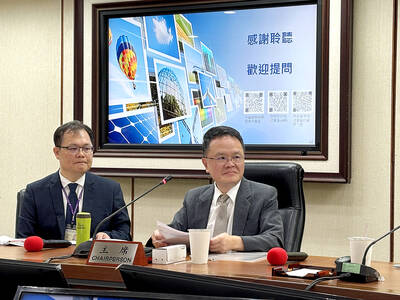
BAD FAITH LITIGATION? The two companies, owned by a California-based private equity firm, could be seeking licensing fees or a settlement payout with the suit Taiwan Intellectual Property Office (TIPO) Director-General Liao Cheng-wei (廖承威) said yesterday he suspected that two firms suing contract chipmaker Taiwan Semiconductor Manufacturing Co (TSMC, 台積電) for patent infringement are “patent trolls.” A patent troll refers to a company that buys patents not for manufacturing products, but to sue other companies for compensation, accusing them of using its patents. Patent trolls, formally called Non-Practicing Entities or Patent Assertion Entities, were responsible for more than 50 percent of lawsuits in the US last year, costing targeted businesses tens of billions of US dollars a year, according to the US-based LegalCharity Web site. Asked whether

RESTRICTION BREACH: ASML said that it denies ‘unfounded rumors regarding non-compliance with export controls concerning China,’ and enforces controls strictly US Secretary of Commerce Howard Lutnick in a series of recent meetings outlined concerns to Dutch chip-equipment giant ASML Holding NV’s senior leaders that one of its top-of-the-line machines might have made its way into China, in violation of US-led export restrictions. In the meetings, Lutnick expressed concern to ASML executives over the company’s extreme ultraviolet lithography (EUV) machines, people familiar with the talks said. EUV systems are used by firms such as Taiwan Semiconductor Manufacturing Co (台積電) to manufacture processors for the likes of Nvidia Corp and Apple Inc. ASML has never been allowed to ship them to China because of curbs


 RSS
RSS