


Fears of a Hong Kong brain drain are increasing after China moved to tax its citizens’ global income, undermining the territory’s appeal to thousands of bankers and other white-collar workers from the mainland.
Faced with a tax rate as high as 45 percent — up from about 15 percent previously — Chinese professionals across Hong Kong are considering moving back home to avoid getting squeezed by both the new levy and sky-high living costs in the territory, according to interviews with workers and recruiters.
The prospect of an exodus has upended expectations that mainland talent would help offset any outflow of locals and foreign expatriates from Hong Kong, many of whom are looking to escape the territory’s controversial new national security legislation.
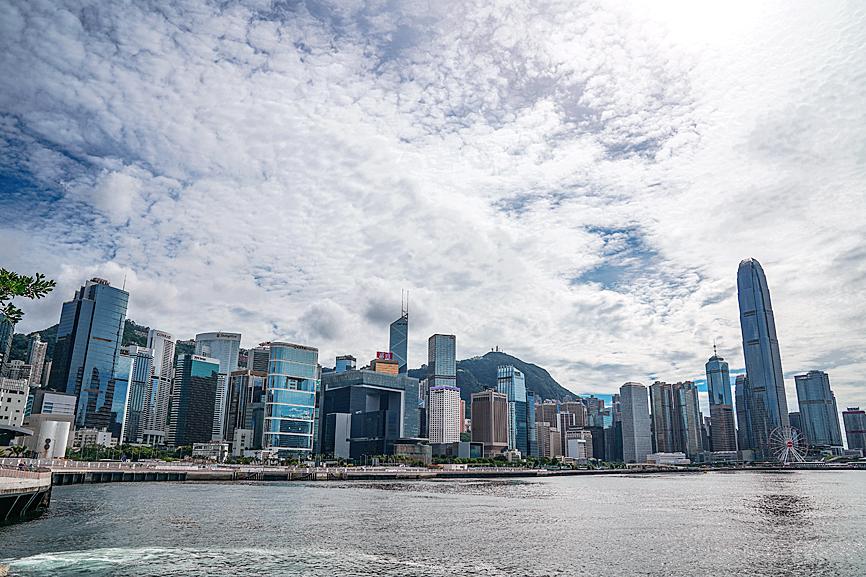
Photo: Bloomberg
While questions remain about how broadly Chinese authorities would apply the new tax rules in Hong Kong, professionals of all stripes now have reasons to leave a territory that not long ago was viewed as one of the world’s most attractive places to build a career. That risks weighing on Hong Kong’s battered economy and further undermining its status as a premier financial center.
The focus on Chinese taxes has intensified in the past few weeks after state-owned enterprises (SOEs) in Hong Kong told workers who transferred from the mainland to declare last year’s income so they can start paying taxes at home.
Chinese SOEs are also informing employees in other locations, such as Singapore, Bloomberg News reported last week.
While Chinese authorities revised the nation’s tax rules in January last year, they only recently disclosed detailed instructions on how to comply — a move that caught many workers off guard.
For now, it appears that only SOE employees who transferred from China have been explicitly instructed to pay taxes on last year’s income. It is unclear how Chinese authorities will apply the tax laws to citizens who were hired overseas or who do not work for state-owned companies.
China’s Liaison Office in Hong Kong and the State Taxation Administration did not respond to faxes seeking comment.
Some companies might act to soften the blow by boosting salaries, particularly for high-ranking executives, but most employees will likely have to absorb the hit to their take-home pay, according to Feng Ao (馮驁), president of Wosheng Law Quotient Academy (沃晟法商學院), a consultancy that advises China’s banks, insurers and trusts on tax laws.
“For the vast majority of employees, the chance of giving subsidies and raises depends on the company’s profitability,” Feng said. “It’s unlikely to happen given the global macro environment amid the pandemic.”
One senior executive at a Chinese state-owned bank said his tax bills will now probably wipe out the savings he amassed since moving his family to Hong Kong a few years ago.
His colleagues have petitioned superiors in Beijing for relief, but have so far failed to gain much traction.
Some are considering moving back to China or swapping their Chinese passport for a Hong Kong passport if they have lived in the territory long enough to qualify, said the banker, who, like several people interviewed for this story, asked not to be named discussing a sensitive subject.
Hong Kong has granted more than 340,000 immigration visas to people from mainland China over the past five years, government figures show.
Investment bankers in the territory typically earn about 25 percent to 30 percent more than those in Shanghai, according to recruiters, although much of that extra pay gets whittled away by higher living costs.
Hong Kong is the world’s sixth-most expensive city for expatriates, compared with 19th for Shanghai and 24th for Beijing, a survey by ECA International found.
Some Chinese workers might have little choice but to stick it out in Hong Kong, said Lee Quane (關禮廉), regional director for Asia at ECA, an advisory firm for expats.

Elon Musk’s lieutenants have reached out to chip industry suppliers, including Applied Materials Inc, Tokyo Electron Ltd and Lam Research Corp, for his envisioned Terafab, early steps in an audacious and likely arduous attempt to break into the production of cutting-edge chips. Staff working for the joint venture between Tesla Inc and Space Exploration Technologies Corp (SpaceX) have sought price quotes and delivery times for an array of chipmaking gear, people familiar with the matter said. In past weeks, they’ve contacted makers of photomasks, substrates, etchers, depositors, cleaning devices, testers and other tools, according to the people, who asked not to

Taiwan is attracting a growing number of foreign jobseekers as companies increasingly recruit overseas talent to ease labor shortages and expand global reach, recruitment platform 104 Job Bank (104人力銀行) said yesterday. More than 40,000 foreign nationals searched for jobs in Taiwan through the platform last year, a 28 percent increase from a year earlier, the company said. Malaysians accounted for the largest share of overseas jobseekers at 12.2 percent, followed by Indonesians at 11.9 percent and Vietnamese at 10.8 percent. Indonesian applicants surged more than 50 percent year-on-year, while Vietnamese jobseekers rose by more than 30 percent. Applicants from the
NO SHORTCUTS: Asked about Elon Musk’s Terafab initiative, TSMC CEO C.C. Wei said it takes two to three years to build a fab and another one to two to ramp it up Taiwan Semiconductor Manufacturing Co (TSMC, 台積電) yesterday raised its revenue growth forecast for this year to above 30 percent, up from the 25 percent it estimated three months earlier, citing extremely robust artificial intelligence (AI)-related chip demand. “Our customers and customers’ customers, who are mainly cloud service providers, continue to send us very positive signals and outlook,” TSMC chairman and CEO C.C. Wei (魏哲家) said at an earnings conference. The company also hiked its capital expenditure for this year toward the higher end of its forecast, or US$56 billion, as it aims to step up advanced chip capacity expansions, such as
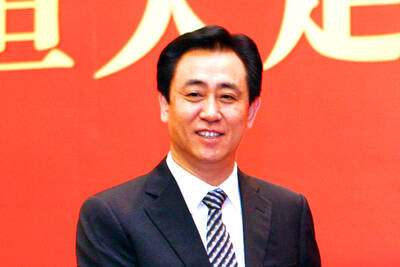
The founder of Chinese property giant Evergrande Group (恆大集團) has pleaded guilty to charges of fraud and bribery, a court said yesterday, the latest blow for what was once the country’s leading developer. Evergrande’s rise was propelled by decades of rapid urbanization and rising living standards, but in 2020, its access to credit dramatically narrowed when the government introduced curbs on excessive borrowing and speculation. The company defaulted in 2021 after struggling to repay creditors. Founder Xu Jiayin (許家印), 67, known as Hui Ka Yan in Cantonese, was reportedly held by police in 2023, with Evergrande saying he had been subjected to


 RSS
RSS