


ASE Technology Holding Co (ASE, 日月光投控), the world’s biggest chip tester and packager, yesterday stood firm on its forecast of annual revenue growth this year, as customers continue to show a strong appetite for its advanced technology.
Growth momentum is expected to continue from the first half of this year, when ASE’s revenue, net profit and equipment utilization all beat its expectations, it said.
In particular, the company received higher orders in the first quarter as its factories in Taiwan kept running following the nation’s quick response to the COVID-19 pandemic, it added.

Photo: Lisa Wang, Taipei Times
“We are firm about our forecast of annual growth in revenue this year,” ASE chief executive officer Tien Wu (吳田玉) told reporters on the sidelines of the company’s annual shareholders’ meeting in Kaohsiung.
Last year, ASE’s revenue rose 11.3 percent year-on-year to NT$413.2 billion (US$13.94 billion).
ASE’s low-end capacities are fully utilized and demand for high-end capacities exceeds what it can supply before September, Wu said.
The company used to provide a business guidance for upcoming quarters, but Wu yesterday declined to quantify the firm’s revenue growth guidance for this year, citing macroeconomic uncertainties, political tensions, the global COVID-19 situation and vaccine development.
“We have seen some dark clouds and uncertainty in the near term,” he said.
The company does not have a clear picture of its business outlook in the fourth quarter, Wu said.
Some capacities might become more available and production might have to be readjusted after September, he said.
However, ASE is positive about long-term prospects, as 5G technology, artificial intelligence (AI), smart manufacturing and electric vehicles are likely to drive semiconductor growth over the next few years, he said, adding that the company is prepared for the next boom in semiconductor demand.
The company last year increased equipment capital spending by US$400 million to US$1.6 billion, from US$1.2 billion in 2018, while its global peers scaled back capital spending by a combined US$700 million, Wu said.
ASE plans to spend the same amount on equipment this year, Wu said.
“We want to make that sure we are the survivor, and we want to maximize our market share after the pandemic ends,” he said.
To combat the pandemic, ASE said it aims to preserve as much cash as it can and has since March suspended the distribution of performance bonuses to about 200 top executives to cope with the fallout from the crisis, it added.
The company applied a similar measure for eight months in 2009 in response to the global financial crisis, it said.
Shareholders approved a plan to distribute a cash dividend of NT$2 per common share, which suggests a dividend yield of 2.94 percent based on ASE’s closing price yesterday of NT$68 in Taipei trading.
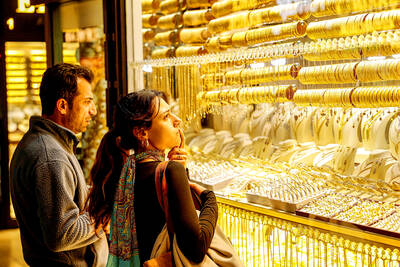
In Italy’s storied gold-making hubs, jewelers are reworking their designs to trim gold content as they race to blunt the effect of record prices and appeal to shoppers watching their budgets. Gold prices hit a record high on Thursday, surging near US$5,600 an ounce, more than double a year ago as geopolitical concerns and jitters over trade pushed investors toward the safe-haven asset. The rally is putting undue pressure on small artisans as they face mounting demands from customers, including international brands, to produce cheaper items, from signature pieces to wedding rings, according to interviews with four independent jewelers in Italy’s main

Japanese Prime Minister Sanae Takaichi has talked up the benefits of a weaker yen in a campaign speech, adopting a tone at odds with her finance ministry, which has refused to rule out any options to counter excessive foreign exchange volatility. Takaichi later softened her stance, saying she did not have a preference for the yen’s direction. “People say the weak yen is bad right now, but for export industries, it’s a major opportunity,” Takaichi said on Saturday at a rally for Liberal Democratic Party candidate Daishiro Yamagiwa in Kanagawa Prefecture ahead of a snap election on Sunday. “Whether it’s selling food or

CONCERNS: Tech companies investing in AI businesses that purchase their products have raised questions among investors that they are artificially propping up demand Nvidia Corp chief executive officer Jensen Huang (黃仁勳) on Saturday said that the company would be participating in OpenAI’s latest funding round, describing it as potentially “the largest investment we’ve ever made.” “We will invest a great deal of money,” Huang told reporters while visiting Taipei. “I believe in OpenAI. The work that they do is incredible. They’re one of the most consequential companies of our time.” Huang did not say exactly how much Nvidia might contribute, but described the investment as “huge.” “Let Sam announce how much he’s going to raise — it’s for him to decide,” Huang said, referring to OpenAI
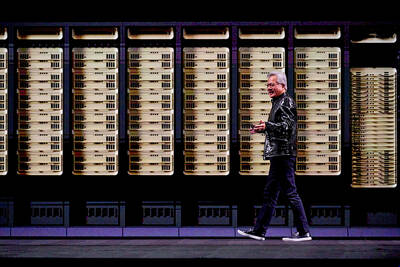
The global server market is expected to grow 12.8 percent annually this year, with artificial intelligence (AI) servers projected to account for 16.5 percent, driven by continued investment in AI infrastructure by major cloud service providers (CSPs), market researcher TrendForce Corp (集邦科技) said yesterday. Global AI server shipments this year are expected to increase 28 percent year-on-year to more than 2.7 million units, driven by sustained demand from CSPs and government sovereign cloud projects, TrendForce analyst Frank Kung (龔明德) told the Taipei Times. Demand for GPU-based AI servers, including Nvidia Corp’s GB and Vera Rubin rack systems, is expected to remain high,


 RSS
RSS