


The demise of the coal industry left the US’ Appalachian region in tatters, with lost jobs, spoiled water and countless kilometers of abandoned underground mines.
Now entrepreneurs are eyeing the rural region with ambitious visions to rebuild its economy by converting old mines into solar power systems and data centers that could help fuel the increasing power demands of the artificial intelligence (AI) boom.
One such project is underway by a non-profit team calling itself Energy DELTA (Discovery, Education, Learning and Technology Accelerator) Lab, which is looking to develop energy sources on about 26,305 hectares of old coal land in southwest Virginia.
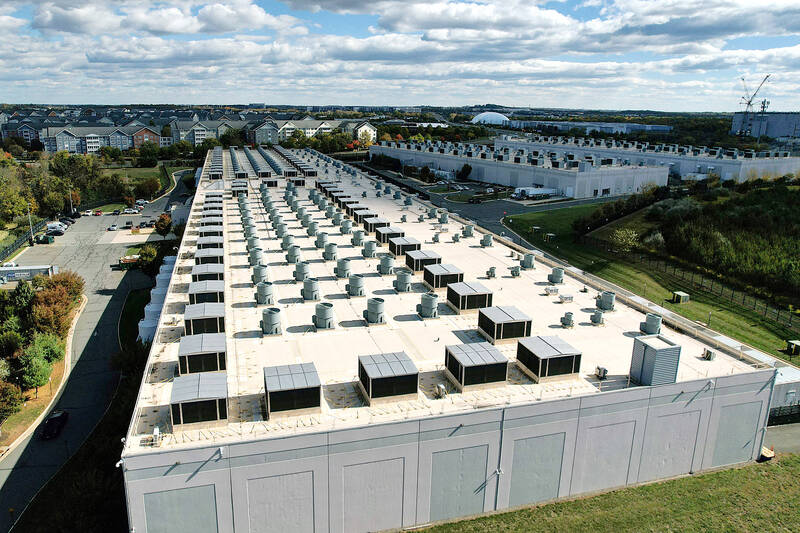
Photo: Reuters
Will Clear and Will Payne, who help manage Energy DELTA Lab, said they imagine building a massive 182 hectare data center ridge on top of old mining lands that could be powered and cooled using the billions of liters of water that naturally replenish below.
Unlike in some neighboring areas, there is no acid mine drainage, which deposits sulfuric acid and heavy metals from exposed mine rock faces, rendering water unusable, Payne said.
The difference has to do with geology, as the Wise County coal fields lack the mineral pyrite, a key culprit in acid mine drainage, he said.
“So, the water quality is there. Obviously, the cost to use, to circulate this water is low,” Payne said.
In support, a handful of localities, including Wise County, have a special tax rate on data center equipment and resolutions aimed at welcoming regional data center investments.
Payne said that their plan could meet with resistance in an area hard-hit by coal’s decline.
“Anyone looking at expanding in the region, there is skepticism, because there have been so many stories of promises made, but not kept,” Payne said at Squabble State Hard Cider & Spirits, a cider-making business he and Clear run near the state border with Tennessee.
Appalachia was once the heart of the nation’s coal industry, whose decline destroyed local communities.
Amid issues of cost, worker health and the fossil fuel’s contributions to global warming, coal has been dropping as a top source of US fuel for decades.
“If you go through coal mining communities, they’re ghost towns,” United Mine Workers of America director of communications Erin Bates said. “The number of bankruptcies that have happened in the last three decades have destroyed these communities.”
Financially, the data center ridge vision is ambitious. Constructing an average-sized data center facility can cost US$500 million to US$2 billion, Allianz SE said.
The entrepreneurs hope to prove the feasibility of their idea to Texas-based Energy Transfer, which owns the land in question. The land is managed by Penn Virginia Operating Co.
“They’re willing to think about the future, whereas others maybe just don’t have the time or don’t have the interest,” Payne said.
Energy Transfer did not respond to interview requests.
Other coal mine repurposing projects are seeing success, at least on a local scale.
The Mineral Gap Data Center, also in Wise County, came online in 2023 and touts itself as the first abandoned mine land to be converted to solar in the state.
In Martin County, Kentucky, a utility-scale solar project on an old mine site that powers about 18,000 homes, came online this month.
The Nature Conservancy, a nonprofit group, is a partner in a 10-megawatt solar project in Wise County built on the former Indian Creek Surface Mine. Start of construction is planned for next year.
The nonprofit is working on a broader conservation effort spanning more than 101,171 hectares in Virginia, Kentucky and Tennessee that could include additional solar development, said Brad Kreps, the Conservancy’s Clinch Valley Program director.
“Our projects are definitely among the first that are moving forward in central Appalachia,” Kreps said.
Building new data centers would need on-site renewable energy to be viable, said Jean Su of the Center for Biological Diversity, a nonprofit group.
However, Su questioned building data centers.
“That should be up to every single jurisdiction to have that type of public interest test to figure out whether it is actually serving their constituency or not — understanding environmental harms, water issues and drainage,” Su said.
Environmental groups criticize the expansion of data centers, which strain power grids and likely require significantly more energy than can be made available.
Some critics such as Bates say data centers might not bring the jobs the area desperately needs, but Payne maintains there would be work for local residents.
A typical data center can add up to 1,500 workers on-site during construction and employ about 50 full-time workers when up and running, a Virginia state report said last year.
Based on average spending by the industry from 2021 to 2023, overall the data center industry is estimated to contribute 74,000 jobs, US$5.5 billion in labor income and US$9.1 billion in GDP to Virginia’s economy each year — mostly in the construction phase, the report said.
Those estimates were just 1 percent more than total statewide employment, income and Virginia GDP for those years, it found.
Nationwide, the number of people working in data centers grew from 306,000 to 501,000 between 2016 and 2023, according to the US Bureau of Labor Statistics.
Meanwhile, US President Donald Trump’s administration is aiming to reverse the decline of coal use, largely to help fuel AI systems.
In October, the US Department of Energy announced it would make US$100 million available to refurbish and modernize coal-fired power plants.
The mining community would be pleased with almost any job-creating solution, Bates said.
“If a battery plant wants to open up, or any kind of plant wants to open up [in] those areas that’s going to help the areas thrive and not be so devastated as they currently are, we’re absolutely going to welcome it,” she added.

Netherlands-based semiconductor equipment supplier ASML Holding NV yesterday said that it is planning to hire an additional 1,000 people in Taiwan this year in response to growing demand from clients. ASML had previously planned to recruit 600 people this year, but that the plan has been adjusted upward, ASML vice president and ASML Taiwan general manager Grace Wang (汪佳慧) told reporters. ASML has a workforce of more than 4,500 in Taiwan, accounting for about 10 percent of its global total, Wang said. This year’s recruitment campaign would focus on adding people in the customer support, manufacturing and supply chain domains to assist ASML

UNDER MICROSCOPE: Taiwan detained three people who allegedly conspired to buy servers in Taiwan and export them using fraudulent documentation, prosecutors said Nvidia Corp chief executive officer Jensen Huang (黃仁勳) on Saturday urged Super Micro Computer Inc to tighten up on compliance after Taiwan detained three people this week for allegedly making fraudulent declarations about artificial intelligence (AI) servers made by its US partner. The development marked the nation’s first crackdown on semiconductor smuggling, which grew after the US slapped restrictions on exports of high-end chips such as Nvidia AI accelerators to China. Nvidia is “rigorous” in explaining regulations to all of its partners, Huang told reporters after arriving in Taipei. “Ultimately Super Micro has to run their own company,” he said in response to

Nvidia Corp yesterday announced that CEO Jensen Huang (黃仁勳) would attend an employee meeting in Taipei tomorrow to celebrate the launch of the company’s Taiwan headquarters project. Huang would attend a gathering at the site of Nvidia’s planned headquarters in Beitou Shilin Technology Park (北投士林科技園區), the company said in a statement. After arriving in Taiwan on Saturday last week, Huang told reporters that he plans to meet with Quanta Computer Inc (廣達) chairman Barry Lam (林百里) and Taiwan Semiconductor Manufacturing Co (TSMC, 台積電) chairman C.C. Wei (魏哲家), and would attend the groundbreaking ceremony for Nvidia’s Taiwan headquarters tomorrow. Nvidia has not yet applied

Starlux Airlines Co (星宇航空) today unveiled a long-haul network expansion plan at a shareholders’ meeting in Taipei, including direct flights to Barcelona, Spain, and Zurich, Switzerland, as well as a service connecting Taipei, Sydney and New Zealand. Starlux is to become the first Taiwanese carrier to offer non-stop services to the two European cities, while the inaugural oceanic route is expected to expand transit opportunities within the Australia-New Zealand market, Starlux said. Flight services to Chicago, Dallas, Washington and New York are under evaluation, the airline added. Prior to the shareholders’ meeting, the airline earlier this year announced that it would be


 RSS
RSS