


Japanese Prime Minister Sanae Takaichi has talked up the benefits of a weaker yen in a campaign speech, adopting a tone at odds with her finance ministry, which has refused to rule out any options to counter excessive foreign exchange volatility.
Takaichi later softened her stance, saying she did not have a preference for the yen’s direction.
“People say the weak yen is bad right now, but for export industries, it’s a major opportunity,” Takaichi said on Saturday at a rally for Liberal Democratic Party candidate Daishiro Yamagiwa in Kanagawa Prefecture ahead of a snap election on Sunday.
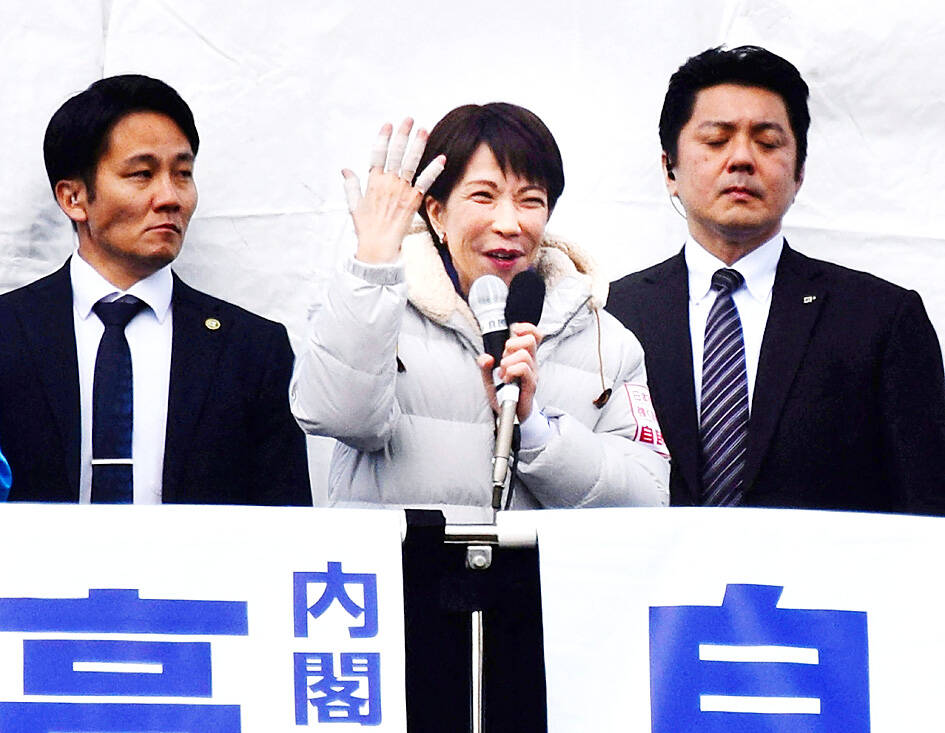
Photo: Jiji Press via AFP
“Whether it’s selling food or automobiles, even though there were US tariffs, the weaker yen has served as a buffer. That has helped us tremendously,” she said.
Takaichi also expressed a desire to build an economic structure resilient to currency fluctuation by boosting domestic investment.
The yen has hovered at 18-month lows against the US dollar, contributing to inflation that has raised the prospect of interest rate hikes by the central bank.
Japanese Minister of Finance Satsuki Katayama has repeatedly said her ministry would take action to support the currency when necessary, which analysts and traders have widely interpreted as market intervention.
Takaichi yesterday wrote on X that she did not favor a specific yen direction.
“I did not say which is better or worse — a strong yen or a weak yen,” Takaichi said.
The government is monitoring financial markets and, as prime minister, she would refrain from commenting specifically on the matter, she added.
“My intention was solely to state that we aim to build an economic structure that is resilient to exchange-rate fluctuation, and not, as some reports have suggested, to emphasize the benefits of a weak yen,” she said.
“That said, a rapid yen appreciation in the past led to hollowing out of the domestic industry, which became a serious issue,” she said.
While the weak yen can lead to higher import prices, impacting people’s lives and businesses, it can also boost domestic investments, exports and overseas income, Takaichi said.
Former prime minister and finance minister Yoshihiko Noda, who coheads the largest — and newly created — opposition party, the Centrist Reform Alliance, said a weak yen hurts households, the Nikkei reported yesterday.
“No one feels pleased while looking at their household budget amid an excessive weakening of the yen,” the newspaper quoted Noda as saying. “The perspective of ordinary people is missing, which has made me concerned once again.”
The yen spiked after reports that the New York Federal Reserve had joined the Japanese authorities in asking banks about exchange rates for yen purchases — queries that market participants often interpret as readiness to intervene.
The yen’s protracted decline and a recent surge in Japanese government bond yields to record highs reflect investor concern about Japan’s strained finances.
However, Takaichi told Saturday’s rally that the nation’s Foreign Exchange Fund Special Account — established by the government for use in cases including currency intervention — has also benefited from the weak yen.
The account balance was at about ¥187 trillion (US$1.21 trillion) as of March last year, Japanese Ministry of Finance data showed.
Additional reporting by Bloomberg

Netherlands-based semiconductor equipment supplier ASML Holding NV yesterday said that it is planning to hire an additional 1,000 people in Taiwan this year in response to growing demand from clients. ASML had previously planned to recruit 600 people this year, but that the plan has been adjusted upward, ASML vice president and ASML Taiwan general manager Grace Wang (汪佳慧) told reporters. ASML has a workforce of more than 4,500 in Taiwan, accounting for about 10 percent of its global total, Wang said. This year’s recruitment campaign would focus on adding people in the customer support, manufacturing and supply chain domains to assist ASML

UNDER MICROSCOPE: Taiwan detained three people who allegedly conspired to buy servers in Taiwan and export them using fraudulent documentation, prosecutors said Nvidia Corp chief executive officer Jensen Huang (黃仁勳) on Saturday urged Super Micro Computer Inc to tighten up on compliance after Taiwan detained three people this week for allegedly making fraudulent declarations about artificial intelligence (AI) servers made by its US partner. The development marked the nation’s first crackdown on semiconductor smuggling, which grew after the US slapped restrictions on exports of high-end chips such as Nvidia AI accelerators to China. Nvidia is “rigorous” in explaining regulations to all of its partners, Huang told reporters after arriving in Taipei. “Ultimately Super Micro has to run their own company,” he said in response to

Nvidia Corp yesterday announced that CEO Jensen Huang (黃仁勳) would attend an employee meeting in Taipei tomorrow to celebrate the launch of the company’s Taiwan headquarters project. Huang would attend a gathering at the site of Nvidia’s planned headquarters in Beitou Shilin Technology Park (北投士林科技園區), the company said in a statement. After arriving in Taiwan on Saturday last week, Huang told reporters that he plans to meet with Quanta Computer Inc (廣達) chairman Barry Lam (林百里) and Taiwan Semiconductor Manufacturing Co (TSMC, 台積電) chairman C.C. Wei (魏哲家), and would attend the groundbreaking ceremony for Nvidia’s Taiwan headquarters tomorrow. Nvidia has not yet applied

Huawei Technologies Co (華為) said it has come up with a new pathway to shorten its gap with industry leader Taiwan Semiconductor Manufacturing Co (TSMC, 台積電), potentially achieving a breakthrough in making advanced semiconductors without cutting-edge equipment. Right now there is about a five-year gap between what TSMC is capable of and what Huawei, together with its manufacturing partner Semiconductor Manufacturing International Corp (中芯), can produce. Huawei is to start making 1.4-nanometer chips by 2031 with its own “LogicFolding” technology, Huawei semiconductor chief He Tingbo (何庭波) said in a rare public appearance during a chip conference yesterday, while TSMC has


 RSS
RSS