


Netflix on Friday faced fierce criticism over its blockbuster deal to acquire Warner Bros Discovery.
The streaming giant is already viewed as a pariah in some Hollywood circles, largely due to its reluctance to release content in theaters and its disruption of traditional industry practices.
As Netflix emerged as the likely winning bidder for Warner Bros — the studio behind Casablanca, the Harry Potter movies and Friends — Hollywood’s elite launched an aggressive campaign against the acquisition. Titanic director James Cameron called the buyout a “disaster,” while a group of prominent producers are lobbying US Congress to oppose the deal, trade magazine Variety said.
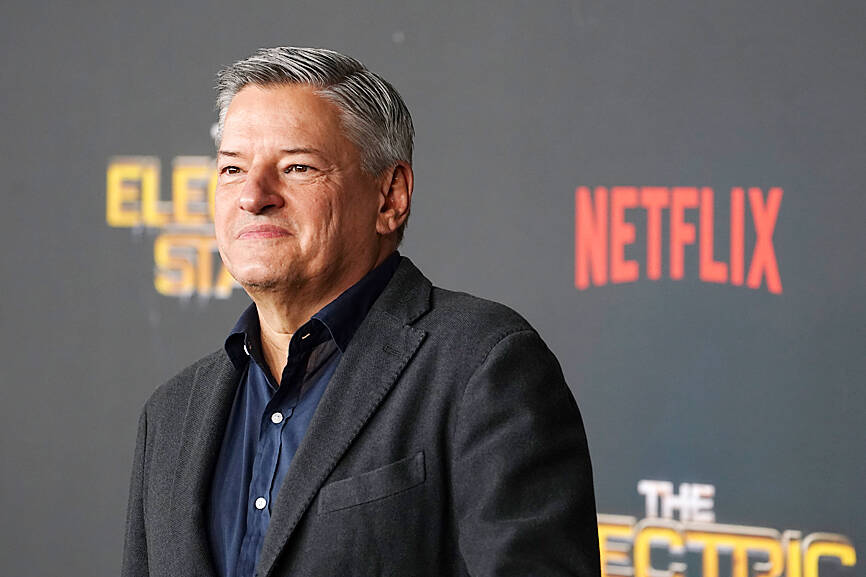
Photo: AP
In a letter to US lawmakers, the anonymous filmmakers said that Netflix would “effectively hold a noose around the theatrical marketplace,” further damaging a Hollywood ecosystem already strained by audiences’ shift from theaters and TV to streaming.
“I could not think of a more effective way to reduce competition in Hollywood than selling WBD to Netflix,” former Warner Bros CEO Jason Kilar wrote on X.
At the center of Hollywood’s ire is Netflix co-CEO Ted Sarandos, who has declared that the era of moviegoers flocking to theaters is over. During an analyst call on Friday, Sarandos acknowledged surprise over the acquisition, but pledged to maintain Warner Bros’ theatrical releases and preserve the HBO Max brand.
Many industry veterans consider theatrical releases essential to cinema’s appeal and prestige — a stark contrast to streaming content consumed on home sofas or on mobile devices.
Variety captured the industry’s alarm with a front-page headline asking: “Is Netflix Trying to Buy Warner Bros or Kill It?”
Michael O’Leary, CEO of Cinema United, the world’s largest exhibition trade association, said: “Netflix’s success is television, not movies on the big screen. Theaters will close, communities will suffer, jobs will be lost.”
The backlash extended beyond Hollywood. Netflix shares plunged more than 3 percent following the announcement, while The Information, influential among tech industry readers, branded the deal an “US$82.7 Billion Blunder” by a management team that “has rarely put a foot wrong.”
Antitrust concerns loom large, with Netflix poised to control an even greater share of an entertainment industry it already dominates.
Bipartisan opposition has emerged in Washington. US Senator Elizabeth Warren, a Democrat, said the deal “could force you into higher prices, fewer choices over what and how you watch, and may put American workers at risk.”
Before the deal was announced, Republican US Senator Mike Lee said Netflix’s acquisition of Warner Bros Discovery’s streaming assets “should send alarms to antitrust enforcers around the world.”
The deal’s biggest loser could be Warner Bros competitor Paramount Skydance Corp, the Hollywood studio owned by Larry Ellison, one of the world’s richest people and a close ally of US President Donald Trump. Ellison’s son David runs Paramount and might lobby the White House directly to block the Netflix-Warner Bros merger.
Unlike Netflix’s targeted acquisition, Paramount had sought to buy Warner Bros in its entirety, including cable networks CNN, TNT and TBS, which are being spun off separately.
In a letter to Warner’s board on Thursday, presumably after it surmised the game was lost, Paramount accused Warner Bros Discovery of running an unfair process that favored Netflix.

Netherlands-based semiconductor equipment supplier ASML Holding NV yesterday said that it is planning to hire an additional 1,000 people in Taiwan this year in response to growing demand from clients. ASML had previously planned to recruit 600 people this year, but that the plan has been adjusted upward, ASML vice president and ASML Taiwan general manager Grace Wang (汪佳慧) told reporters. ASML has a workforce of more than 4,500 in Taiwan, accounting for about 10 percent of its global total, Wang said. This year’s recruitment campaign would focus on adding people in the customer support, manufacturing and supply chain domains to assist ASML

UNDER MICROSCOPE: Taiwan detained three people who allegedly conspired to buy servers in Taiwan and export them using fraudulent documentation, prosecutors said Nvidia Corp chief executive officer Jensen Huang (黃仁勳) on Saturday urged Super Micro Computer Inc to tighten up on compliance after Taiwan detained three people this week for allegedly making fraudulent declarations about artificial intelligence (AI) servers made by its US partner. The development marked the nation’s first crackdown on semiconductor smuggling, which grew after the US slapped restrictions on exports of high-end chips such as Nvidia AI accelerators to China. Nvidia is “rigorous” in explaining regulations to all of its partners, Huang told reporters after arriving in Taipei. “Ultimately Super Micro has to run their own company,” he said in response to

Nvidia Corp yesterday announced that CEO Jensen Huang (黃仁勳) would attend an employee meeting in Taipei tomorrow to celebrate the launch of the company’s Taiwan headquarters project. Huang would attend a gathering at the site of Nvidia’s planned headquarters in Beitou Shilin Technology Park (北投士林科技園區), the company said in a statement. After arriving in Taiwan on Saturday last week, Huang told reporters that he plans to meet with Quanta Computer Inc (廣達) chairman Barry Lam (林百里) and Taiwan Semiconductor Manufacturing Co (TSMC, 台積電) chairman C.C. Wei (魏哲家), and would attend the groundbreaking ceremony for Nvidia’s Taiwan headquarters tomorrow. Nvidia has not yet applied

Huawei Technologies Co (華為) said it has come up with a new pathway to shorten its gap with industry leader Taiwan Semiconductor Manufacturing Co (TSMC, 台積電), potentially achieving a breakthrough in making advanced semiconductors without cutting-edge equipment. Right now there is about a five-year gap between what TSMC is capable of and what Huawei, together with its manufacturing partner Semiconductor Manufacturing International Corp (中芯), can produce. Huawei is to start making 1.4-nanometer chips by 2031 with its own “LogicFolding” technology, Huawei semiconductor chief He Tingbo (何庭波) said in a rare public appearance during a chip conference yesterday, while TSMC has


 RSS
RSS