


Trumpf SE + Co KG, a global leader in supplying laser technology and plasma generators used in chip production, is expanding its investments in Taiwan in an effort to deeply integrate into the global semiconductor supply chain in the pursuit of growth.
The company, headquartered in Ditzingen, Germany, has invested significantly in a newly inaugurated regional technical center for plasma generators in Taoyuan, its latest expansion in Taiwan after being engaged in various industries for more than 25 years.
The center, the first of its kind Trumpf built outside Germany, aims to serve customers from Taiwan, Japan, Southeast Asia and South Korea, the company said.
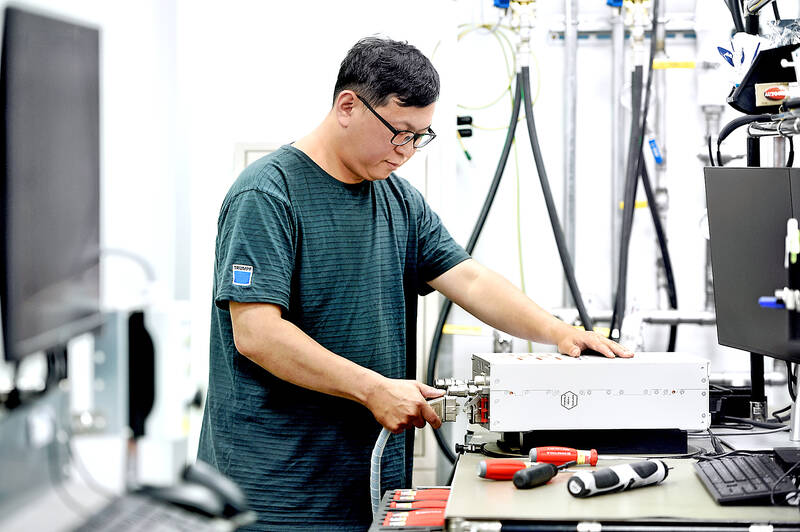
Photo courtesy of Trumpf Taiwan Industries Co
It is equipped with infrastructure dedicated to the analysis, service and calibration of Trumpf’s plasma generators, it said. Prior to the launch of the center, the service and renewal of plasma generators mostly took place in Trumpf’s Germany headquarters.
“This was a starting point for our further development in this [semiconductor] industry... Our intention is also to extend this in upcoming years, not only one year,” Trumpf Taiwan Industries Co (台灣創浦) managing director Patrick Kemnitz said in an exclusive interview with the Taipei Times on Monday last week.
“So, we will follow our local-for-local strategy again. Based on this, we can say further extension of our services which we can provide locally to our customers,” Kemnitz said, adding that Trumpf has been diversifying and localizing its supply chains to enhance resilience since the COVID-19 pandemic, and that the approach helped it counteract geopolitical risks.
As the company is ramping up its plasma generator business in Taiwan, the number of local employees is expected to rise to about 170 by the end of this year, compared with 160 currently, Kemnitz said.
Trumpf operates five sites in Taiwan, and develops its businesses in alignment with industrial megatrends and customer demand, he added.
On top of the machine tools and industrial lasers, semiconductors have become a new growth pillar for Trumpf over the past 10 years.
The company generated about 1 billion euros (US$1.16 billion) from the semiconductor sector, which made up about 23 percent of the company’s total revenue of 4.3 billion euros during the fiscal year between July 1, 2024, and June 30 last year, its annual report showed.
Trumpf has been developing different applications in the semiconductor supply chain from plasma generators, which is a core component for semiconductor production equipment, Kemnitz said.
The company, established more than 100 years ago, also supplies carbon dioxide lasers for extreme ultraviolet (EUV) lithography systems for ASML Holding NV, he said.
Trumpf is the sole laser source supplier to ASML. It uses Trumpf’s carbon dioxide laser to hit tin droplets to generate a plasma, which then generates EUV that is captured and brought to the scanner.
To expand its local ecosystem, Trumpf in 2023 set up an EUV training center in Tainan, one year after Taiwan Semiconductor Manufacturing Co (TSMC, 台積電) started volume production of 3-nanometer chips at its Fab 18 in Tainan using ASML’s EUV tools.
TSMC’s 2-nanometer chips entered volume production at its Fab 22 in the fourth quarter of last year.
The chipmaker’s 3-nanometer and 2-nanometer technology are used by Nvidia Corp and Advanced Micro Devices Inc for their artificial intelligence (AI) chips.
Trumpf also supplies laser cutting machines, bending machines, punching machines and laser welding machines, Kemnitz said.
These machines are used to manufacture equipment for fabs, from major chipmakers and original equipment manufacturing service providers — such as TSMC — to data centers, Kemnitz added.
As most of the infrastructure is made of sheet metal, the semiconductor became a very important industry for Trumpf’s overall businesses, he said.
While analysts and investors are debating whether the AI industry is overheating and heading for a crash, Kemnitz said he believed AI would continue to be a growing field this year, given its fast paced technology development.
“I would say this [AI] trend will continue because if you can see the speed and the pace AI is developing, I think there are still many steps possible,” Kemnitz said.
AI applications would continue driving the overall semiconductor industry this year and Trumpf’s semiconductor business would grow along with the industry, he added.
The global semiconductor market is expected to expand at least 11 percent annually to US$890 billion this year, as significant AI infrastructure investments continue to drive demand for AI accelerators, power management chips and other chips for AI devices, International Data Corp forecast.
World Semiconductor Trade Statistics was more optimistic, projecting the industry to grow more than 25 percent this year to reach US$975 billion, with growth across all regions and product categories.

SECOND-RATE: Models distilled from US products do not perform the same as the original and undo measures that ensure the systems are neutral, the US’ cable said The US Department of State has ordered a global push to bring attention to what it said are widespread efforts by Chinese companies, including artificial intelligence (AI) start-up DeepSeek (深度求索), to steal intellectual property from US AI labs, according to a diplomatic cable. The cable, dated Friday and sent to diplomatic and consular posts around the world, instructs diplomatic staff to speak to their foreign counterparts about “concerns over adversaries’ extraction and distillation of US AI models.” Distillation is the process of training smaller AI models using output from larger, more expensive ones to lower the costs of training a powerful new

Singapore-based ride-hailing and delivery giant Grab Holdings’ planned acquisition of Foodpanda’s Taiwan operations has yet to enter the formal review stage, as regulators await supplementary documents, the Fair Trade Commission (FTC) said yesterday. Acting FTC Chairman Chen Chih-min (陳志民) told the legislature’s Economics Committee that although Grab submitted its application on March 27, the case has not been officially accepted because required materials remain incomplete. Once the filing is finalized, the FTC would launch a formal probe into the deal, focusing on issues such as cross-shareholding and potential restrictions on market competition, Chen told lawmakers. Grab last month announced that it would acquire
Shares of Taiwan Semiconductor Manufacturing Co (TSMC, 台積電) have repeatedly hit new highs, but an equity analyst said the stock’s valuation remains within a reasonable range and any pullback would likely be technical. The contract chipmaker’s historical price-to-earnings (P/E) ratio has ranged between 20 and 30, Cathay Futures Consultant Co (國泰證期) analyst Tsai Ming-han (蔡明翰) told Central News Agency. With market consensus projecting that TSMC would post earnings per share of about NT$100 (US$3.17) this year, supported by strong global demand for artificial intelligence (AI) applications, and the stock currently trading at a P/E ratio of below 25, Tsai said the valuation
The artificial intelligence (AI) boom has triggered a seismic reshuffling of global equity markets, with Taiwan and South Korea muscling past European nations one by one. With its stock market now valued at nearly US$4.3 trillion, Taiwan surpassed the UK, Europe’s biggest market, earlier this month, data compiled by Bloomberg showed. South Korea is about US$140 billion away from doing the same. The tech-heavy Asian markets have shot past Germany and France in the past seven months. The shift is largely down to massive gains in shares of three companies that provide essential hardware for AI: Taiwan Semiconductor Manufacturing Co (TSMC, 台積電),


 RSS
RSS