


Center Laboratories Inc (晟德大藥廠) yesterday said that it plans to “unblind” the data from the phase II clinical trial of its diabetes drug candidate CS02 in the second half of this year, after completing the “last patient’s last visit” late last month.
“Last patient’s last visit” is considered a milestone and the final step toward completion of a clinical trial.
The firm would collect and unblind the data to see if the experimental drug is safe and effective, general manager Robert Hsu (許瑞寶) told the Taipei Times by telephone.
The double-blind and placebo-controlled phase II clinical test randomized 185 patients into four groups that received a single dose of placebo or CS02 in dosages of 150mg, 300mg or 450mg, and then evaluated them over a 12-week period, Hsu said.
“We wanted to see which dosage would be optimal. As CS02 is developed to restore impaired beta-cells in pancreatic islets that synthesize and secrete insulin, we do not think higher doses would necessarily have a better effect,” Hsu said.
All of the enrolled patients were type 2 diabetes patients for whom the first-line treatment metformin proved ineffective, he said.
Center Laboratories aims to market CS02 as a second-line treatment for people with type 2 diabetes, Hsu said.
The company would see whether the enrolled patients’ glycosylated hemoglobin level, which reflects the average blood glucose level over the past three months, decreased after taking CS02 and check their beta-cell activity to determine whether the drug works, Hsu said.
“We would focus on the two gauges for the time being, given that global regulators have not set official gauges for the assessment of type 2 diabetes patients,” he said.
If approved for marketing, CS02 would be taken daily in the initial stage, but patients could gradually reduce the dosage and eventually stop taking the drug as their beta-cells would be restored, Hsu said.
After unblinding the data, the firm would apply to hold meetings with regulators in Taiwan and the US to review the results, and discuss the protocols for a phase III trial if the results are good, he added.
Center Laboratories would look for partners in the US and China to help conduct phase III trials there to alleviate its financial burden, but plans to conduct the final tests in Taiwan by itself, Hsu said.
The firm’s revenue dropped 14.81 percent to NT$307 million (US$10.27 million) in the first three months of this year, as the sales of some antiviral drugs fell due to fewer people catching the flu during the period, Hsu said, adding that Taiwanese paid more attention to their health amid the COVID-19 pandemic.
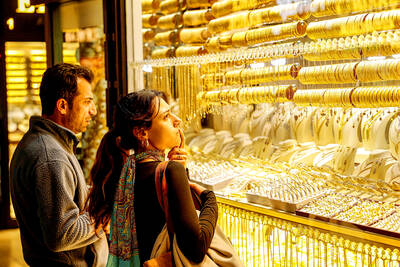
In Italy’s storied gold-making hubs, jewelers are reworking their designs to trim gold content as they race to blunt the effect of record prices and appeal to shoppers watching their budgets. Gold prices hit a record high on Thursday, surging near US$5,600 an ounce, more than double a year ago as geopolitical concerns and jitters over trade pushed investors toward the safe-haven asset. The rally is putting undue pressure on small artisans as they face mounting demands from customers, including international brands, to produce cheaper items, from signature pieces to wedding rings, according to interviews with four independent jewelers in Italy’s main

Japanese Prime Minister Sanae Takaichi has talked up the benefits of a weaker yen in a campaign speech, adopting a tone at odds with her finance ministry, which has refused to rule out any options to counter excessive foreign exchange volatility. Takaichi later softened her stance, saying she did not have a preference for the yen’s direction. “People say the weak yen is bad right now, but for export industries, it’s a major opportunity,” Takaichi said on Saturday at a rally for Liberal Democratic Party candidate Daishiro Yamagiwa in Kanagawa Prefecture ahead of a snap election on Sunday. “Whether it’s selling food or

CONCERNS: Tech companies investing in AI businesses that purchase their products have raised questions among investors that they are artificially propping up demand Nvidia Corp chief executive officer Jensen Huang (黃仁勳) on Saturday said that the company would be participating in OpenAI’s latest funding round, describing it as potentially “the largest investment we’ve ever made.” “We will invest a great deal of money,” Huang told reporters while visiting Taipei. “I believe in OpenAI. The work that they do is incredible. They’re one of the most consequential companies of our time.” Huang did not say exactly how much Nvidia might contribute, but described the investment as “huge.” “Let Sam announce how much he’s going to raise — it’s for him to decide,” Huang said, referring to OpenAI
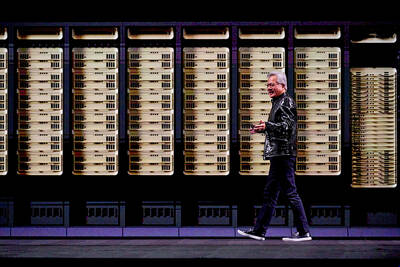
The global server market is expected to grow 12.8 percent annually this year, with artificial intelligence (AI) servers projected to account for 16.5 percent, driven by continued investment in AI infrastructure by major cloud service providers (CSPs), market researcher TrendForce Corp (集邦科技) said yesterday. Global AI server shipments this year are expected to increase 28 percent year-on-year to more than 2.7 million units, driven by sustained demand from CSPs and government sovereign cloud projects, TrendForce analyst Frank Kung (龔明德) told the Taipei Times. Demand for GPU-based AI servers, including Nvidia Corp’s GB and Vera Rubin rack systems, is expected to remain high,


 RSS
RSS