


Cashbox Partyworld Co Ltd (錢櫃) representatives yesterday bowed at a news conference to offer their apologies to the public for a deadly fire that broke out at one of the popular karaoke chain’s outlets in Taipei on Sunday.
The company has suspended its business operations in Taiwan for one week to improve fire and building safety at its outlets, Cashbox chief executive officer Lien Fu-tsai (連福財) said.
Cashbox operates 17 KTV outlets in Taiwan. Prior to yesterday’s announcement, six of them had already been ordered to suspend operations for three days after failing safety inspections by local governments on Monday.
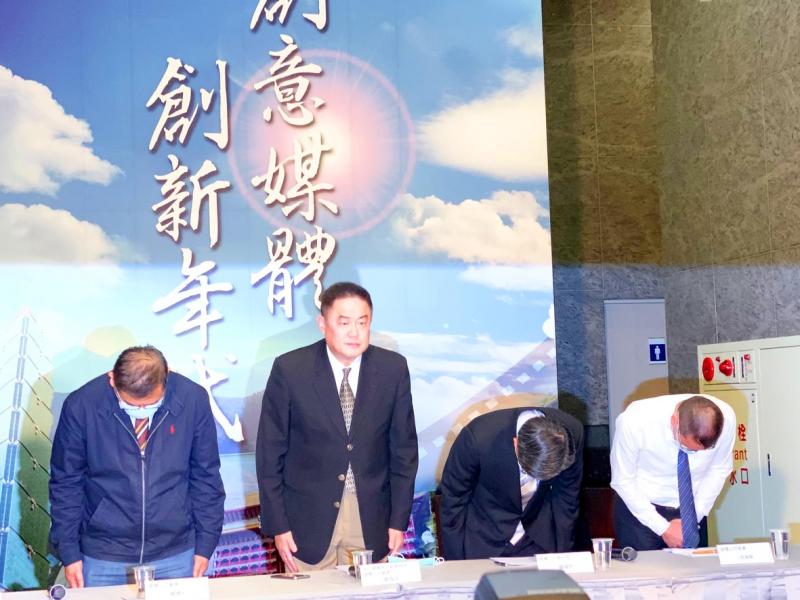
Photo: Yang Ya-min, Taipei Times
The fire broke out on Sunday morning at Cashbox KTV’s outlet on Linsen N Road, leaving five dead, more than 40 injured and one person in a critical condition.
Lien said that the family of each victim would receive NT$1 million (US$33,293) on top of NT$100,000 that the company had given them earlier.
The company would also pay other compensation to the families of the victims, and fully cover the medical costs of those injured, he added.
Cashbox board director Yen Chih-ching (嚴智徑) offered his apologies to the public on behalf of chairman Lien Tai-sheng (練台生), who did not attend the news conference.
Yen denied local media reports that Lien Tai-sheng had contacted Taipei City Government officials after the fire.
At a separate news conference at the Taipei Exchange, Cashbox chief financial officer and spokeswoman Eve Kao (高心華) said that she could not report on the company’s potential losses in monetary terms.
The estimated losses would be clear next month, she said.
Cashbox reported NT$212.62 million in consolidated revenue last month, down 28.35 percent from a year earlier, as the COVID-19 outbreak affected business, Kao said.

In Italy’s storied gold-making hubs, jewelers are reworking their designs to trim gold content as they race to blunt the effect of record prices and appeal to shoppers watching their budgets. Gold prices hit a record high on Thursday, surging near US$5,600 an ounce, more than double a year ago as geopolitical concerns and jitters over trade pushed investors toward the safe-haven asset. The rally is putting undue pressure on small artisans as they face mounting demands from customers, including international brands, to produce cheaper items, from signature pieces to wedding rings, according to interviews with four independent jewelers in Italy’s main

Japanese Prime Minister Sanae Takaichi has talked up the benefits of a weaker yen in a campaign speech, adopting a tone at odds with her finance ministry, which has refused to rule out any options to counter excessive foreign exchange volatility. Takaichi later softened her stance, saying she did not have a preference for the yen’s direction. “People say the weak yen is bad right now, but for export industries, it’s a major opportunity,” Takaichi said on Saturday at a rally for Liberal Democratic Party candidate Daishiro Yamagiwa in Kanagawa Prefecture ahead of a snap election on Sunday. “Whether it’s selling food or

CONCERNS: Tech companies investing in AI businesses that purchase their products have raised questions among investors that they are artificially propping up demand Nvidia Corp chief executive officer Jensen Huang (黃仁勳) on Saturday said that the company would be participating in OpenAI’s latest funding round, describing it as potentially “the largest investment we’ve ever made.” “We will invest a great deal of money,” Huang told reporters while visiting Taipei. “I believe in OpenAI. The work that they do is incredible. They’re one of the most consequential companies of our time.” Huang did not say exactly how much Nvidia might contribute, but described the investment as “huge.” “Let Sam announce how much he’s going to raise — it’s for him to decide,” Huang said, referring to OpenAI
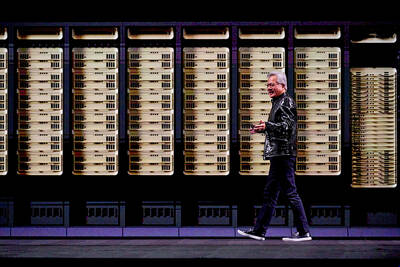
The global server market is expected to grow 12.8 percent annually this year, with artificial intelligence (AI) servers projected to account for 16.5 percent, driven by continued investment in AI infrastructure by major cloud service providers (CSPs), market researcher TrendForce Corp (集邦科技) said yesterday. Global AI server shipments this year are expected to increase 28 percent year-on-year to more than 2.7 million units, driven by sustained demand from CSPs and government sovereign cloud projects, TrendForce analyst Frank Kung (龔明德) told the Taipei Times. Demand for GPU-based AI servers, including Nvidia Corp’s GB and Vera Rubin rack systems, is expected to remain high,


 RSS
RSS