


In a rare retreat for Amazon.com Inc, the e-commerce giant plans to shut down its Chinese marketplace business in July as it shifts its focus to offering Chinese consumers overseas products rather than goods from local sellers.
Amazon will keep running its other businesses in China, including Amazon Web Services, Kindle e-books and cross-border operations that help ship goods from Chinese merchants to customers abroad.
Starting on July 18, customers logging in to Amazon’s Chinese Web portal, Amazon.cn, will only see a selection of goods from its global store, rather than products from third-party sellers.
Pulling out of e-commerce in China represents a setback for the company in the world’s largest retail market and for chief executive officer Jeff Bezos, known for his willingness to weather losses to achieve long-term gains.
It is also the latest example of a US tech company in China struggling to contend with local leaders like Alibaba Group Holding Ltd (阿里巴巴) and JD.com Inc (京東), as well as group-buying app Pinduoduo Inc (拼多多), which went public in New York last year.
Amazon entered China in 2004, when it bought a local online book seller for US$75 million.
Since then, it has invested in warehouses, data centers and programs to teach Chinese sellers how to get their goods to Amazon customers.
It launched its Prime membership program in China in 2016 with hopes of luring customers with promises of high-quality Western goods and perks like free international deliveries, but extra perks like Prime Video, which has been used to woo customers in other markets, are not available to users in China.
Alibaba, JD and other Chinese platforms also ramped up their offerings of everything from US cherries to Australian baby formula with steep discounts.
Amazon still has less than 1 percent market share in China, according to iResearch.
The pullback is the latest sign that Amazon is ceding China so it can focus on India, where it stands a better chance of becoming a dominant player.
It has plowed billions of dollars into the India business since opening its Web site there in 2013, building more than 50 warehouses to support the business.
However, Amazon still has to contend with Chinese e-commerce players in India, where Alibaba and others are building up operations or investing in local start-ups such as Paytm E-commerce Pvt and BigBasket.
For now, Amazon’s commitment to China remains strong and it will continue to invest in the country, a spokeswoman said.
She said it has been shifting the focus of its online retail business in the country to cross-border sales, which cater both to Chinese merchants selling to consumers abroad and to Chinese customers looking for high-quality goods from around the world.
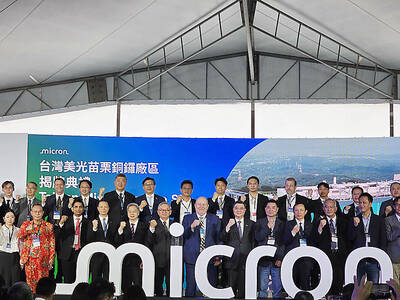
UNPRECEDENTED PACE: Micron Technology has announced plans to expand manufacturing capabilities with the acquisition of a new chip plant in Miaoli Micron Technology Inc unveiled a newly acquired chip plant in Miaoli County yesterday, as the company expands capacity to meet growing demand for advanced DRAM chips, including high-bandwidth memory chips amid the artificial intelligence boom. The plant in Miaoli County’s Tongluo Township (銅鑼), which Micron acquired from Powerchip Semiconductor Manufacturing Corp (力積電) for US$1.8 billion, is expected to make a sizeable capacity contribution to the company from fiscal 2028, the company said in a statement. It would be an extended production site of Micron’s large-scale manufacturing hub in Taichung, the company said. As the global semiconductor industry is racing to reach US$1 trillion

Singapore-based ride-hailing and delivery giant Grab Holdings Ltd has applied for regulatory approval to acquire the Taiwan operations of Germany-based Delivery Hero SE's Foodpanda in a deal valued at about US$600 million. Grab submitted the filing to the Fair Trade Commission on Friday last week, with the transaction subject to regulatory review and approval, the company said in a statement yesterday. Its independent governance structure would help foster a healthy and competitive market in Taiwan if the deal is approved, Grab said. Grab, which is listed on the NASDAQ, said in the filing that US-based Uber Technologies Inc holds about 13 percent of

ABOVE LEGAL REQUIREMENT: The Ministry of Economic Affairs is prepared if LNG supply is disrupted, with more than the legal requirement of 11 days of inventory Taiwan has largely secured liquefied natural gas (LNG) supplies through May and arranged about half of June’s supply, Minister of Economic Affairs Kung Ming-hsin (龔明鑫) said yesterday. Since the Middle East conflict began on Feb. 28, Taiwan’s LNG inventories have remained more than 12 days, exceeding the legal requirement of 11 days, indicating no major supply concerns for domestic gas and electricity, Kung said at a meeting of the legislature’s Economics Committee in Taipei. The ministry aims to increase the figure to 14 days by the end of next year, he said. While one or two LNG or crude oil shipments for May

Taiwan’s food delivery market could undergo a major shift if Singapore-based Grab Holdings Ltd completes its planned acquisition of Delivery Hero SE’s Foodpanda business in Taiwan, industry experts said. Grab on Monday last week announced it would acquire Foodpanda’s Taiwan operations for US$600 million. The deal is expected to be finalized in the second half of this year, with Grab aiming to complete user migration to its platform by the first half of next year. A duopoly between Uber Eats and Foodpanda dominates Taiwan’s delivery market, a structure that has remained intact since the Fair Trade Commission (FTC) blocked Uber Technologies Inc’s


 RSS
RSS