


Not long before he died on Oct. 15, tech visionary Paul Allen traveled to the south of France for a personal tour of a 35-country quest to replicate the workings of the sun. The goal is to one day produce clean, almost limitless energy by fusing atoms together rather than splitting them apart.
The Microsoft Corp cofounder said he wanted to view the early stages of the International Thermonuclear Experimental Reactor (ITER) in Cadarache firsthand, to witness preparations “for the birth of a star on Earth.”
Allen was not just a bystander in the hunt for the holy grail of nuclear power. He was among a growing number of ultra-rich clean-energy advocates pouring money into start-ups that are rushing to produce the first commercially viable fusion reactor long before the US$23 billion ITER program’s mid-century forecast.
Amazon founder and chief executive officer Jeff Bezos, Microsoft cofounder Bill Gates and venture capitalist Peter Thiel are just three of the billionaires chasing what late physicist Stephen Hawking called humankind’s most promising technology.
Scientists have long known that fusion has the potential to revolutionize the energy industry, but development costs have been too high for all but a handful of governments and investors. Recent advances in exotic materials, 3D printing, machine learning and data processing are all changing that.
“It’s the SpaceX moment for fusion,” said Christofer Mowry, chief executive officer of the Bezos-backed General Fusion Inc near Vancouver, Canada. He was referring to Elon Musk’s reusable rocket maker.
“If you care about climate change you have to care about the timescale and not just the ultimate solution. Governments aren’t working with the urgency needed,” Mowry said.
The company Allen supported, TAE Technologies, stood alone when it was incorporated as Tri-Alpha Energy two decades ago. Now it has at least two dozen rivals, many funded by investors with a track record of disruption.
As a result, there has been an explosion of discoveries that are driving the kind of competition needed for a transformational breakthrough, Mowry said.
One of the clearest measures of progress in the field was on display last week in Gandhinagar, India, where the Vienna-based International Atomic Energy Agency held its biennial fusion forum. The conference highlighted a record 800 peer-reviewed research papers, 60 percent more than a decade ago.
Fusion itself is not the problem. The tricky part is generating more energy than is used in the process. Such reactors have to mimic conditions found only in deep space, a much more complex and costly endeavor than fission. Heating plasma to temperatures higher than stars and then containing the ensuing reactions inside cryogenic cooling vessels can require a million parts or more.
Even if commercial fusion takes longer than expected to achieve, many of the innovations produced along the way are likely to prove lucrative on their own, said IP Group PLC, a London-based investor in intellectual property.
Research firms are already minting patents to protect their creations, from software that simulates plasma burning at 150 million degrees Celsius to a new type of magnet that has applications in healthcare.
“There’ll still be significant residual value,” said Robert Trezona, who oversees IP Group’s investment in First Light Fusion Ltd, a company near Oxford University, the advisory board of which includes former US secretary of energy Steven Chu.
“It would have been inconceivable for a small company like First Light to make advancements in fusion sciences 20 years ago,” Trezona said.
One of the most ambitious ventures is Commonwealth Fusion Systems, a company founded last year by six Massachusetts Institute of Technology professors. Backed by some of the biggest names in business, they are confident they will be able to produce a prototype of a so-called net energy reactor by 2025.
The start-up raised US$50 million in March from a group led by Italy’s Eni SpA, one of several oil producers preparing for a carbon-neutral world. Last month it secured an unspecified sum from Breakthrough Energy Ventures, a fund seeded by Gates, Bezos and fellow tycoons including Richard Branson, Ray Dalio and Michael Bloomberg, the majority owner of Bloomberg LP.
“The greater danger is not having anybody succeed than having everybody,” Commonwealth Fusion chief executive officer Bob Mumgaard said by phone from Cambridge, Massachusetts. “We need more smart people driving very hard to crack this.”
Still, ITER remains the best bet in terms of breaking the code for producing cheap energy on a massive scale, saod Nawal Prinja, a nuclear engineer at Aberdeen-based John Wood Group PLC and a featured speaker at the forum in India.
“They’re coming up with all kinds of new ideas to make the industry more efficient, but turning ideas into a commercial station is a different story,” Prinja said.
Only ITER, Latin for “the way,” has the resources needed to perfect the kind of reactor that can run entire cities, he said.
If so, many of today’s fusion investors might not live long enough to benefit from the rollout. It has already taken ITER more than three decades just to lay the foundation of a machine designed to prove the viability of its concept, and it does not expect to have a reactor capable of powering a couple million US households until about 2050.
Tim Luce, ITER’s chief scientist and Allen’s host at the sprawling research facility about 50km north of Marseille, dismissed criticism of the time horizon.
What the international effort is trying to accomplish, he said, is simply too ambitious for any one actor in the private sector.
“These other competitors have a vision for doing something smaller, but I haven’t seen a compelling piece of physics that shows they can do it,” Luce said. “It’s the story of the tortoise and the hare and we’re the tortoise.”
Then there is Musk, a serial innovator who thinks the whole fusion crowd is barking up the wrong tree.
In a weed-and-whiskey podcast that went viral last month, the Tesla and Solar City cofounder said smart money like his is better spent on finding more efficient ways to capture the sun’s energy than on trying to recreate it.
“We’ve got a giant thermonuclear reactor in the sky,” Musk said. “It shows up every day very reliably. If you can generate solar panels and store it with batteries, you can have it 24 hours a day.”

SECOND-RATE: Models distilled from US products do not perform the same as the original and undo measures that ensure the systems are neutral, the US’ cable said The US Department of State has ordered a global push to bring attention to what it said are widespread efforts by Chinese companies, including artificial intelligence (AI) start-up DeepSeek (深度求索), to steal intellectual property from US AI labs, according to a diplomatic cable. The cable, dated Friday and sent to diplomatic and consular posts around the world, instructs diplomatic staff to speak to their foreign counterparts about “concerns over adversaries’ extraction and distillation of US AI models.” Distillation is the process of training smaller AI models using output from larger, more expensive ones to lower the costs of training a powerful new
Micron Technology Inc is a driving force pushing the US Congress to pass legislation that would put new export restrictions on equipment its Chinese competitors use to make their chips, according to people familiar with the matter. A US House of Representatives panel yesterday was to vote on the “MATCH Act,” a bill designed to close gaps in restrictions on chipmaking equipment. It would also pressure foreign companies that sell equipment to Chinese chipmaking facilities to align with export curbs on US companies like Lam Research Corp and Applied Materials Inc. The bill targets facilities operated by China’s ChangXin Memory Technologies Inc

Singapore-based ride-hailing and delivery giant Grab Holdings’ planned acquisition of Foodpanda’s Taiwan operations has yet to enter the formal review stage, as regulators await supplementary documents, the Fair Trade Commission (FTC) said yesterday. Acting FTC Chairman Chen Chih-min (陳志民) told the legislature’s Economics Committee that although Grab submitted its application on March 27, the case has not been officially accepted because required materials remain incomplete. Once the filing is finalized, the FTC would launch a formal probe into the deal, focusing on issues such as cross-shareholding and potential restrictions on market competition, Chen told lawmakers. Grab last month announced that it would acquire
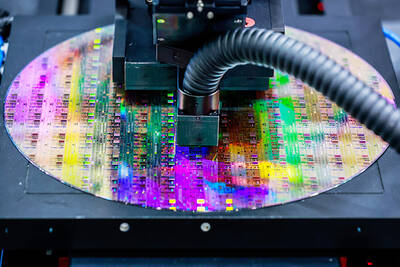
The artificial intelligence (AI) boom has triggered a seismic reshuffling of global equity markets, with Taiwan and South Korea muscling past European nations one by one. With its stock market now valued at nearly US$4.3 trillion, Taiwan surpassed the UK, Europe’s biggest market, earlier this month, data compiled by Bloomberg showed. South Korea is about US$140 billion away from doing the same. The tech-heavy Asian markets have shot past Germany and France in the past seven months. The shift is largely down to massive gains in shares of three companies that provide essential hardware for AI: Taiwan Semiconductor Manufacturing Co (TSMC, 台積電),


 RSS
RSS