


Alibaba Group Holding Ltd (阿里巴巴) is heralding the end of the Jack Ma (馬雲) era.
A former English teacher who helped found Alibaba Group Holding Ltd two decades ago, Ma outlined plans to hand the executive chairman role to Daniel Zhang (張勇), a finance veteran who has presided over an ambitious expansion and won over investors in three years as chief executive officer.
Ma is to officially pass the baton in exactly 12 months’ time, on his 55th birthday, but remain on the board until 2020.
He intends to focus on philanthropy and education, but also pursue unspecified “new dreams,” he said in a statement yesterday.
China’s richest man has become synonymous with turning the company that started in his Hangzhou apartment into a global e-commerce giant with burgeoning cloud computing and package delivery businesses.
Ma’s 46-year-old successor has pushed Alibaba deeper into the wallets of Chinese consumers as it bought and transformed brick-and-mortar outlets: A so-called “New Retail” vision that has cost billions of dollars and took it into the realm of physical stores.
“Starting the process of passing the Alibaba torch to Daniel and his team is the right decision at the right time, because I know from working with them that they are ready,” Ma said in the statement. “Since he took over as CEO, he has demonstrated his superb talent, business acumen and determined leadership.”
The succession plan would unite Alibaba’s two biggest roles for the first time since Ma gave up his chief executive officer title in 2013 to focus on being chairman and groom lieutenants, including Zhang, a Shanghai-educated certified accountant.
Zhang joined Taobao.com (淘寶) in 2007 as chief financial officer of the consumer-to-consumer marketplace. He pioneered the company’s push into getting established brands to sell to customers and is credited with helping turn Singles’ Day into a Chinese shopping bonanza.
Zhang’s appointment might come as a surprise to those accustomed to tracking Ma’s other high-profile lieutenants, such as vice chairman Joseph Tsai (蔡崇信).
The chief executive officer has proven a capable hand and Alibaba’s stock has surged 87 percent over his tenure and now has a market value of about US$420 billion, bigger than arch-foe and WeChat operator Tencent Holdings Ltd (騰訊).
Ma is moving on with Alibaba in a dominant position in China and pushing into overseas markets from Southeast Asia to Russia. Leadership would now fall to Zhang and the 35 other partners who control the company.
The billionaire started Alibaba.com in 1999 as a business-to-business marketplace with 17 cofounders.
An investment from Japan’s Softbank Group Corp helped the company expand to allow consumers in China buy online and fueled its rise.
Through the Taobao and Tmall.com (天貓) platforms, it is responsible for billions of dollars in sales and last year saw daily package deliveries reach 55 million.
Alibaba has since moved into cloud computing, digital payments, healthcare, Hollywood movies and backing China’s start-ups.
Its share price has more than doubled since its record 2014 initial public offering.
“Ma possesses an enviable clarity about how everything fits together,” said Mark Tanner, founder of Shanghai-based research and marketing company China Skinny. “He has understood Chinese consumer needs better than anyone and provided online services to meet them through convenience, entertainment and efficiencies.”
Ma in an interview with Bloomberg TV last week said that he plans to shift his focus to philanthropy and education, taking him back to his profession before starting an e-commerce empire.
He has created a foundation in his own name, modeled in part on the efforts of Microsoft Corp cofounder and fellow billionaire Bill Gates.
“I’ve prepared a Jack Ma Foundation. All these things that I’ve been preparing for 10 years,” he said. “There’s a lot of things I can learn from Bill Gates. I can never be as rich, but one thing I can do better is to retire earlier.”
Ma has remained the public face of Alibaba, showing off his wit and dispensing folksy wisdom on the global stage.
“There isn’t a face or name more recognizable globally that represents the rise of China’s Internet and its consumers than Jack Ma,” Tanner said.
Taiwan Semiconductor Manufacturing Co (TSMC, 台積電) has approved a capital budget of US$31.28 billion for production expansion to meet long-term development needs during the artificial intelligence (AI) boom. The company’s board meeting yesterday approved the capital appropriation plan for purposes such as the installation of advanced technology capacity and fab construction, the world’s largest contract chipmaker said in a statement. At an earnings conference last month, TSMC forecast that its capital expenditure for this year would be at the higher end of the US$52 billion to US$56 billion range it forecast in January in response to robust demand for 5G, AI and
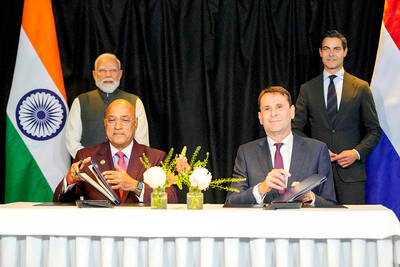
NEW MARKET: The partnership opens up India to the Dutch company, which already has a strong hold in the semiconductor market of South Korea, Taiwan and China ASML Holding NV entered into a partnership agreement with Tata Electronics Pvt Ltd aimed at ramping up India’s goal to develop domestic chip-manufacturing capabilities. The Dutch company’s technology would help power Tata Electronics’ planned 300 millimeter (mm) semiconductor foundry in Gujarat, according to a joint statement from the two companies on Saturday. The signing of a memorandum of understanding coincides with a visit by Indian Prime Minister Narendra Modi to the Netherlands, which is looking to deepen bilateral relations with New Delhi. ASML, whose top customers include Taiwan Semiconductor Manufacturing Co (台積電) and Samsung Electronics Co, makes lithography machines that can print
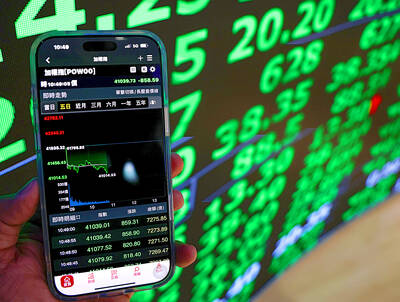
PORTFOLIO REBALANCING: The adjustments in three global equity indices reflect rising investor appetite for semiconductor and artificial intelligence-related stocks Taiwan’s weighting in major global equity indices compiled by MSCI Inc is to rise modestly following the latest quarterly review, underscoring the market’s expanding role in emerging-market portfolios, as global investors continue to favor the nation’s technology sector. Taiwan’s weighting in the MSCI Emerging Markets Index is to increase by 0.30 percentage points to 23.76 percent, after the changes take effect at the close of the May 29 session. Its weighting in the MSCI All-Country Asia ex-Japan Index is to rise 0.37 percentage points to 27.16 percent, while that in the MSCI All Country World Index is to edge up slightly to
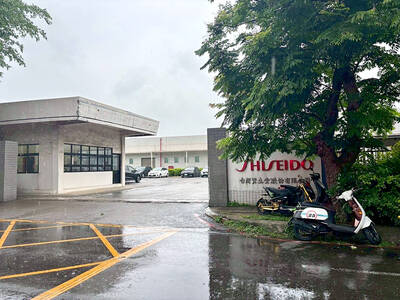
The Hsinchu County Government’s Labor Affairs Department yesterday said that it has received a plan from cosmetics brand Taiwan Shiseido Co (台灣資生堂) detailing mass layoffs at its plant in Hukou Township (湖口). While the labor authorities did not disclose the number of employees to be laid off, Japanese news media earlier in the day reported that the closure of the company’s factory in Hukou would result in 170 employees losing their jobs. Shiseido followed the law by reporting its layoff plan, the department said, adding that authorities would closely monitor negotiations between the management and affected employees and step in if any


 RSS
RSS