


Demand for more variety in Scotch whisky from fast-growing emerging markets and the request for lower-alcohol varieties among health-conscious drinkers are challenging a closely guarded centuries-old tradition.
Drinks giant Diageo PLC, producer of market leader Johnnie Walker, sent shock waves through the industry earlier this year when a “highly confidential” document, leaked to the Wall Street Journal, revealed potential innovations such as flavored infusions, low-alcohol variants and whisky finished in tequila casks.
However, it is operating within very tight restrictions, as British law stipulates that Scotch must be at least 40 percent alcohol — which means distillers cannot reach out to health-conscious millennials or tap into the lucrative Middle Eastern market with lower or zero-alcohol Scotch.
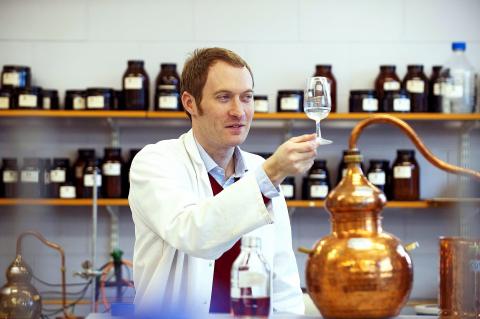
Photo: AFP
“There is a lot of interest in lower-alcohol spirit drinks across the spirit sector to do with things like the Dry January craze and minimum pricing of alcohol,” Heriot-Watt University International Centre for Brewing and Distilling assistant professor Matthew Pauley said. “A few people have been experimenting throughout the sector with lower-alcohol spirits, and no-alcohol spirit variants. Not all of them have been well received.”
Pauley’s shelves are packed with herbs, spices and flavorings used in experiments with gin — but they are kept well away from the whisky stills.
The law restricts Scotch ingredients to barley, water and yeast aged in oak casks, meaning flavored infusions and tequila-cask finishes are also likely to attract the attention of the litigious Scotch Whisky Association (SWA).
“Johnnie Walker can’t suddenly make strawberry whisky and send it off to China,” Pauley said. “The SWA spend a lot of money sending people around the world collecting samples of things like random bottles of brown liquid with tartan on it, and there is a whole legal team who go and shut that person down.”
In his lab, Pauley also has bagfuls of an extra-roasted barley called “chocolate malt” that has proved controversial.
French-owned giant Glenmorangie markets a single malt Scotch called Signet that uses a hint of chocolate malt — but the Eden Mill craft distillery in St Andrews abandoned its own chocolate malt product when the SWA warned it not to stray too far from the traditional Scotch flavor.
“It’s the extra flavors that the chocolate malt will add that the distillers are looking for and that the SWA have issue with,” Pauley said. “The different roasts will potentially add different flavors, so that is what is being investigated, researched and has come into some controversy.”
“Some of the easy wins have been won, so people naturally start to look at some of the more left-field suggestions and line extensions, and we get back to the issue of how you make a line extension without harming the core brand,” he added.
An association spokesman said there is no ban on producing new products based on Scotch whisky, but “the marketing of such products must not confuse consumers in any way — in particular, they must not suggest the product is Scotch whisky when it is not.”
Flavored whiskies are already marketed as liqueurs, but must not be labeled Scotch, which has a similar geographical protection to Champagne, the association said.
“One would not add flavoring to Champagne and expect to trade on the reputation of Champagne by selling it as such,” the spokesman said.
Murdo Fraser, convener of the Scottish Parliament’s cross-party group on Scotch whisky, also urged caution on innovation.
“My own preference would be that we don’t see any dilution of the Scotch whisky brand, and we therefore need to be careful about going down the route of innovating too quickly,” he said.
Patrons in the Roseburn Bar, near BT Murrayfield Stadium in Edinburgh, were divided on the debate between tradition and innovation.
Sipping a dram of Aberlour, 53-year-old stonemason Alan McGuire said that unpalatable innovations would “contradict the whole thing that whisky is.”
“It’s a beautiful drink that has been laid down for years, and to add something like ginger, or lemon or raspberry or something to it would just kill the brand,” he added.
However, 35-year-old nurse Christopher Gauld said he is “a big believer in change,” as he sampled a trendy looking Islay malt called the Classic Laddie.
“The whisky we have today wouldn’t be the way it is if people didn’t try things in the past, so I’m open to experiments,” he said.

Ryanair, Transavia, Volotea and other low-cost airlines are feeling the financial pain from high jet fuel prices as a result of the Middle East war and are cutting flights. The closure of the Strait of Hormuz has taken a huge chunk of oil supplies off the market, sending the price of jet fuel soaring and triggering fears of shortages that could force airlines to cancel flights. Airlines are not waiting for a lack of supplies to react. “Travel alert: Airlines are cutting thousands of flights right now,” Travel Therapy host Karen Schaler said in an Instagram reel this past weekend.

MANAGING RISKS: Taiwan has secured LNG sufficient to cover 95 percent of electricity demand for next month, UBS said, describing the government’s approach as proactive UBS Group AG has raised its forecast for Taiwan’s economic growth this year to 8 percent, up from 6.9 percent previously, and said expansion could reach as high as 8.6 percent if external energy shocks are avoided. The upgrade reflects a stronger-than-expected first-quarter performance and sustained momentum in artificial intelligence (AI)-driven exports, which UBS said are providing a firm foundation for growth despite geopolitical and energy risks. Taiwan’s GDP expanded 13.69 percent year-on-year in the first quarter, the fastest growth since the second quarter of 1987, the Directorate-General of Budget, Accounting and Statistics (DGBAS) reported on Thursday. On a seasonally

The Fair Trade Commission’s (FTC) ongoing review of Grab Holdings Ltd’s US$600 million acquisition of Foodpanda Taiwan’s operations, announced on March 23, has taken on fresh urgency as industry experts warn that the transaction could embed significant Chinese cybersecurity vulnerabilities into Taiwan’s digital infrastructure through Grab’s deep ties to autonomous-driving firm WeRide (文遠知行). Less than 16 months after the FTC blocked Uber Eats’ direct attempt to acquire Foodpanda Taiwan — citing potential combined market shares of 80 to 90 percent — the emergence of Grab as the buyer has prompted questions about whether the same competitive harm is simply being rerouted

The list of Asian stocks that benefit from business partnership with Nvidia Corp is getting longer, as the region further integrates into the artificial intelligence (AI) chip giant’s business ecosystem. Just in the past week, South Korea’s LG Electronics Inc, Taiwan’s Nanya Technology Corp (南亞科技), as well as China’s Huizhou Desay SV Automotive Co (德賽西威) and Pateo Connect Technology Shanghai Corp (博泰車聯) have become the latest to rally on news of tie-ups, supply-chain participation or product collaboration with the US chip designer. Asian suppliers account for about 90 percent of Nvidia’s production costs, up from about 65 percent last year, data compiled


 RSS
RSS