


The TMDEX (天馬虛擬商品交換平台), Taiwan’s first digital asset exchange, officially came online on Tuesday last week, joining a short list of second-generation cryptocurrency exchanges in the world.
As it does not process withdrawals or deposits in fiat money, the exchange is in compliance with current laws and subject to less stringent regulatory controls, its management team told the Taipei Times in an interview on Friday.
The management said the TMDEX is a second-generation exchange that trades cryptocurrencies exclusively and aims to help further the proliferation of the cryptocurrency market by providing a trading platform with improved transparency and cybersecurity.
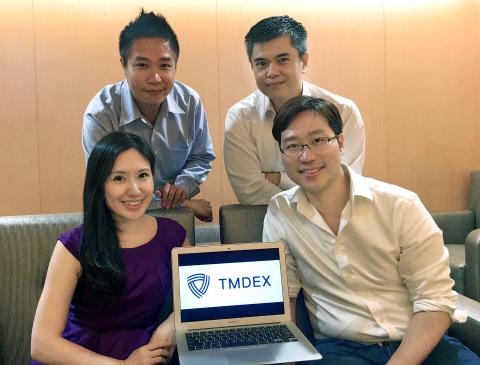
Photo courtesy of TMDEX
By contrast, first-generation exchanges form partnerships with banks to serve as a fiat gateway to process transactions between legal tender and cryptocurrencies, TMDEX chief executive officer Yao Lee (李耀庭) said.
In light of bitcoin’s meteoritic rise in valuation and the rapid evolution of blockchain technology, second-generation exchanges are to play an increasingly vital role as more cryptocurrencies are minted, Yao Lee said.
Since the creation of bitcoin in 2009, a multitude of “altcoins” — alternative currencies to bitcoin that are based on a similar blockchain transaction database — have hit the market.
However, many of these altcoins have become unviable and inactive, adding confusion to the cryptocurrency market.
Yao Lee said that a pivotal change came when the Ethereum blockchain came into existence, as its smart contract capability and ERC-20 token standard brought improved transaction compatibility between different cryptocurrencies.
With more listings on the market, secondary exchanges help sustain the long-term viability of cryptocurrencies by boosting liquidity and providing market participants with a means to diversify their investments.
Out of the more than 1,000 altcoins that have been launched worldwide, the index currently lists bitcoin, Ethereum, Ethereum Classic and litecoin, with plans to add more.
The TMDEX does not list tokens issued through initial coin offerings, which have been banned by South Korean and Chinese authorities.
“We have a very stringent selection process that is based on our philosophy,” Yao Lee said.
Cryptocurrencies can be understood as solutions designed to address specific problems or bring improvements to current processes, and their value is partly reflected by their effectiveness in that regard, as well as whether they are able to generate traction among market participants, he said.
Bitcoin, the world’s first cryptocurrency, was created to perform peer-to-peer payments without an intermediary or a central authority, while litecoin serves as a testing ground for bitcoin, with new features that allow faster transactions at larger volumes.
Golem is a token that allows participants to purchase processing time from a supercomputer network powered by idle computers across the globe, while DASH is a coin designed for anonymous transactions.
For many, bitcoin satisfies the need to have total control over their personal assets by creating a store of value that is impervious to the effects of inflation, interest rate policies or actions by banks and courts, Yao Lee said.
As a general guideline, investors are advised to look for cryptocurrencies whose creators maintain open communication with the community, he said, adding that Ethereum’s Vitalik Buterin and litecoin’s Charlie Lee (李啟威) are good examples of being transparent in disclosing development plans for cryptocurrencies.
Investors are also advised to check whether the source code underpinning the cryptocurrencies is actively updated, he added.
The index also plans to seek expert advice in related fields, monitor community discussions and assess the source code of each new undertaking.
“The auditing process is constantly being refined,” he said.
As opposed to replacing the incumbent financial systems, the exchange aims to coexist with other systems and to offer consumers additional choices, in the same vein that consumers can choose between the iOS and Android mobile operating systems, TMDEX chief marketing officer Allen Chiu (邱瑞文) said.
In China, the rise of WeChat Pay (微信支付) and Alipay (支付寶) has not crushed the banking industry, but has instead created a positive stimulus toward improving efficiency and convenience, while maintaining the same level of security as the incumbents, Chiu said.
Central Bank Governor Perng Fai-nan (彭淮南) said last week that cryptocurrencies are not subject to the central bank’s controls, as they are classified as a virtual commodity and not a currency, but the exchange is fully prepared to comply with Perng’s suggestion to include cryptocurrencies in monitoring to prevent money laundering, Chiu said.
Users of the exchange would be required to register their identities on transactions bigger than two bitcoins — valued at more than US$5,000 — to meet money laundering monitoring and reporting requirements, he said.
“While we fully intend to meet compliance, what worries us the most are uncertainties about policy direction,” Chiu said.
While Financial Supervisory Commission Chairman Wellington Koo (顧立雄) has expressed openness toward promoting financial technology innovations under sound risk management and regulatory compliance, Yao Lee said the exchange is not planning to participate in the commission’s upcoming regulatory sandbox, as the measure’s experimentation is geared toward fiat and not relevant to its crypto asset business model.
The TMDEX offers fee-free trading until the end of this year, and plans to set fees at 0.1 percent on each transaction beginning on Jan. 1, payable in cryptocurrency.
While first-generation exchanges have a 5 to 15 percent spread in ask and bid prices, pricing on TMDEX reflects the market rate and has no spread, Yao Lee said.
That compares with the 5 to 18 percent range charged by most first-generation exchanges, while the TMDEX also has smaller gaps in its bid and spread prices.
To defend against hacking attacks that could result in disruptions to trading and theft, the exchange has adopted extensive cybersecurity measures, such as redundancy and multilayer signature authentication, to verify transactions. It also stores users’ cryptocurrencies on wallets of different security levels.
The company said that 2 to 3 percent of users’ assets on average are stored in “hot” wallets to conduct immediate trading, requiring a few seconds to complete. The other portion of users’ assets are stored in “warm” wallets, which take more time to be released for trading, typically from a few hours to several days.
For maximum security, assets can be stored in “cold” wallets, which reside on offline storage devices.
In the event of theft, the exchange’s maximum exposure is limited to the 2 to 3 percent of users’ assets that are stored in hot wallets, Lee said, adding that its income from fees would be able to cover affected customers’ losses.
Lee expects to see the exchange’s daily turnover reach US$300,000 in the near term, adding that daily transactions have averaged around 200 since its soft launch last month.

NEW MARKET: The partnership opens up India to the Dutch company, which already has a strong hold in the semiconductor market of South Korea, Taiwan and China ASML Holding NV entered into a partnership agreement with Tata Electronics Pvt Ltd aimed at ramping up India’s goal to develop domestic chip-manufacturing capabilities. The Dutch company’s technology would help power Tata Electronics’ planned 300 millimeter (mm) semiconductor foundry in Gujarat, according to a joint statement from the two companies on Saturday. The signing of a memorandum of understanding coincides with a visit by Indian Prime Minister Narendra Modi to the Netherlands, which is looking to deepen bilateral relations with New Delhi. ASML, whose top customers include Taiwan Semiconductor Manufacturing Co (台積電) and Samsung Electronics Co, makes lithography machines that can print
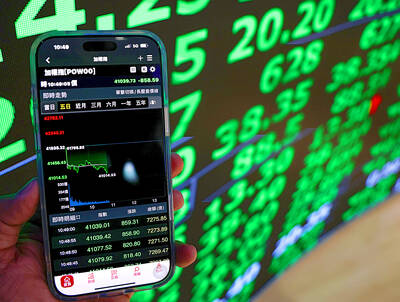
PORTFOLIO REBALANCING: The adjustments in three global equity indices reflect rising investor appetite for semiconductor and artificial intelligence-related stocks Taiwan’s weighting in major global equity indices compiled by MSCI Inc is to rise modestly following the latest quarterly review, underscoring the market’s expanding role in emerging-market portfolios, as global investors continue to favor the nation’s technology sector. Taiwan’s weighting in the MSCI Emerging Markets Index is to increase by 0.30 percentage points to 23.76 percent, after the changes take effect at the close of the May 29 session. Its weighting in the MSCI All-Country Asia ex-Japan Index is to rise 0.37 percentage points to 27.16 percent, while that in the MSCI All Country World Index is to edge up slightly to
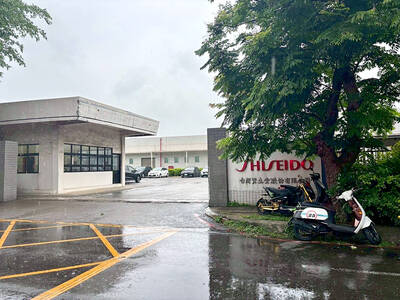
The Hsinchu County Government’s Labor Affairs Department yesterday said that it has received a plan from cosmetics brand Taiwan Shiseido Co (台灣資生堂) detailing mass layoffs at its plant in Hukou Township (湖口). While the labor authorities did not disclose the number of employees to be laid off, Japanese news media earlier in the day reported that the closure of the company’s factory in Hukou would result in 170 employees losing their jobs. Shiseido followed the law by reporting its layoff plan, the department said, adding that authorities would closely monitor negotiations between the management and affected employees and step in if any
Hon Hai Precision Industry Co (鴻海精密) on Tuesday confirmed a cyberattack targeting some of its North American facilities, but said the affected factories were gradually returning to normal. The company, known globally as Foxconn Technology Group (富士康科技集團), said that its cybersecurity team “activated the response mechanism and implemented operational measures to ensure the continuity of production and delivery.” “The affected factories are resuming normal production,” the company said in a statement. Hon Hai had previously described it as a “technical issue,” when news of the cyberattack first surfaced. The confirmation followed media reports of a large-scale information technology system incident that broke out at


 RSS
RSS