


Tight-fisted shoppers, unsteady economic growth and a shrinking population: Japan does not exactly fit the image of a spending powerhouse these days.
However, you would never know it in Ginza — Tokyo’s answer to the Champs-Elysees or Fifth Avenue — where a new 13-story upscale mall is proving that Japan is still a whale in the luxury business.
The nation logs about US$22.7 billion in annual spending on top-end goods made by brands including Chanel, Dior and Prada, ranking it as the world’s No. 2 luxury market behind the US.
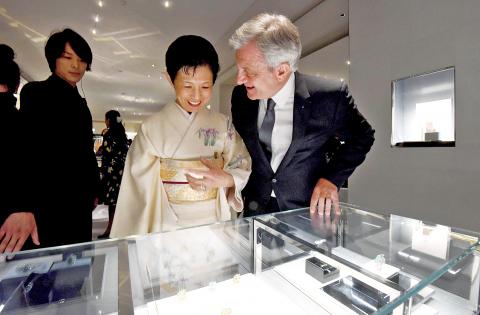
Photo: AFP
“Luxury products may be more expensive, but they are very well-made,” 79-year-old Toshiko Obu said, carrying her longtime Fendi bag outside the Ginza Six building, which has been drawing big crowds since last week’s opening.
Japan is renowned among the world’s priciest retailers for its discriminating clientele — Chanel tries to keep local customers physically separated from tourists packing more cash than class.
“You shouldn’t forget that a big portion of the luxury clientele is here in Japan,” Christian Dior Couture chief executive Sidney Toledano said at the opening of the 241-store building.
“It remains a strategic market for luxury and, I’d say, true luxury,” he said.
Dior is counting on Japan’s luxury market to rise this year, while rival Chanel is also expecting an upbeat year, after global sales of personal luxury goods barely grew last year.
“We did not lose our character,” said Richard Collasse, head of Chanel in Japan.
“There are brands that are suffering — the ones that at some stage stopped investing in Japan because China was the new El Dorado, and today they are biting their fingernails,” he said.
Few brands predicted that deep-pocketed Chinese shoppers visiting Japan would support its luxury market — tourists account for about one-third of top-end spending.
Japan is hoping to land 40 million visitors in 2020, the year that Tokyo hosts the Olympics. Last year, about 6 million Chinese visited, compared with 2.4 million in 2014.
“Historically, [Japan has] been a very insular luxury market where 90 to 95 percent of the spending was by locals,” said Joelle de Montgolfier, Paris-based director of consumer and luxury product research at consultancy Bain & Company.
But now about 30 percent of sales are generated by foreign visitors owing to tourism, she added.
A stronger yen dented visitors’ purchasing power last year, with luxury sales down 1 percent, after a 9 percent rise in 2015.
Toledano said it is an opportunity to refocus on Japanese clientele.
“We don’t ignore tourists, of course, but we’re not a duty-free shop,” he added.
Some Chanel shops in Tokyo have a separate cosmetics and perfume section reserved for top Japanese customers, in a bid to keep them away from the nouveau riche crowd. It also tips off local clientele about the expected arrival time of tourist buses so they can avoid them.
“The loyal Japanese clients tend to run away from customers who were not very well-raised and are wearing whatever or lying all over the sofa, touching everything,” Collasse said.
Dior’s haute couture show at the new mall’s opening featured Japanese-inspired dresses, underscoring a focus on the local market.
However, warning signs lurk behind smiling clerks and glitzy interiors at the new property on one of the world’s priciest shopping streets.
Japan has struggled to reverse a decades-long economic slump while a falling population continues to shrink its labor force — and the pool of future luxury consumers.
Younger people, many on tenuous work contracts, do not have the money or the same interest in luxury brands anymore, especially since top-end goods can now be rented online instead, said Naoko Kuga, a consumer lifestyle analyst at Tokyo’s NLI Research Institute.
“When you look at consumer purchasing behavior, younger people put less value on luxury brand products” than previous generations, she said.
Taiwan’s foreign exchange reserves fell below the US$600 billion mark at the end of last month, with the central bank reporting a total of US$596.89 billion — a decline of US$8.6 billion from February — ending a three-month streak of increases. The central bank attributed the drop to a combination of factors such as outflows by foreign institutional investors, currency fluctuations and its own market interventions. “The large-scale outflows disrupted the balance of supply and demand in the foreign exchange market, prompting the central bank to intervene repeatedly by selling US dollars to stabilize the local currency,” Department of Foreign

ENERGY ISSUES: The TSIA urged the government to increase natural gas and helium reserves to reduce the impact of the Middle East war on semiconductor supply stability Chip testing and packaging service provider ASE Technology Holding Co (日月光投控) yesterday said it planned to invest more than NT$100 billion (US$3.15 billion) in building a new advanced chip testing facility in Kaohsiung to keep up with customer demand driven by the artificial intelligence (AI) boom. That would be included in the company’s capital expenditure budget next year, ASE said. There is also room to raise this year’s capital spending budget from a record-high US$7 billion estimated three months ago, it added. ASE would have six factories under construction this year, another record-breaking number, ASE chief operating officer Tien Wu

For weeks now, the global tech industry has been waiting for a major artificial intelligence (AI) launch from DeepSeek (深度求索), seen as a benchmark for China’s progress in the fast-moving field. More than a year has passed since the start-up put Chinese AI on the map in early last year with a low-cost chatbot that performed at a similar level to US rivals. However, despite reports and rumors about its imminent release, DeepSeek’s next-generation “V4” model is nowhere in sight. Speculation is also swirling over the geopolitical implications of which computer chips were chosen to train and power the new

Intel Corp is joining Elon Musk’s long-shot effort to develop semiconductors for Tesla Inc, Space Exploration Technologies Corp and xAI, marking a surprising twist in the chipmaker’s comeback bid. Intel would help the Terafab project “refactor” the technology in a chip factory, the company said on Tuesday in a post on X, Musk’s social media platform. That is a stage in the development process that typically helps make chips more powerful or reliable. The chipmaker’s shares jumped 4.2 percent to US$52.91 in New York trading on Tuesday. The Terafab project is a grand plan by Musk to eventually manufacture his own chips for


 RSS
RSS