


Grain by grain, truckload by truckload, Laos’ section of the Mekong River is being dredged of sand to make cement — a commodity being devoured by a Chinese-led building boom in the capital. However, the hollowing out of the riverbed is also damaging a vital waterway that feeds hundreds of thousands of fishermen and farmers in the poverty-stricken nation.
“Today, it’s more complicated for us to go fetch water for crops,” Deam Saengarn said from the muddy river’s shores, describing how its gentle slopes have given way to steep embankments.
The 36-year-old mother of two captures Laos’ development conundrum: She depends on a US$10 daily wage from a sand extraction firm, but also relies on the very river she is helping to gouge.
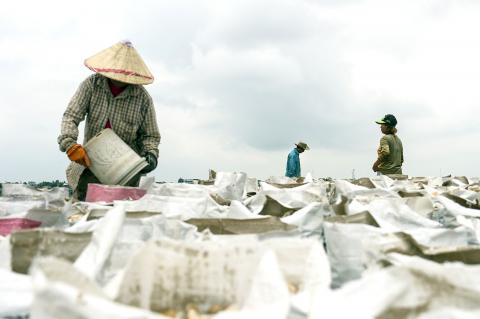
Photo: AFP
“We really need this water,” she added wistfully, dripping with sweat as she separated stones from the mountains of sediment piled on the shore.
All around her, industrial pipes and excavators suck up the Mekong’s floor, carving moon-like craters into the bed of a river that winds through most of the landlocked nation.
It is a familiar story in a country whose natural resources have been steadily plundered by businesses — many of them Chinese — under the gaze of communist leaders who brook no dissent, but welcome foreign cash.
Sand, an unflashy and seemingly infinite resource, is the chief ingredient in cement and the hidden hand behind the explosion of cities worldwide.
China is also its top consumer — devouring more than 60 percent of the global output and using more sand in four years than the US did in the entire 20th century.
Dredging has been taking place for years along the Mekong, but the industrial scale is relatively new to Laos, where the grains pave a flurry of new construction projects in the country’s sleepy capital, many of them funded by Chinese firms.
“We now have many Chinese clients. They are constructing huge buildings in Vientiane, so they need a lot of sand and pebbles,” said Air Phangnalay, who helps run an extraction company in Laos.
China is the largest source of foreign investment in neighboring Laos.
Chinese businesspeople loom large in the isolated nation and have zeroed in on its array of timber and mineral resources — often to the dismay of an impoverished populace with few outlets to air grievances.
Experts say the uptick in sand mining, a lesser-known resource grab, is harming the delicate ecosystem of a river that about 60 million people across the region depend on.
The 4,800km Mekong, which starts in southwestern China and empties out in southern Vietnam, is the world’s largest inland fishery and among the most biodiverse rivers on the globe, according to the Worldwide Fund for Nature (WWF).
It naturally produces about 20 million tonnes of sediment a year, but is now seeing twice that much extracted annually, according to the latest research to which the WWF contributed.
Most of the dredging is taking place in Cambodia and Vietnam, but the pace of mining is picking up speed in Laos — an opaque country where big businesses can swallow up resources with minimal scrutiny.
The WWF’s Marc Goichot said the rate of mining along the Mekong has become “unsustainable” and is setting the stage for especially dire damage downstream.
“The river needs the sand to be transported from upstream down to the delta to fight against salinization and encroachment of the sea in this crucial area for agriculture,” he said.
Farmers along the Mekong’s vast delta in Vietnam are already battling the worst saline intrusion rates in decades, thanks to severe droughts that have parched rice paddies across the region.
An official from the Laotian Ministry of Public Works conceded the dredging “affects the Mekong river and its ecosystem structure.”
However, the official declined a full interview or to provide figures on how much sand has already been extracted. Without strict regulation, the dredging will trigger erosion patterns that could take decades to reverse, according to the UN’s environmental agency.
“The problem is that we have long believed that sand was an inexhaustible commodity,” Pascal Peduzzi said, adding that rivers across the world are now under threat from a global spike in extraction.
Yet sand mining is not the only effort to monetize the mighty Mekong — while dangerously disrupting its flow. There are already 12 dams built or under construction on the river’s upper reaches in China, with at least seven more planned. Another nine are underway or planned in Laos, plus two more in Cambodia.
Environmental groups strongly oppose the stoppages, which they say hamper crucial fish migrations, block key sediment transfers and threaten to flood lands that tens of thousands of people call home.
It is damage that will only be compounded by a free-for-all race to scoop up the river’s sand.
“The river has changed a lot. Here, the banks are collapsing. This did not happen before,” a Laotian fisherman said as he drew his nets, declining to give his name in a country where many fear speaking out. “It requires us to go further to fish. It’s not good for us.”
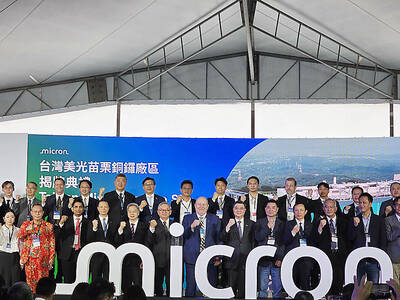
UNPRECEDENTED PACE: Micron Technology has announced plans to expand manufacturing capabilities with the acquisition of a new chip plant in Miaoli Micron Technology Inc unveiled a newly acquired chip plant in Miaoli County yesterday, as the company expands capacity to meet growing demand for advanced DRAM chips, including high-bandwidth memory chips amid the artificial intelligence boom. The plant in Miaoli County’s Tongluo Township (銅鑼), which Micron acquired from Powerchip Semiconductor Manufacturing Corp (力積電) for US$1.8 billion, is expected to make a sizeable capacity contribution to the company from fiscal 2028, the company said in a statement. It would be an extended production site of Micron’s large-scale manufacturing hub in Taichung, the company said. As the global semiconductor industry is racing to reach US$1 trillion

Singapore-based ride-hailing and delivery giant Grab Holdings Ltd has applied for regulatory approval to acquire the Taiwan operations of Germany-based Delivery Hero SE's Foodpanda in a deal valued at about US$600 million. Grab submitted the filing to the Fair Trade Commission on Friday last week, with the transaction subject to regulatory review and approval, the company said in a statement yesterday. Its independent governance structure would help foster a healthy and competitive market in Taiwan if the deal is approved, Grab said. Grab, which is listed on the NASDAQ, said in the filing that US-based Uber Technologies Inc holds about 13 percent of
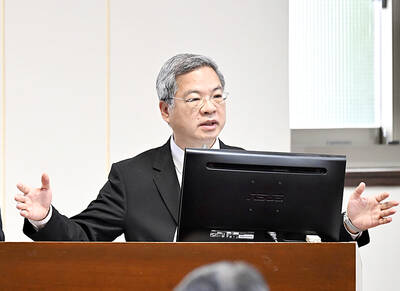
ABOVE LEGAL REQUIREMENT: The Ministry of Economic Affairs is prepared if LNG supply is disrupted, with more than the legal requirement of 11 days of inventory Taiwan has largely secured liquefied natural gas (LNG) supplies through May and arranged about half of June’s supply, Minister of Economic Affairs Kung Ming-hsin (龔明鑫) said yesterday. Since the Middle East conflict began on Feb. 28, Taiwan’s LNG inventories have remained more than 12 days, exceeding the legal requirement of 11 days, indicating no major supply concerns for domestic gas and electricity, Kung said at a meeting of the legislature’s Economics Committee in Taipei. The ministry aims to increase the figure to 14 days by the end of next year, he said. While one or two LNG or crude oil shipments for May

Taiwan’s food delivery market could undergo a major shift if Singapore-based Grab Holdings Ltd completes its planned acquisition of Delivery Hero SE’s Foodpanda business in Taiwan, industry experts said. Grab on Monday last week announced it would acquire Foodpanda’s Taiwan operations for US$600 million. The deal is expected to be finalized in the second half of this year, with Grab aiming to complete user migration to its platform by the first half of next year. A duopoly between Uber Eats and Foodpanda dominates Taiwan’s delivery market, a structure that has remained intact since the Fair Trade Commission (FTC) blocked Uber Technologies Inc’s


 RSS
RSS