


Cooking a channeled whelk is not for the squeamish. However, sliced and sprinkled over a bed of linguine, it is a chewy delicacy in old-fashioned Italian eateries along the US’ east coast.
The sea snails known by Italian Americans as scungilli used to be such a niche market that fishermen ignored them when they turned up in lobster traps or oyster dredges.
Now they are a prized commodity. Because of growing demand in Asia and the collapse of other industries, such as lobster, fishermen searching for something else to catch are keeping and selling the big marine snails.
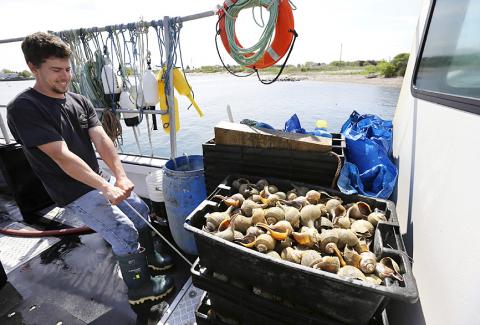
Photo: AP
“There’s an international market for the product, primarily in Hong Kong and South China,” said Rick Robins, who owns Bernie’s Conchs in Virginia and manages export sales for Chesapeake Bay Packing. “It’s a popular item in Cantonese cooking.”
Most people who order a plate of scungilli probably have not seen one of the hairy-shelled gastropods in the wild. A voracious predator, it crawls along the bottom of Atlantic coastal inlets from Nantucket Sound to North Carolina’s Outer Banks, piercing its razor-edged proboscis into clams and other prey.
“They’re not like their Caribbean cousin,” Rhode Island fisherman Greg Mataronas said, comparing it to the tropical, vegetarian conch. “They’re the northern, ugly version. Their faces are a hunk of meat.”
It is an increasingly lucrative hunk of meat: A large whelk can be sold for as much as US$7 in a live market.
The annual dockside value of the whelk catch now tops US$1 million in Virginia and Rhode Island, US$1.4 million in New Jersey and US$5.7 million in Massachusetts, according to marine fishery agencies in those states. In Delaware, knobbed and channeled whelks are now the third most valuable fishery behind blue crabs and striped bass.
In the colder waters of Maine, a smaller waved whelk served up as a “pickled wrinkle” is seeing a resurgence in popularity. The same whelk is also fished in Canada and favored in Korean cuisine, Robins said.
In southern New England, as the lobster industry declined from Cape Cod to Long Island Sound, the market for channeled whelks grew so quickly that states have scrambled to establish rules to let the snails grow big enough to breed.
“As lobster fishing has declined, whelk fishing has increased,” said Scott Morello, a researcher at Maine’s Downeast Institute for Applied Marine Research & Education. “Even so, it’s still not as profitable for a year-round fishery that you’d want to base an entire economy off of it.”
Mataronas identifies himself as a lobsterman, just as his father and grandfather did in the Rhode Island seaside town of Little Compton.
“Lobstering was so good in the ’90s” that he paid no attention to snails, Mataronas said.
However, since 2000, he has devoted much of his spring and fall to trapping whelks in the calm waters of the Sakonnet River, a tidal strait that flows into Rhode Island Sound. Baited by dogfish meat and horseshoe crabs, the snails crawl into traps left about 3m deep on the muddy sea floor.
Some upscale New York City restaurants now feature fresh or even raw whelks on the menu. The old-school Italian restaurants that serve sea snail salad — a popular Christmastime dish — usually get it canned from a handful of specialty processors.
“It’s almost impossible to find fresh scungilli these days,” said Frank Lombardi, owner of Lombardi’s Trattoria in Connecticut. “The texture has to be soft, it has to be cooked right and do the right job. The only way you can really find good scungilli is in a can.”
Lombardi recalls a similar dish from his childhood in Naples, Italy, but culinary experts dispute whether it is really an Italian food or something invented by Italian Americans in the northeast.
“I imagine that early Italian immigrants in the late 19th and early 20th century in Massachusetts, Rhode Island, Connecticut, New York and New Jersey found whelks on the beaches,” cookbook author Clifford Wright said. “It was a cheap food and they were poor people.”
For those courageous enough to cook fresh whelk on their own, Morello said it is worth the hassle. Some use a hammer to get at the snail’s muscular foot.
Morello prefers to boil it in its shell, then chops off the snail’s lid-like operculum, digs out the meat with a fork, removes the organs and pan-fries the rest.

Micron Memory Taiwan Co (台灣美光), a subsidiary of US memorychip maker Micron Technology Inc, has been granted a NT$4.7 billion (US$149.5 million) subsidy under the Ministry of Economic Affairs A+ Corporate Innovation and R&D Enhancement program, the ministry said yesterday. The US memorychip maker’s program aims to back the development of high-performance and high-bandwidth memory chips with a total budget of NT$11.75 billion, the ministry said. Aside from the government funding, Micron is to inject the remaining investment of NT$7.06 billion as the company applied to participate the government’s Global Innovation Partnership Program to deepen technology cooperation, a ministry official told the

Taiwan Semiconductor Manufacturing Co (TSMC, 台積電), the world’s leading advanced chipmaker, officially began volume production of its 2-nanometer chips in the fourth quarter of this year, according to a recent update on the company’s Web site. The low-key announcement confirms that TSMC, the go-to chipmaker for artificial intelligence (AI) hardware providers Nvidia Corp and iPhone maker Apple Inc, met its original roadmap for the next-generation technology. Production is currently centered at Fab 22 in Kaohsiung, utilizing the company’s first-generation nanosheet transistor technology. The new architecture achieves “full-node strides in performance and power consumption,” TSMC said. The company described the 2nm process as

Shares in Taiwan closed at a new high yesterday, the first trading day of the new year, as contract chipmaker Taiwan Semiconductor Manufacturing Co (TSMC, 台積電) continued to break records amid an artificial intelligence (AI) boom, dealers said. The TAIEX closed up 386.21 points, or 1.33 percent, at 29,349.81, with turnover totaling NT$648.844 billion (US$20.65 billion). “Judging from a stronger Taiwan dollar against the US dollar, I think foreign institutional investors returned from the holidays and brought funds into the local market,” Concord Securities Co (康和證券) analyst Kerry Huang (黃志祺) said. “Foreign investors just rebuilt their positions with TSMC as their top target,

POTENTIAL demand: Tesla’s chance of reclaiming its leadership in EVs seems uncertain, but breakthrough in full self-driving could help boost sales, an analyst said Chinese auto giant BYD Co (比亞迪) is poised to surpass Tesla Inc as the world’s biggest electric vehicle (EV) company in annual sales. The two groups are expected to soon publish their final figures for this year, and based on sales data so far this year, there is almost no chance the US company led by CEO Elon Musk would retain its leadership position. As of the end of last month, BYD, which also produces hybrid vehicles, had sold 2.07 million EVs. Tesla, for its part, had sold 1.22 million by the end of September. Tesla’s September figures included a one-time boost in


 RSS
RSS