


A Shanghai court has accused the former chairman of state-owned Bright Food Group Co Ltd (光明食品) of embezzling about US$31 million and accepting bribes, Chinese state media reported.
The allegations against Wang Zongnan (王宗南) relate to his time at state-owned companies Shanghai Friendship Group (上海友誼集團) and Lianhua Supermarket Holdings Co Ltd (聯華超市).
Wang was general manager at Shanghai Friendship Group and then at Lianhua Supermarket, before becoming chairman at Bright Food in 2006 until his resignation for health reasons last year.
At a hearing in Shanghai, prosecutors accused Wang of embezzling 190 million yuan (US$31 million) between 2000 and 2006 while he was chairman of Lianhua Supermarket, Xinhua news agency said late on Friday.
The court also charged him with accepting 2.69 million yuan in bribes, the report added.
In 2003, Wang’s parents bought two Shanghai villas for 2.1 million yuan — 2.7 million yuan less than the then-market price — from a company subsidiary their son allegedly did an unspecified favor for in 2000, Xinhua said, without elaborating.
A verdict is expected later, it added.
While chairman of Bright Food, Wang helped put one of China’s biggest food corporations on the global stage with several acquisitions, including a deal for a majority stake in Britain’s Weetabix, which valued the cereal maker at US$1.94 billion.
Under Wang, Bright Food also bought into Australia’s Manassen Foods and New Zealand’s Synlait Milk Ltd.
Wang’s trial is the latest incident in a government anti-corruption campaign that has embroiled several senior state officials, including a former security chief, and that has recently extended to executives at major state companies.
Separately, a former vice president of China North East Petroleum Holdings Ltd (CNEP, 中國東北石油控股) was sentenced to three years’ probation for an accounting misstep after more serious charges were dropped or dismissed in a case spawned by US regulators’ investigation of reverse mergers involving Chinese companies.
Chao Jiang (姜超), 34, was also fined US$10,000 by US District Judge Richard Leon in Washington on Friday for failing to maintain accounting controls at CNEP.
The charges grew out of a 2012 US Securities and Exchange Commission civil fraud case against CNEP. The commission has been investigating reverse mergers since 2010 amid concerns that some Chinese companies that gained listings on US exchanges were doctoring their financial statements.
CNEP was a Nevada corporation formed to undertake exploration, drilling and production in China, with principal offices in New York and California, court filings said.
It was formed through a reverse merger with a US-based shell company in 2004, according to the filings. The New York Stock Exchange delisted the shares in 2012.
Jiang was originally charged with conspiracy, securities and wire fraud, and making false statements.
Leon threw out some of the counts and in April declared a mistrial after jurors failed to agree on the remaining charges.
Jiang pleaded guilty to the failing to maintain accounting controls charge in September. Prosecutors recommended probation.
Additional reporting by Bloomberg
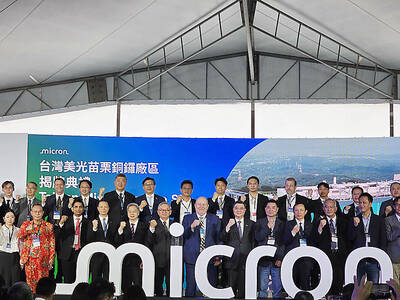
UNPRECEDENTED PACE: Micron Technology has announced plans to expand manufacturing capabilities with the acquisition of a new chip plant in Miaoli Micron Technology Inc unveiled a newly acquired chip plant in Miaoli County yesterday, as the company expands capacity to meet growing demand for advanced DRAM chips, including high-bandwidth memory chips amid the artificial intelligence boom. The plant in Miaoli County’s Tongluo Township (銅鑼), which Micron acquired from Powerchip Semiconductor Manufacturing Corp (力積電) for US$1.8 billion, is expected to make a sizeable capacity contribution to the company from fiscal 2028, the company said in a statement. It would be an extended production site of Micron’s large-scale manufacturing hub in Taichung, the company said. As the global semiconductor industry is racing to reach US$1 trillion

Singapore-based ride-hailing and delivery giant Grab Holdings Ltd has applied for regulatory approval to acquire the Taiwan operations of Germany-based Delivery Hero SE's Foodpanda in a deal valued at about US$600 million. Grab submitted the filing to the Fair Trade Commission on Friday last week, with the transaction subject to regulatory review and approval, the company said in a statement yesterday. Its independent governance structure would help foster a healthy and competitive market in Taiwan if the deal is approved, Grab said. Grab, which is listed on the NASDAQ, said in the filing that US-based Uber Technologies Inc holds about 13 percent of
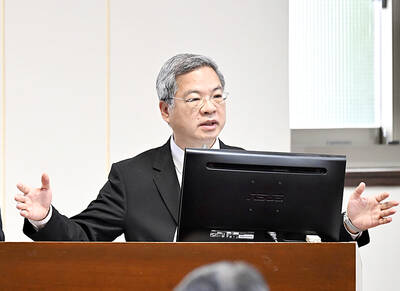
ABOVE LEGAL REQUIREMENT: The Ministry of Economic Affairs is prepared if LNG supply is disrupted, with more than the legal requirement of 11 days of inventory Taiwan has largely secured liquefied natural gas (LNG) supplies through May and arranged about half of June’s supply, Minister of Economic Affairs Kung Ming-hsin (龔明鑫) said yesterday. Since the Middle East conflict began on Feb. 28, Taiwan’s LNG inventories have remained more than 12 days, exceeding the legal requirement of 11 days, indicating no major supply concerns for domestic gas and electricity, Kung said at a meeting of the legislature’s Economics Committee in Taipei. The ministry aims to increase the figure to 14 days by the end of next year, he said. While one or two LNG or crude oil shipments for May

Taiwan’s food delivery market could undergo a major shift if Singapore-based Grab Holdings Ltd completes its planned acquisition of Delivery Hero SE’s Foodpanda business in Taiwan, industry experts said. Grab on Monday last week announced it would acquire Foodpanda’s Taiwan operations for US$600 million. The deal is expected to be finalized in the second half of this year, with Grab aiming to complete user migration to its platform by the first half of next year. A duopoly between Uber Eats and Foodpanda dominates Taiwan’s delivery market, a structure that has remained intact since the Fair Trade Commission (FTC) blocked Uber Technologies Inc’s


 RSS
RSS