


The US Federal Reserve is likely to make a final push into the post-crisis era this week with a decision to finally wind up its six-year-old economic stimulus operations.
A few worrisome clouds over the global economy might be expected to give Fed Chair Janet Yellen’s Federal Open Market Committee (FOMC) pause when they meet tomorrow and on Wednesday.
However, after repeatedly signaling the end this month of the bond-buying program known as quantitative easing (QE), the Fed is unlikely to change course, analysts said.
The Fed is currently adding US$15 billion in cheap funds to the economy per month under QE, down from US$85 billion in December last year.
The chance that the FOMC might hold off remains.
Last week James Bullard, head of the Fed’s St Louis branch and a former FOMC member, said QE should continue until the data is clearer.
US inflation expectations are dropping, Bullard said.
“That is something that a central bank cannot abide ... we could go on pause on the taper at this juncture and wait until we see how the data shakes out into December,” he said.
However, analysts said that the Fed does not act on one or two months’ data, but looks at the trend, which has been steady if modest improvement in the US economy.
More important, they said, is what the FOMC says about the next phase of policy: the initial increase in the benchmark Fed funds interest rate, which has been held at zero since the end of 2008.
Right now that is not expected until the middle of next year.
However, any change in FOMC guidance language could give a start to rate-sensitive markets.
For the Fed, the move signals the beginning of policy “normalization” after six years of a crisis stance.
Since 2008, the Fed has pumped into the economy about US$3.5 trillion of easy money through QE operations, buying Treasury and mortgage securities to push down long-term interest rates to encourage investment and spending.
That was achieved, but with limited impact in part because while the Fed injected cash into the system, the government has slashed spending for the past three years.
One clear result though has been to reinflate the value of stocks, property and other assets that collapsed during the crisis.
Now US stocks have soared to record levels, sparking recent calls for caution, including from the IMF, that QE operations have overheated markets.
Yet, at the same time, the IMF and others have warned the Fed to be careful gearing down for the turbulence that could come with rising interest rates around the world.
“We expect the committee will stick to its guns and shut the controversial program down after Wednesday’s FOMC meeting,” FTN Financial’s Chris Low said.
The end of QE technically would not amount to tightening.
The Fed said it does not plan to sell off the assets, and for those maturing it would roll them over in the near term.
Yellen said it could “take to the end of the decade” for the Fed to get rid of assets it bought under QE.
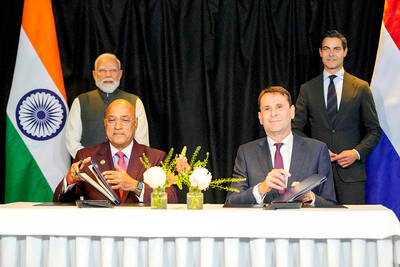
NEW MARKET: The partnership opens up India to the Dutch company, which already has a strong hold in the semiconductor market of South Korea, Taiwan and China ASML Holding NV entered into a partnership agreement with Tata Electronics Pvt Ltd aimed at ramping up India’s goal to develop domestic chip-manufacturing capabilities. The Dutch company’s technology would help power Tata Electronics’ planned 300 millimeter (mm) semiconductor foundry in Gujarat, according to a joint statement from the two companies on Saturday. The signing of a memorandum of understanding coincides with a visit by Indian Prime Minister Narendra Modi to the Netherlands, which is looking to deepen bilateral relations with New Delhi. ASML, whose top customers include Taiwan Semiconductor Manufacturing Co (台積電) and Samsung Electronics Co, makes lithography machines that can print
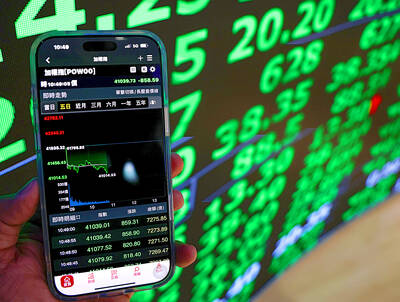
PORTFOLIO REBALANCING: The adjustments in three global equity indices reflect rising investor appetite for semiconductor and artificial intelligence-related stocks Taiwan’s weighting in major global equity indices compiled by MSCI Inc is to rise modestly following the latest quarterly review, underscoring the market’s expanding role in emerging-market portfolios, as global investors continue to favor the nation’s technology sector. Taiwan’s weighting in the MSCI Emerging Markets Index is to increase by 0.30 percentage points to 23.76 percent, after the changes take effect at the close of the May 29 session. Its weighting in the MSCI All-Country Asia ex-Japan Index is to rise 0.37 percentage points to 27.16 percent, while that in the MSCI All Country World Index is to edge up slightly to
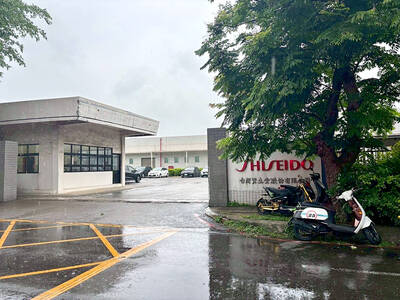
The Hsinchu County Government’s Labor Affairs Department yesterday said that it has received a plan from cosmetics brand Taiwan Shiseido Co (台灣資生堂) detailing mass layoffs at its plant in Hukou Township (湖口). While the labor authorities did not disclose the number of employees to be laid off, Japanese news media earlier in the day reported that the closure of the company’s factory in Hukou would result in 170 employees losing their jobs. Shiseido followed the law by reporting its layoff plan, the department said, adding that authorities would closely monitor negotiations between the management and affected employees and step in if any

Hon Hai Precision Industry Co (鴻海精密) on Tuesday confirmed a cyberattack targeting some of its North American facilities, but said the affected factories were gradually returning to normal. The company, known globally as Foxconn Technology Group (富士康科技集團), said that its cybersecurity team “activated the response mechanism and implemented operational measures to ensure the continuity of production and delivery.” “The affected factories are resuming normal production,” the company said in a statement. Hon Hai had previously described it as a “technical issue,” when news of the cyberattack first surfaced. The confirmation followed media reports of a large-scale information technology system incident that broke out at


 RSS
RSS