


Yahoo Inc on Wednesday added Vizify to the long list of startups it has bought since former Google Inc executive Marissa Mayer took the helm less than two years ago.
The company did not disclose how much it paid for Vizify, which specializes in letting people turn their social media data into videos, infograpics or other visual presentations.
“We have found in Vizify a company that shares our passion for visualization technology and the user experience,” Yahoo said.
Founded in 2011, Vizify is based in Portland, Oregon. Its five-member team are to join Yahoo’s media product group in San Francisco.
“As for what’s next, we can’t talk specifics just yet, but we’re excited to bring a more visual approach to data at Yahoo,” the Vizify team said in a post on the company’s Web site.
“We have a lot more up our sleeves and can’t wait to get started,” the team said.
Sunnyvale, California-based Yahoo has bought more than two dozen startups as Mayer tries to pump new life into the aging Internet pioneer eclipsed by Silicon Valley neighbor Google.
Last month, Yahoo acquired Wander, which makes the smartphone visual diary-app Days.
The Days app, launched a year ago, lets people weave images captured at various moments into “visual diaries” of any given days in their lives.
The Wander team are to work in Yahoo offices in New York as the company adds more muscle to its efforts to be center stage on smartphones and tablets.
Meanwhile, Yahoo on Wednesday confirmed that it would stop letting people sign into its online services using credentials from rival Internet titans Facebook or Google.
The shift began with the Yahoo Sports Tourney Pick’Em arena and will gradually expand to all of the company’s online services and products, including photo-sharing Web site Flickr.
“We are moving towards requiring all users to access our service with a Yahoo username over time,” the faded Internet search star said. “Eventually, the sign in buttons for Facebook and Google will be removed from all Yahoo properties.”
Yahoo portrayed the move as enabling the California-based firm to provide more personalized services and content to visitors, but it was also seen as part of a strategy to better target money-making ads.

MANAGING RISKS: Taiwan has secured LNG sufficient to cover 95 percent of electricity demand for next month, UBS said, describing the government’s approach as proactive UBS Group AG has raised its forecast for Taiwan’s economic growth this year to 8 percent, up from 6.9 percent previously, and said expansion could reach as high as 8.6 percent if external energy shocks are avoided. The upgrade reflects a stronger-than-expected first-quarter performance and sustained momentum in artificial intelligence (AI)-driven exports, which UBS said are providing a firm foundation for growth despite geopolitical and energy risks. Taiwan’s GDP expanded 13.69 percent year-on-year in the first quarter, the fastest growth since the second quarter of 1987, the Directorate-General of Budget, Accounting and Statistics (DGBAS) reported on Thursday. On a seasonally
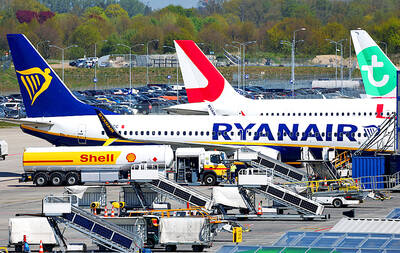
Ryanair, Transavia, Volotea and other low-cost airlines are feeling the financial pain from high jet fuel prices as a result of the Middle East war and are cutting flights. The closure of the Strait of Hormuz has taken a huge chunk of oil supplies off the market, sending the price of jet fuel soaring and triggering fears of shortages that could force airlines to cancel flights. Airlines are not waiting for a lack of supplies to react. “Travel alert: Airlines are cutting thousands of flights right now,” Travel Therapy host Karen Schaler said in an Instagram reel this past weekend.

Shares of Taiwan Semiconductor Manufacturing Co (TSMC, 台積電) have repeatedly hit new highs, but an equity analyst said the stock’s valuation remains within a reasonable range and any pullback would likely be technical. The contract chipmaker’s historical price-to-earnings (P/E) ratio has ranged between 20 and 30, Cathay Futures Consultant Co (國泰證期) analyst Tsai Ming-han (蔡明翰) told Central News Agency. With market consensus projecting that TSMC would post earnings per share of about NT$100 (US$3.17) this year, supported by strong global demand for artificial intelligence (AI) applications, and the stock currently trading at a P/E ratio of below 25, Tsai said the valuation

The US Department of Commerce last week ordered multiple chip equipment companies to halt shipments of certain tools to China’s second-largest chipmaker, Hua Hong Semiconductor Ltd (華虹半導體), its latest action to slow the country’s development of advanced chips, two people familiar with the matter said. The department sent letters to at least a handful of companies informing them of restrictions on tools and other materials destined for two Hua Hong facilities US officials believe make China’s most sophisticated chips, the people said. Top US chip equipment companies Lam Research Corp, Applied Materials Inc and KLA Corp, each of which has significant


 RSS
RSS