


After years of communist-era shortages, then a craze for Western fast food, Polish cuisine is undergoing a revival thanks to quality local ingredients and a modern twist on traditional fare.
Leading the renaissance is Atelier Amaro, a Warsaw eatery that won Poland’s first Michelin star in March for using “local produce to create innovative cuisine and original combinations.”
Tucked away in a wooded area by the Polish capital’s modern art center, the 32-seater began serving up modern takes on Polish specialties in September 2011. With no fixed menu, the dishes change with the season and feature such inspired ingredients as bison grass, burnt oak oil, wild rose petals and nettle — a native stinging plant.
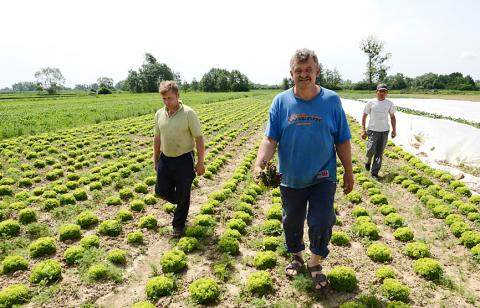
Photo: AFP
Sample recipes include “pearmain in nettle syrup, cotton candy with ginger and cinnamon, nettle sorbet” and “chilled mirabelle plum soup with vanilla, hazelnut emulsion, lemon verbena leaves.”
Owner-chef Wojciech Modest Amaro says the emphasis is on natural ingredients, preferably Polish ones. The 41-year-old electronics expert and political scientist learned to cook while living in England. He then honed his skills at elBulli, Spain’s now shuttered Michelin three-star restaurant, before opening up his own place.
“We want to put Poland on the culinary map of the world...” said his wife, Agnieszka Amaro.
Polish cuisine was once rich with Italian, German, Jewish and Armenian influences, but communism stripped it of its variety, leaving it with a bland reputation.
“For 50 years, really only around a dozen staple ingredients were available,” Amaro said, referring to the chronic shortages under communism.
“So we learned to cook very simple dishes like pierogi and breaded pork chops, which ironically are not part of traditional Polish cuisine,” he said. “After the fall of communism, Poles quickly grew richer and adopted a Western lifestyle — fast food included — and it’s only recently that they’ve begun to respect local products.”
Amaro is determined to revolutionize the national cuisine by reaching out to small farms that operate the traditional way: no pesticides, preservatives or additives.
Poland is “rich in natural food: We are the world’s fifth producer of wild herbs and flowers, we’re the land of mushrooms and game thanks to our forests,” Amaro said, pointing to the country’s mountains, lakes and Baltic Sea shore.
Before opening his restaurant, Amaro clocked 60,000km driving around the country seeking out farmers like Piotr and Maryla Rutkowski in the central village of Maciejowice. They started out selling a few kinds of lettuce 15 years ago and now the 40-somethings also grow herbs, cucumbers, strawberries, tomatoes, cauliflower, squash and zucchini.
“The demand for vegetables grown the traditional way is continually on the rise, especially among young people, to the point that sometimes we run out of product,” Maryla Rutkowski said.
In the hip Warsaw neighborhood of Saska Kepa, one enthusiast of the Slow Food movement — which promotes natural ingredients in contrast to fast food — started the Le Targ farmer’s market, one of six in the city.
Stocked with produce from across Poland, the market is one of four to crop up in Warsaw in the past year, reflecting “a niche that keeps on growing,” founder Zuzana Groniowska said.
With about 30 stands, the market features vegetables, honey, yoghurts, bread and charcuterie and draws shoppers from all over.
Amaro predicts bright days ahead for Polish food.
“The Michelin star shows that we have all the elements needed to create a great Polish cuisine that can be exported around the world,” he said.
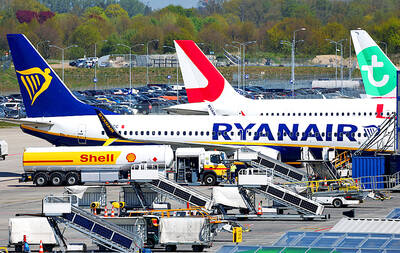
Ryanair, Transavia, Volotea and other low-cost airlines are feeling the financial pain from high jet fuel prices as a result of the Middle East war and are cutting flights. The closure of the Strait of Hormuz has taken a huge chunk of oil supplies off the market, sending the price of jet fuel soaring and triggering fears of shortages that could force airlines to cancel flights. Airlines are not waiting for a lack of supplies to react. “Travel alert: Airlines are cutting thousands of flights right now,” Travel Therapy host Karen Schaler said in an Instagram reel this past weekend.
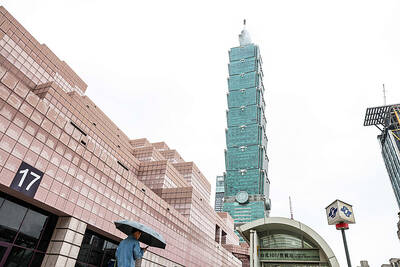
MANAGING RISKS: Taiwan has secured LNG sufficient to cover 95 percent of electricity demand for next month, UBS said, describing the government’s approach as proactive UBS Group AG has raised its forecast for Taiwan’s economic growth this year to 8 percent, up from 6.9 percent previously, and said expansion could reach as high as 8.6 percent if external energy shocks are avoided. The upgrade reflects a stronger-than-expected first-quarter performance and sustained momentum in artificial intelligence (AI)-driven exports, which UBS said are providing a firm foundation for growth despite geopolitical and energy risks. Taiwan’s GDP expanded 13.69 percent year-on-year in the first quarter, the fastest growth since the second quarter of 1987, the Directorate-General of Budget, Accounting and Statistics (DGBAS) reported on Thursday. On a seasonally
The Fair Trade Commission’s (FTC) ongoing review of Grab Holdings Ltd’s US$600 million acquisition of Foodpanda Taiwan’s operations, announced on March 23, has taken on fresh urgency as industry experts warn that the transaction could embed significant Chinese cybersecurity vulnerabilities into Taiwan’s digital infrastructure through Grab’s deep ties to autonomous-driving firm WeRide (文遠知行). Less than 16 months after the FTC blocked Uber Eats’ direct attempt to acquire Foodpanda Taiwan — citing potential combined market shares of 80 to 90 percent — the emergence of Grab as the buyer has prompted questions about whether the same competitive harm is simply being rerouted

The list of Asian stocks that benefit from business partnership with Nvidia Corp is getting longer, as the region further integrates into the artificial intelligence (AI) chip giant’s business ecosystem. Just in the past week, South Korea’s LG Electronics Inc, Taiwan’s Nanya Technology Corp (南亞科技), as well as China’s Huizhou Desay SV Automotive Co (德賽西威) and Pateo Connect Technology Shanghai Corp (博泰車聯) have become the latest to rally on news of tie-ups, supply-chain participation or product collaboration with the US chip designer. Asian suppliers account for about 90 percent of Nvidia’s production costs, up from about 65 percent last year, data compiled


 RSS
RSS