


Japan Display Inc, which supplies LCDs to Apple Inc, is expanding a factory that makes panels for smartphones and tablet computers as the yen’s weakness helps spur overseas demand.
The company is boosting capacity of high-definition LCDs at its plant in Chiba Prefecture, east of Tokyo, president Shuichi Otsuka said in an interview on Thursday.
Japan Display plans to start the operations next month as it targets sales of as much as ¥800 billion (US$7.8 billion) this year, he said.
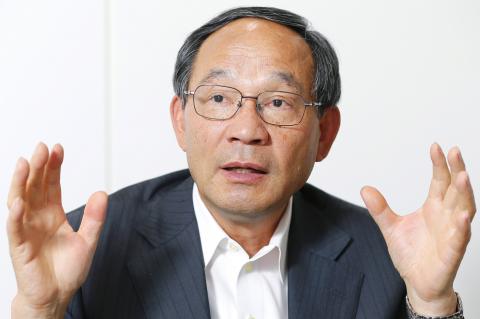
Photo: Bloomberg
Tokyo-based Japan Display was set up last year, when Sony Corp, Toshiba Corp and Hitachi Ltd spun off their businesses to a government-backed fund after struggling to compete with South Korea’s Samsung Electronics Co and Taiwan’s Innolux Corp (群創光電) in the TV display market.
“Our business is now on track,” said Otsuka, a former chief operating officer at Elpida Memory Inc. “Our technology is unique, so it won’t be easy for other companies to do the same.”
The yen touched ¥102.76 per US dollar this week, the weakest since October 2008. It has tumbled about 21 percent since November, making it the biggest loser among 10 developed-nation currencies tracked by Bloomberg Correlation Weighted Indexes.
“It’s positive for our business,” Otsuka said.
Every ¥1 drop in the US dollar boosts Japan Display’s profit by ¥1.5 billion, he said.
Apple CEO Tim Cook told analysts last month that new products are in the works for later this year and through next year, without giving details.
IPhone 5S production may start as early as late next month, Jefferies Group LLC analyst Peter Misek said in a note this week.
Japan Display is ahead of its target with the expansion. Sales may reach between ¥700 billion and ¥800 billion in the year started April 1, from about ¥450 billion last fiscal year, Otsuka said.
The company plans to remain profitable, after posting an operating margin of no more than about 1 percent last year, he said without elaborating.
Japan Display wants to expand sales of displays used in cars such as instrument panels, Otsuka said.
Japan Display’s share of revenue in the global market for small and mid-sized LCDs was 16.6 percent last year, according to NPD DisplaySearch.
Sharp Corp held 14.8 percent, followed by LG Display Co’s 13.5 percent and Innolux’s 10.2 percent, the market researcher said.
ENERGY ISSUES: The TSIA urged the government to increase natural gas and helium reserves to reduce the impact of the Middle East war on semiconductor supply stability Chip testing and packaging service provider ASE Technology Holding Co (日月光投控) yesterday said it planned to invest more than NT$100 billion (US$3.15 billion) in building a new advanced chip testing facility in Kaohsiung to keep up with customer demand driven by the artificial intelligence (AI) boom. That would be included in the company’s capital expenditure budget next year, ASE said. There is also room to raise this year’s capital spending budget from a record-high US$7 billion estimated three months ago, it added. ASE would have six factories under construction this year, another record-breaking number, ASE chief operating officer Tien Wu

The EU and US are nearing an agreement to coordinate on producing and securing critical minerals, part of a push to break reliance on Chinese supplies. The potential deal would create incentives, such as minimum prices, that could advantage non-Chinese suppliers, according to a draft of an “action plan” seen by Bloomberg. The EU and US would also cooperate on standards, investments and joint projects, as well as coordinate on any supply disruptions by countries like China. The two sides are additionally seeking other “like-minded partners” to join a multicountry accord to help create these new critical mineral supply chains, which feed into

For weeks now, the global tech industry has been waiting for a major artificial intelligence (AI) launch from DeepSeek (深度求索), seen as a benchmark for China’s progress in the fast-moving field. More than a year has passed since the start-up put Chinese AI on the map in early last year with a low-cost chatbot that performed at a similar level to US rivals. However, despite reports and rumors about its imminent release, DeepSeek’s next-generation “V4” model is nowhere in sight. Speculation is also swirling over the geopolitical implications of which computer chips were chosen to train and power the new
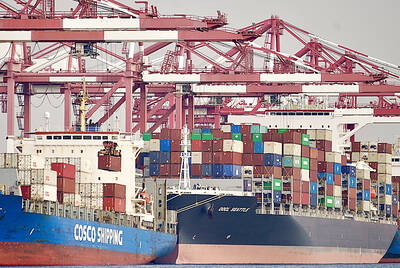
TECH WINNERS: Taiwan and South Korea reported robust trade, which suggests that they have critical advantages in the rapidly expanding AI supply chain, an official said Exports last month surged to a new high, as booming demand tied to artificial intelligence (AI) infrastructure fueled shipments of advanced technology components, underscoring the nation’s pivotal role in the global semiconductor supply chain. Outbound shipments climbed to US$80.18 billion, the highest ever for a single month, rising 61.8 percent from a year earlier and marking the 29th consecutive month of growth, the Ministry of Finance said yesterday. “The surge was driven primarily by global investment in AI infrastructure,” Department of Statistics Director-General Beatrice Tsai (蔡美娜) said. The mass production of next-generation AI computing systems has accelerated procurement across the semiconductor supply


 RSS
RSS