


Samsung Electronics Co chairman Lee Kun-hee will retain control of Asia’s biggest consumer electronics maker after a court rejected relatives’ bids for a 4.1 trillion won (US$3.7 billion) stake in the group.
The brother, sister and three other family members of billionaire Lee, 71, failed to prove they should be given the stakes in Samsung Electronics and Samsung Life Insurance Co, the Seoul District Court ruled yesterday.
The family feud comes as Samsung Electronics moves ahead of Apple Inc, Sony Corp and Panasonic Corp as the world’s biggest maker of mobile phones, TVs and computer-memory chips.
The South Korea-based company boosted fourth-quarter profits by 76 percent after shipping one of every three smartphones and selling one of every four flat-panel TVs.
Lee’s brother Lee Maeng-hee and sister Lee Sook-hee, who do not have any role in the group, sued in February last year, claiming they were entitled to additional stakes. Three other relatives also sued.
The five plaintiffs will decide if they will appeal after reviewing the ruling, their lawyer Cha Dong-eon said.
Yun Jae-yun, a lawyer for Lee Kun-hee, said the judge’s decision was reasonable. Lee Kun-hee had said before the ruling he would not give a “dime” to his relatives because inheritance matters had been settled by his father, and he would appeal a loss, according to media reports.
Handing over the shares to his siblings would have meant the chairman would no longer be the largest investor in Samsung Life.
In South Korea’s complex world of cross-holding of shares in companies, that could have triggered a dispute over control of Samsung Electronics, Chae Yi-bai, a researcher at the Center for Good Corporate Governance, a Seoul-based private institute monitoring South Korean conglomerates, said before the ruling.
Lee Kun-hee holds 41.5 million shares, or about 21 percent, of Samsung Life, making him the largest shareholder, according to data compiled by Bloomberg.
His elder brother wanted at least 9.65 million shares and his sister wanted 2.6 million shares.
The public holdings of Lee Kun-hee, South Korea’s richest man, are valued at US$11.2 billion, according to data compiled by Bloomberg.
The family conglomerate, Samsung Group, controls more than 80 companies making armored vehicles and artillery for South Korea’s military, oil tankers, amusement parks and apartment complexes.
Samsung Group generates about 20 percent of South Korea’s GDP.

ENERGY ISSUES: The TSIA urged the government to increase natural gas and helium reserves to reduce the impact of the Middle East war on semiconductor supply stability Chip testing and packaging service provider ASE Technology Holding Co (日月光投控) yesterday said it planned to invest more than NT$100 billion (US$3.15 billion) in building a new advanced chip testing facility in Kaohsiung to keep up with customer demand driven by the artificial intelligence (AI) boom. That would be included in the company’s capital expenditure budget next year, ASE said. There is also room to raise this year’s capital spending budget from a record-high US$7 billion estimated three months ago, it added. ASE would have six factories under construction this year, another record-breaking number, ASE chief operating officer Tien Wu

The EU and US are nearing an agreement to coordinate on producing and securing critical minerals, part of a push to break reliance on Chinese supplies. The potential deal would create incentives, such as minimum prices, that could advantage non-Chinese suppliers, according to a draft of an “action plan” seen by Bloomberg. The EU and US would also cooperate on standards, investments and joint projects, as well as coordinate on any supply disruptions by countries like China. The two sides are additionally seeking other “like-minded partners” to join a multicountry accord to help create these new critical mineral supply chains, which feed into

For weeks now, the global tech industry has been waiting for a major artificial intelligence (AI) launch from DeepSeek (深度求索), seen as a benchmark for China’s progress in the fast-moving field. More than a year has passed since the start-up put Chinese AI on the map in early last year with a low-cost chatbot that performed at a similar level to US rivals. However, despite reports and rumors about its imminent release, DeepSeek’s next-generation “V4” model is nowhere in sight. Speculation is also swirling over the geopolitical implications of which computer chips were chosen to train and power the new
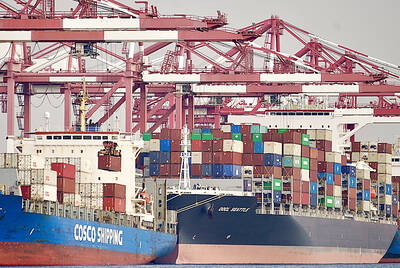
TECH WINNERS: Taiwan and South Korea reported robust trade, which suggests that they have critical advantages in the rapidly expanding AI supply chain, an official said Exports last month surged to a new high, as booming demand tied to artificial intelligence (AI) infrastructure fueled shipments of advanced technology components, underscoring the nation’s pivotal role in the global semiconductor supply chain. Outbound shipments climbed to US$80.18 billion, the highest ever for a single month, rising 61.8 percent from a year earlier and marking the 29th consecutive month of growth, the Ministry of Finance said yesterday. “The surge was driven primarily by global investment in AI infrastructure,” Department of Statistics Director-General Beatrice Tsai (蔡美娜) said. The mass production of next-generation AI computing systems has accelerated procurement across the semiconductor supply


 RSS
RSS