


Samsung Electronics Co, the world’s largest maker of TVs and mobile phones, said an internal audit of suppliers in China found “inadequate practices” that include employees working more overtime than allowed by law.
Samsung found that some of the 105 suppliers checked in September were fining workers for being late or absent and were holding copies of labor contracts, the company said in an e-mailed statement yesterday.
The review did not identify any instance of child labor at the suppliers, Samsung said.
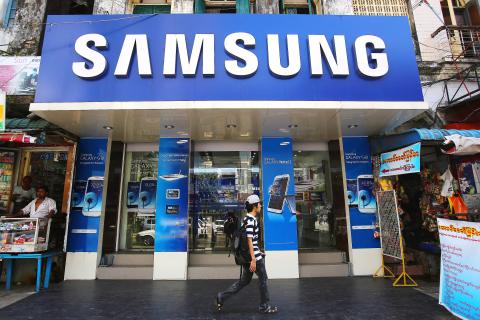
Photo: Bloomberg
A New York-based labor group said in August an assembler contracted by the South Korean company hired children.
Labor advocates are widening monitoring of electronics factories in Asia to Samsung, Dell Inc and Hewlett-Packard Co after suicides at a China plant of Apple Inc supplier Foxconn Technology Group (富士康科技集團) in 2010 drew increased attention to working conditions.
China Labor Watch said in a report in September it discovered “severe labor abuses” at factories owned and operated by Samsung and its suppliers.
“Samsung takes concerns about working conditions in China seriously,” the Suwon, South Korea-based company said in yesterday’s statement. “Whenever an issue is identified, we take immediate and appropriate steps to correct it.”
Samsung is developing and implementing corrective actions to address every violation, it said in the statement.
Those may include new hiring policies, work hours and overtime practices, it said.
The company said all candidates will be interviewed in person before hiring to strengthen identity verification measures and to detect fake IDs.
Measures to eliminate working hours beyond legal limits will be implemented by the end of 2014, the company said.
Samsung said it examined 105 companies in China, with a total of more than 65,000 workers, during a four-week period in response to China Labor Watch’s reports on its suppliers.
The company said it will review another 144 suppliers by year’s end.
The labor group said in August that seven children younger than 16 were working in a factory of HEG Electronics (Huizhou) Co (海格國利電子) that makes phones and DVD players for Samsung.
“Although we did not identify any child labor during our audits in September, we have demanded all suppliers to adopt a new hiring process immediately, and contracts with suppliers who use child labor will be terminated,” Samsung said in yesterday’s statement.
In a Sept. 4 report, China Labor Watch said it found abuses at six factories owned and operated by Samsung and two of its suppliers’ facilities.
The violations included forced overtime work amounting to more than 100 hours a month, unpaid work and 11 to 12 hours of standing, the group said.
The eight plants investigated by the labor group employed a combined 24,000 workers making mobile phones, DVD players, mobile displays and air conditioners, the Sept. 4 report said.
The base salary for workers at a printer factory owned by Samsung is about US$250 a month, the report said.
Samsung plans to have the Electronic Industry Citizenship Coalition (EICC), a Washington-based industry group, regularly check its own plants and all of its suppliers in China from next year.
The EICC is a group monitoring industry supply chains, with electronics and technology companies as members. Its current board members include officials from International Business Machines Corp, Dell, HP and Intel Corp, according to its Web site.
Foxconn, the Apple supplier targeted by human-rights activists after the suicides, has cut working hours and improved safety at a faster pace than it was required, the Fair Labor Association (FLA) said in a report in August.
Apple opened factories making its products to the FLA, becoming the first electronics company to join the Washington-based independent labor monitoring group.
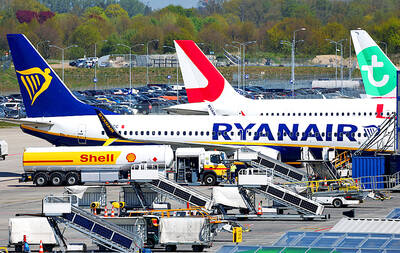
Ryanair, Transavia, Volotea and other low-cost airlines are feeling the financial pain from high jet fuel prices as a result of the Middle East war and are cutting flights. The closure of the Strait of Hormuz has taken a huge chunk of oil supplies off the market, sending the price of jet fuel soaring and triggering fears of shortages that could force airlines to cancel flights. Airlines are not waiting for a lack of supplies to react. “Travel alert: Airlines are cutting thousands of flights right now,” Travel Therapy host Karen Schaler said in an Instagram reel this past weekend.
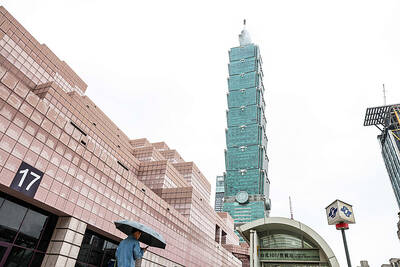
MANAGING RISKS: Taiwan has secured LNG sufficient to cover 95 percent of electricity demand for next month, UBS said, describing the government’s approach as proactive UBS Group AG has raised its forecast for Taiwan’s economic growth this year to 8 percent, up from 6.9 percent previously, and said expansion could reach as high as 8.6 percent if external energy shocks are avoided. The upgrade reflects a stronger-than-expected first-quarter performance and sustained momentum in artificial intelligence (AI)-driven exports, which UBS said are providing a firm foundation for growth despite geopolitical and energy risks. Taiwan’s GDP expanded 13.69 percent year-on-year in the first quarter, the fastest growth since the second quarter of 1987, the Directorate-General of Budget, Accounting and Statistics (DGBAS) reported on Thursday. On a seasonally

The list of Asian stocks that benefit from business partnership with Nvidia Corp is getting longer, as the region further integrates into the artificial intelligence (AI) chip giant’s business ecosystem. Just in the past week, South Korea’s LG Electronics Inc, Taiwan’s Nanya Technology Corp (南亞科技), as well as China’s Huizhou Desay SV Automotive Co (德賽西威) and Pateo Connect Technology Shanghai Corp (博泰車聯) have become the latest to rally on news of tie-ups, supply-chain participation or product collaboration with the US chip designer. Asian suppliers account for about 90 percent of Nvidia’s production costs, up from about 65 percent last year, data compiled
The Fair Trade Commission’s (FTC) ongoing review of Grab Holdings Ltd’s US$600 million acquisition of Foodpanda Taiwan’s operations, announced on March 23, has taken on fresh urgency as industry experts warn that the transaction could embed significant Chinese cybersecurity vulnerabilities into Taiwan’s digital infrastructure through Grab’s deep ties to autonomous-driving firm WeRide (文遠知行). Less than 16 months after the FTC blocked Uber Eats’ direct attempt to acquire Foodpanda Taiwan — citing potential combined market shares of 80 to 90 percent — the emergence of Grab as the buyer has prompted questions about whether the same competitive harm is simply being rerouted


 RSS
RSS