


Four fund managers involved in the handling of four government funds may have engaged in illegal trading activity, Financial Supervisory Commission (FSC) Chairman Chen Yuh-chang (陳裕璋) said at a meeting of the legislature’s Finance Committee yesterday.
Chen added that the commission plans to complete its financial scrutiny of all securities investment trust companies handling the four government funds within a month.
The four government funds are the Civil Servants Pension Fund, the Postal Savings Fund, the Labor Insurance Fund and the Labor Pension Fund.
The latest discovery was part of the commission’s investigation into abnormal stock transactions by the securities investment trust firms. The probe was launched after a report by the Chinese-language Business Today (今周刊) earlier this month alleging that former ING Securities Investment and Trust Co (ING SITC, 安泰投信) vice president Sam Hsieh (謝青良) and his peers, using the government’s Labor Insurance Fund and Labor Pension Fund, made huge profits from manipulating the stock of Ablerex Electronics Co (盈正豫順電子) via dummy accounts.
The government-owned funds incurred more than NT$100 million (US$3.4 million) in losses in 2010 after Ablerex stock nose-dived later, Council of Labor Affairs Minister Pan Shih-wei (潘世偉) said earlier this month.
Chen said the commission had finished its preliminary investigation of 38 securities investment trust companies and found four fund managers in four different firms contracted to manage government funds had “abnormal stock holdings” either themselves or by their families.
“None of the four cases are related to the Ablerex investment,” Chen said in a question-and-answer session at the committee.
He refused to name the four companies.
The commission has asked the four firms to submit a thorough explanation of the four fund managers’ behavior within 15 working days.
Asked what the commission would do after three or four fund managers reportedly resigned after the commission announced its plan to launch an investigation earlier this month, Huang Tien-mu (黃天牧), director-general of the commission’s Securities and Futures Bureau, said on the sidelines of the legislative session: “We will further clarify why they resigned.”
In its latest report, Business Today said that more alleged rogue traders like Hsieh in other securities investment trust firms were contracted to manage government funds.
The weekly said that two former fund managers, Peng Kuo-hsing (彭國星) of KGI Securities Investment Trust Co Ltd (凱基投信) and Chen Bo-yu (陳伯俞) of First Securities Inc (第一金證券), were also involved in the Ablerex case.
As First Securities Inc is a subsidiary of state-run First Financial Holding Co (第一金控), the magazine said the government should strengthen internal oversight and self-discipline to minimize malpractices.
Chen Yuh-chang, who had served as chairman of First Financial before assuming his current post as FSC chairman in 2010, said he did not know about the allegations against Chen Bo-yu because he had already left First Financial when the latter started trading Ablerex shares.
Meanwhile, the Ministry of Finance is considering new measures to monitor and operate government funds.
Minister of Finance Chang Sheng-ford (張盛和) said the government may establish a special agency in charge of the operation of the four government funds or place their operation under a single government agency.
However, the commission did not support the idea of abolishing the practice of outsourcing management of government funds, saying it is a business model used by many major countries.

ENERGY ISSUES: The TSIA urged the government to increase natural gas and helium reserves to reduce the impact of the Middle East war on semiconductor supply stability Chip testing and packaging service provider ASE Technology Holding Co (日月光投控) yesterday said it planned to invest more than NT$100 billion (US$3.15 billion) in building a new advanced chip testing facility in Kaohsiung to keep up with customer demand driven by the artificial intelligence (AI) boom. That would be included in the company’s capital expenditure budget next year, ASE said. There is also room to raise this year’s capital spending budget from a record-high US$7 billion estimated three months ago, it added. ASE would have six factories under construction this year, another record-breaking number, ASE chief operating officer Tien Wu

The EU and US are nearing an agreement to coordinate on producing and securing critical minerals, part of a push to break reliance on Chinese supplies. The potential deal would create incentives, such as minimum prices, that could advantage non-Chinese suppliers, according to a draft of an “action plan” seen by Bloomberg. The EU and US would also cooperate on standards, investments and joint projects, as well as coordinate on any supply disruptions by countries like China. The two sides are additionally seeking other “like-minded partners” to join a multicountry accord to help create these new critical mineral supply chains, which feed into

For weeks now, the global tech industry has been waiting for a major artificial intelligence (AI) launch from DeepSeek (深度求索), seen as a benchmark for China’s progress in the fast-moving field. More than a year has passed since the start-up put Chinese AI on the map in early last year with a low-cost chatbot that performed at a similar level to US rivals. However, despite reports and rumors about its imminent release, DeepSeek’s next-generation “V4” model is nowhere in sight. Speculation is also swirling over the geopolitical implications of which computer chips were chosen to train and power the new
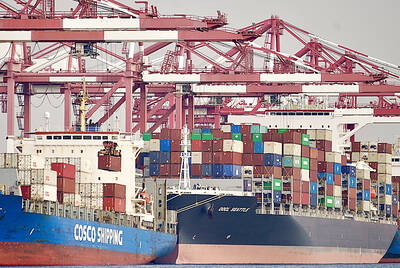
TECH WINNERS: Taiwan and South Korea reported robust trade, which suggests that they have critical advantages in the rapidly expanding AI supply chain, an official said Exports last month surged to a new high, as booming demand tied to artificial intelligence (AI) infrastructure fueled shipments of advanced technology components, underscoring the nation’s pivotal role in the global semiconductor supply chain. Outbound shipments climbed to US$80.18 billion, the highest ever for a single month, rising 61.8 percent from a year earlier and marking the 29th consecutive month of growth, the Ministry of Finance said yesterday. “The surge was driven primarily by global investment in AI infrastructure,” Department of Statistics Director-General Beatrice Tsai (蔡美娜) said. The mass production of next-generation AI computing systems has accelerated procurement across the semiconductor supply


 RSS
RSS