


The composite monitoring indicators for the economy flashed “blue” for the sixth consecutive month last month, reflecting continuing sluggish sentiment, the Council for Economic Planning and Development (CEPD) said yesterday.
The score of the composite monitoring economic indicators, which tracks nine components, was unchanged from a month earlier at 14 last month.
However, the index of leading indicators rebounded for the eighth straight month last month, providing more evidence the economy may bottom out in the second half, or might even have bottomed out in the first quarter, the council said.
The index of leading indicators, which is used to gauge near-term economic outlook, increased 0.6 percent from a month earlier to 131.4 points, the council said in its monthly report.
The index’s annualized six-month rate of change, which provides a more accurate forecast of the business cycle in the near term, climbed 0.7 percentage points to 6.6 percent last month from a month ago, marking eight months of consecutive improvement, the report indicated.
Among the seven indicators making up the trend-adjusted index, the SEMI book-to-bill ratio and stock price index improved from the previous month, with the other five indicators — building permits, real monetary aggregates M1B, index of export orders, average monthly overtime in industries and services, and the index of producer’s inventory for manufacturing — deteriorating from a month ago.
“The pace of economic recovery remains sluggish because of external and internal uncertainties,” Hung Jui-bin (洪瑞彬), director-general of the council’s economic research department, told a press conference.
Hung said the reigniting of the eurozone’s debt crises sparked by political instability in some European countries and the slowdown in China were two major external factors dragging down exports.
Domestically, consumers’ anticipation of rising consumer prices has climbed, further impacting on private consumption, Hung added.
However, Hung said he expected the economy to rebound moderately in the second half of the year, with annual economic growth expanding quarter-by-quarter.
The latest figures on the index of leading indicators of the Organisation for Economic Co-operation and Development and five Asian countries — China, India, Indonesia, Japan and South Korea — both showed a continuing recovery, which might provide some upside catalysts for Taiwan’s economy in the near future, the council said.
Last month’s trend-adjusted index of coincident indicators, which tracks the current pace of economic activity, decreased 0.1 percent to 95.9 points from a month earlier, while the trend-adjusted lagging index stood at 103.5 points last month, down 0.3 percent from a month ago, the report showed.
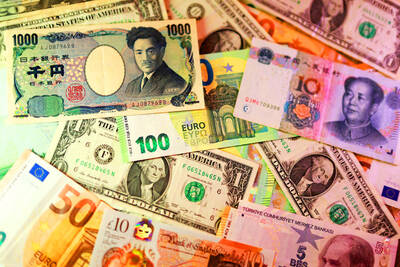
Taiwan’s foreign exchange reserves fell below the US$600 billion mark at the end of last month, with the central bank reporting a total of US$596.89 billion — a decline of US$8.6 billion from February — ending a three-month streak of increases. The central bank attributed the drop to a combination of factors such as outflows by foreign institutional investors, currency fluctuations and its own market interventions. “The large-scale outflows disrupted the balance of supply and demand in the foreign exchange market, prompting the central bank to intervene repeatedly by selling US dollars to stabilize the local currency,” Department of Foreign

ENERGY ISSUES: The TSIA urged the government to increase natural gas and helium reserves to reduce the impact of the Middle East war on semiconductor supply stability Chip testing and packaging service provider ASE Technology Holding Co (日月光投控) yesterday said it planned to invest more than NT$100 billion (US$3.15 billion) in building a new advanced chip testing facility in Kaohsiung to keep up with customer demand driven by the artificial intelligence (AI) boom. That would be included in the company’s capital expenditure budget next year, ASE said. There is also room to raise this year’s capital spending budget from a record-high US$7 billion estimated three months ago, it added. ASE would have six factories under construction this year, another record-breaking number, ASE chief operating officer Tien Wu

The EU and US are nearing an agreement to coordinate on producing and securing critical minerals, part of a push to break reliance on Chinese supplies. The potential deal would create incentives, such as minimum prices, that could advantage non-Chinese suppliers, according to a draft of an “action plan” seen by Bloomberg. The EU and US would also cooperate on standards, investments and joint projects, as well as coordinate on any supply disruptions by countries like China. The two sides are additionally seeking other “like-minded partners” to join a multicountry accord to help create these new critical mineral supply chains, which feed into

For weeks now, the global tech industry has been waiting for a major artificial intelligence (AI) launch from DeepSeek (深度求索), seen as a benchmark for China’s progress in the fast-moving field. More than a year has passed since the start-up put Chinese AI on the map in early last year with a low-cost chatbot that performed at a similar level to US rivals. However, despite reports and rumors about its imminent release, DeepSeek’s next-generation “V4” model is nowhere in sight. Speculation is also swirling over the geopolitical implications of which computer chips were chosen to train and power the new


 RSS
RSS