


Strip malls — once anchors of postwar North American suburban neighborhoods — are doomed, with thousands across Canada and the US already derelict and eyed by land developers.
However, at least one Canadian academic sees value in maintaining the ubiquitous local retailing plazas and has amassed proposals, such as adding community gardens or toboggan slides, or morphing them into giant bee hives or parking lots for food caravans.
“Strip malls were once the economic hubs of new suburbs,” said Rob Shields, a sociology professor at the University of Alberta in Edmonton, who received a government grant to rethink strip malls so that they can benefit the communities around them.
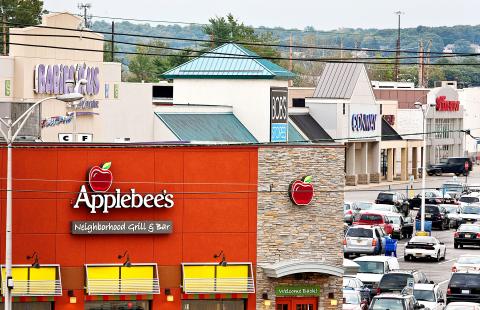
Photo: Bloomberg
For more than 50 years, retailers favored the rows of boxy single-story shops opening onto a common parking lot facing major roadways bringing commuters driving between their suburban homes and downtown workplaces.
However, they are losing favor because of rising fuel prices, traffic congestion and city planners’ demands to make cities denser as part of a drive for more “walkable” cities.
More than 11 percent of strip malls in North America are derelict, representing 28 million square meters of vacant retail space, according to the Washington-based Urban Land Institute.
The rest are arguably in decline.
City planners such as Winnipeg’s Jeff Palmer view strip malls as “retail relics.”
“They reflect a time and a place that is no longer environmentally sustainable or economically viable. They do nothing to add to the vibrancy of a neighborhood and they don’t encourage walking, communicating or socializing,” he said.
They once housed banks, dry cleaners, drugstores, post offices and video stores all in one convenient location.
However, retailing has changed. Video stores lost out to online downloading, while superstores now sell groceries as well as other goods and services all under one roof.
“If they’re going next door for a product or service, why not keep them in-house,” John Williams, a senior consultant with retail consulting firm JC Williams Group, said of superstores.
Developers, meanwhile, would rather build regional “power centers” — big strip malls that pack in more stores and two or three anchor tenants locked into 20-year leases providing more stable cash flows.
And owners increasingly view “not very pretty” strip malls as “superb redevelopment opportunities,” said Ed Sonshine, CEO of RioCan Real Estate, which owns more than 100 strip malls in Canada and the US.
Sonshine turned a 2,100m2 strip mall in Toronto into a seven-story condominium building with retail stores on the ground floor and three levels of underground parking.
The main argument for strip malls is that they allow some form of neighborhood retailing to survive, said Palmer, “so that we’re not all driving 5km to buy milk.”
Some have been transformed into restaurant plazas, which have proved to be popular. Food retailing is one of the few still strong segments in retailing.
Shields, along with cities researcher Merle Patchett, held a design contest to generate new ideas to transform others. The top entries from 11 countries, including Australia, Brazil, Egypt, Germany and Iran, are posted at www.strip-appeal.com.
“There’s still a demand for local retail services and these facilities are standing there and so the question is, how can they be reused to make suburbs more vibrant and more sustainable?” Shields said.
Many of the proposals were hashed out by the communities they seek to change. Shields plans to put on display the finalists at city halls, starting in Buffalo, New York, hoping to generate support for salvaging strip malls.
However, Sonshine offers a more sober view. Eventually all strip malls will be redeveloped, he says, “because the land will become too valuable and there is a natural limit to what retailers will pay in rent, whereas the redevelopment potential will keep growing.”
A finalist in Shields’ contest came to the same conclusion and urged stripping Buffalo’s Central Park Plaza for parts: 4,700 bricks, 12,500 concrete blocks, 1,000 ceiling tiles, 120 steel beams, 125 wood panels, 20 aluminum door and window frames, and 600 sheets of steel decking.

ENERGY ISSUES: The TSIA urged the government to increase natural gas and helium reserves to reduce the impact of the Middle East war on semiconductor supply stability Chip testing and packaging service provider ASE Technology Holding Co (日月光投控) yesterday said it planned to invest more than NT$100 billion (US$3.15 billion) in building a new advanced chip testing facility in Kaohsiung to keep up with customer demand driven by the artificial intelligence (AI) boom. That would be included in the company’s capital expenditure budget next year, ASE said. There is also room to raise this year’s capital spending budget from a record-high US$7 billion estimated three months ago, it added. ASE would have six factories under construction this year, another record-breaking number, ASE chief operating officer Tien Wu

The EU and US are nearing an agreement to coordinate on producing and securing critical minerals, part of a push to break reliance on Chinese supplies. The potential deal would create incentives, such as minimum prices, that could advantage non-Chinese suppliers, according to a draft of an “action plan” seen by Bloomberg. The EU and US would also cooperate on standards, investments and joint projects, as well as coordinate on any supply disruptions by countries like China. The two sides are additionally seeking other “like-minded partners” to join a multicountry accord to help create these new critical mineral supply chains, which feed into

For weeks now, the global tech industry has been waiting for a major artificial intelligence (AI) launch from DeepSeek (深度求索), seen as a benchmark for China’s progress in the fast-moving field. More than a year has passed since the start-up put Chinese AI on the map in early last year with a low-cost chatbot that performed at a similar level to US rivals. However, despite reports and rumors about its imminent release, DeepSeek’s next-generation “V4” model is nowhere in sight. Speculation is also swirling over the geopolitical implications of which computer chips were chosen to train and power the new
TECH WINNERS: Taiwan and South Korea reported robust trade, which suggests that they have critical advantages in the rapidly expanding AI supply chain, an official said Exports last month surged to a new high, as booming demand tied to artificial intelligence (AI) infrastructure fueled shipments of advanced technology components, underscoring the nation’s pivotal role in the global semiconductor supply chain. Outbound shipments climbed to US$80.18 billion, the highest ever for a single month, rising 61.8 percent from a year earlier and marking the 29th consecutive month of growth, the Ministry of Finance said yesterday. “The surge was driven primarily by global investment in AI infrastructure,” Department of Statistics Director-General Beatrice Tsai (蔡美娜) said. The mass production of next-generation AI computing systems has accelerated procurement across the semiconductor supply


 RSS
RSS