


As governments around the world turn their attention to alternative sources of energy, Taiwan is focusing on solar power and AC light-emitting diodes (LED) as the main drivers of the nation’s green technology initiatives.
The local AC LED Alliance, under the direction of the Industrial Technology Research Institute (ITRI, 工研院), is ready to submit the world’s first AC-powered LED technology standard proposal to the International Commission on Illumination in the hopes of taking a lead in the field and setting standards for the burgeoning technology.
Taiwan owns 80 patents on various AC LED innovations and is working closely with the National Institute of Standards and Technology, a US federal technology agency that develops and promotes measurements and scientific standards, as well as Germany’s Underwriters Laboratories Inc, which provides product safety certification and compliance solutions in Germany.
“From upstream to downstream, we are strategically mapping our AC LED-related patents to avoid patent disputes because we don’t own the core technologies,” Ian Chan (詹益仁), vice president and director-general of ITRI’s Electronics and Optoelectronics Research Laboratories, said at a product exhibition in Taipei yesterday.
“Out goal is to become the international leader in AC LED technology,” he said.
By 2015, ITRI expects Taiwan’s AC LED industry to generate more than NT$60 billion (US$1.84 billion), Can Wei-ji (甘薇璣), senior specialist at the Ministry of Economic Affairs’ industrial technology department, said at the meeting.
“Currently, Taiwan is the world leader in terms of LED shipment value and volume,” Can said.
Also present at the product exposition were companies such as Liquidleds Lighting Corp (液光固態照明), Everlight Electronic Light (億光電子), Forward Electronics Co (福華電子) and Lustrous Technology Ltd (齊瀚光電).
AC LED is basically LED lighting that can operate on AC power without the need for a DC converter, Epistar Corp (晶元光電) executive assistant Wang Shi-wei (王希維) told the Taipei Times yesterday.
Espistar is Taiwan’s largest maker of LED and began shipping AC LED chips to downstream companies this quarter for mainstream mass manufacturing.
The major benefits of AC LED are its lack of requirement for a power transformer, low cost, compact size and no electrostatic discharges, Wang said.
“What makes AC LED green is its energy efficiency, which effectively saves between 15 percent and 30 percent of electricity compared with regular LED. It can replace traditional light bulbs, incandescent tubes and halogen used in households,” Wang said.
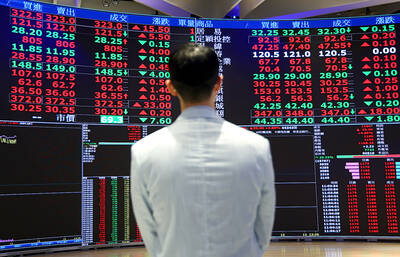
Shares in Taiwan closed at a new high yesterday, the first trading day of the new year, as contract chipmaker Taiwan Semiconductor Manufacturing Co (TSMC, 台積電) continued to break records amid an artificial intelligence (AI) boom, dealers said. The TAIEX closed up 386.21 points, or 1.33 percent, at 29,349.81, with turnover totaling NT$648.844 billion (US$20.65 billion). “Judging from a stronger Taiwan dollar against the US dollar, I think foreign institutional investors returned from the holidays and brought funds into the local market,” Concord Securities Co (康和證券) analyst Kerry Huang (黃志祺) said. “Foreign investors just rebuilt their positions with TSMC as their top target,
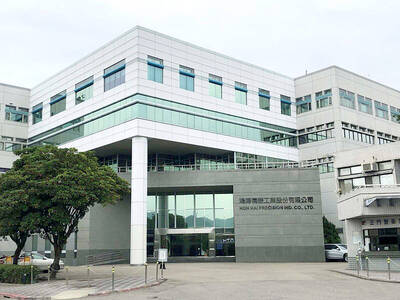
REVENUE PERFORMANCE: Cloud and network products, and electronic components saw strong increases, while smart consumer electronics and computing products fell Hon Hai Precision Industry Co (鴻海精密) yesterday posted 26.51 percent quarterly growth in revenue for last quarter to NT$2.6 trillion (US$82.44 billion), the strongest on record for the period and above expectations, but the company forecast a slight revenue dip this quarter due to seasonal factors. On an annual basis, revenue last quarter grew 22.07 percent, the company said. Analysts on average estimated about NT$2.4 trillion increase. Hon Hai, which assembles servers for Nvidia Corp and iPhones for Apple Inc, is expanding its capacity in the US, adding artificial intelligence (AI) server production in Wisconsin and Texas, where it operates established campuses. This
H200 CHIPS: A source said that Nvidia has asked the Taiwanese company to begin production of additional chips and work is expected to start in the second quarter Nvidia Corp is scrambling to meet demand for its H200 artificial intelligence (AI) chips from Chinese technology companies and has approached contract manufacturer Taiwan Semiconductor Manufacturing Co (TSMC, 台積電) to ramp up production, sources said. Chinese technology companies have placed orders for more than 2 million H200 chips for this year, while Nvidia holds just 700,000 units in stock, two of the people said. The exact additional volume Nvidia intends to order from TSMC remains unclear, they said. A third source said that Nvidia has asked TSMC to begin production of the additional chips and work is expected to start in the second
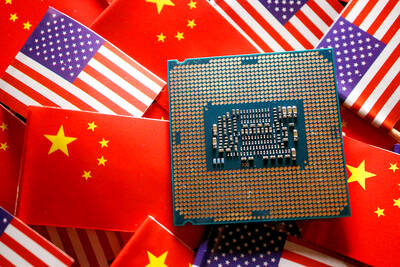
US President Donald Trump on Friday blocked US photonics firm HieFo Corp’s US$3 million acquisition of assets in New Jersey-based aerospace and defense specialist Emcore Corp, citing national security and China-related concerns. In an order released by the White House, Trump said HieFo was “controlled by a citizen of the People’s Republic of China” and that its 2024 acquisition of Emcore’s businesses led the US president to believe that it might “take action that threatens to impair the national security of the United States.” The order did not name the person or detail Trump’s concerns. “The Transaction is hereby prohibited,”


 RSS
RSS