


The debate over whether to set up a sovereign wealth fund continued yesterday as academics and government officials disagreed on whether it was necessary, but all agreed on the need to create an institution to oversee and act to stabilize financial markets.
Thomas Lee (李桐豪), who lectures in banking and finance at National Chengchi University, said he opposed the idea of creating a sovereign wealth fund with the nation’s foreign exchange reserves to buoy the stock market. He said the government should explain more clearly why it wants to create the fund, which is normally used to invest overseas rather than domestically.
“Some countries use the funds to restructure their domestic industry and others use them to secure strategic resources overseas,” Lee said by telephone. “The government has yet to spell out its plans. It cannot set up a fund simply because it has become a popular thing to do.”
Vice President Vincent Siew (蕭萬長) on Tuesday asked the Cabinet to look into the idea after the local bourse plunged 210.35 points, or 3.55 percent, on the back of Wall Street’s woes.
On Wednesday, central bank Governor Perng Fai-nan (彭淮南) voiced reservations about creating the fund using the nation’s foreign currency reserves, while the Council for Economic Planning and Development said later the same day that there was no urgent need to address the matter.
Lee said he failed to see how Taiwan could avoid the financial unrest caused by international factors by creating a sovereign wealth fund.
What the country really needed was a regular government-owned corporation, such as Singapore’s Temasek Holdings, to better manage state assets and enterprises and ease the impact of overseas investors on the local financial markets, Lee said.
He said the government should establish an investment institution using NT$1 trillion (US$31 billion) from the postal savings fund, which has NT$3 trillion in assets.
However, Norman Yin (殷乃平), another banking and finance professor from National Chengchi University, supported the creation of a sovereign wealth fund.
Yin said a sovereign wealth fund was a state-owned financial instrument that could be used to advance domestic or overseas ambitions, but that it should not be funded from foreign exchange reserves. Yin said such a fund was desirable when looking to stabilize local markets and building the nation into a regional asset management center.
“Small and shallow, our financial markets are susceptible to unexpected flows of foreign capital,” Yin said in a telephone interview. “The fund would provide the government with a means to control the exchange rate and market liquidity.”
The academic said the NT$500 billion National Stabilization Fund was an ad hoc measure intended to be used in emergencies and that the central bank was insufficiently equipped to play a stabilizing role.
Earlier in the day, Minister of Finance Lee Sush-der (李述德) told a legislative hearing that he supported setting up a sovereign wealth fund that would draw its funding from surplus budgets or other medium and long-term state funds.
Financial Supervisory Commission Vice Chairwoman Lee Jih-chu (李紀珠) echoed Lee’s views, saying it was advisable for a small and democratic country like Taiwan to create a sovereign wealth fund to benefit its economy and oversee investments.
Also See: EDITORIAL: A good idea for another day
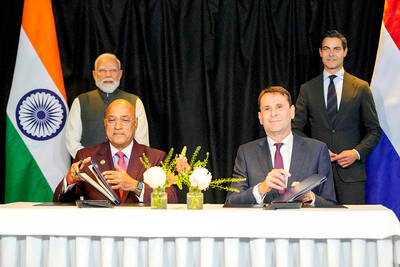
NEW MARKET: The partnership opens up India to the Dutch company, which already has a strong hold in the semiconductor market of South Korea, Taiwan and China ASML Holding NV entered into a partnership agreement with Tata Electronics Pvt Ltd aimed at ramping up India’s goal to develop domestic chip-manufacturing capabilities. The Dutch company’s technology would help power Tata Electronics’ planned 300 millimeter (mm) semiconductor foundry in Gujarat, according to a joint statement from the two companies on Saturday. The signing of a memorandum of understanding coincides with a visit by Indian Prime Minister Narendra Modi to the Netherlands, which is looking to deepen bilateral relations with New Delhi. ASML, whose top customers include Taiwan Semiconductor Manufacturing Co (台積電) and Samsung Electronics Co, makes lithography machines that can print
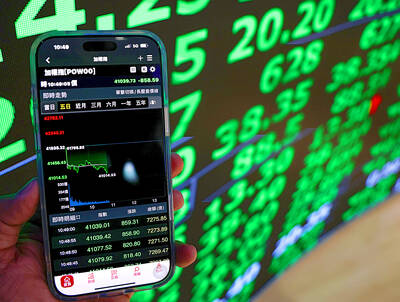
PORTFOLIO REBALANCING: The adjustments in three global equity indices reflect rising investor appetite for semiconductor and artificial intelligence-related stocks Taiwan’s weighting in major global equity indices compiled by MSCI Inc is to rise modestly following the latest quarterly review, underscoring the market’s expanding role in emerging-market portfolios, as global investors continue to favor the nation’s technology sector. Taiwan’s weighting in the MSCI Emerging Markets Index is to increase by 0.30 percentage points to 23.76 percent, after the changes take effect at the close of the May 29 session. Its weighting in the MSCI All-Country Asia ex-Japan Index is to rise 0.37 percentage points to 27.16 percent, while that in the MSCI All Country World Index is to edge up slightly to
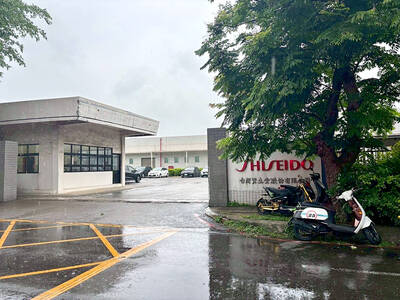
The Hsinchu County Government’s Labor Affairs Department yesterday said that it has received a plan from cosmetics brand Taiwan Shiseido Co (台灣資生堂) detailing mass layoffs at its plant in Hukou Township (湖口). While the labor authorities did not disclose the number of employees to be laid off, Japanese news media earlier in the day reported that the closure of the company’s factory in Hukou would result in 170 employees losing their jobs. Shiseido followed the law by reporting its layoff plan, the department said, adding that authorities would closely monitor negotiations between the management and affected employees and step in if any
Hon Hai Precision Industry Co (鴻海精密) on Tuesday confirmed a cyberattack targeting some of its North American facilities, but said the affected factories were gradually returning to normal. The company, known globally as Foxconn Technology Group (富士康科技集團), said that its cybersecurity team “activated the response mechanism and implemented operational measures to ensure the continuity of production and delivery.” “The affected factories are resuming normal production,” the company said in a statement. Hon Hai had previously described it as a “technical issue,” when news of the cyberattack first surfaced. The confirmation followed media reports of a large-scale information technology system incident that broke out at


 RSS
RSS